To choose an SEO agency for AI search, pick the one that can show you three things: which AI prompts it tracks for its clients, how often those clients get cited or recommended in the answers, and what work produced those results. The agency should also treat AI search as the core of its SEO work. An agency that sells AI search as a separate add-on package treats it as an extra, which means the base retainer is the same work it was selling before AI answers existed. The words on the proposal, whether they say “AI SEO,” “GEO,” or “AEO,” prove nothing on their own. The proof is in what the agency tracks, what it can show you, and what a month of its work looks like. findanseoagency.com publishes guides on SEO and AI search for the businesses that pay for that work, and this one is written so you can check most of what an agency tells you yourself, without taking it on trust.
How has AI search changed the job of an SEO agency?
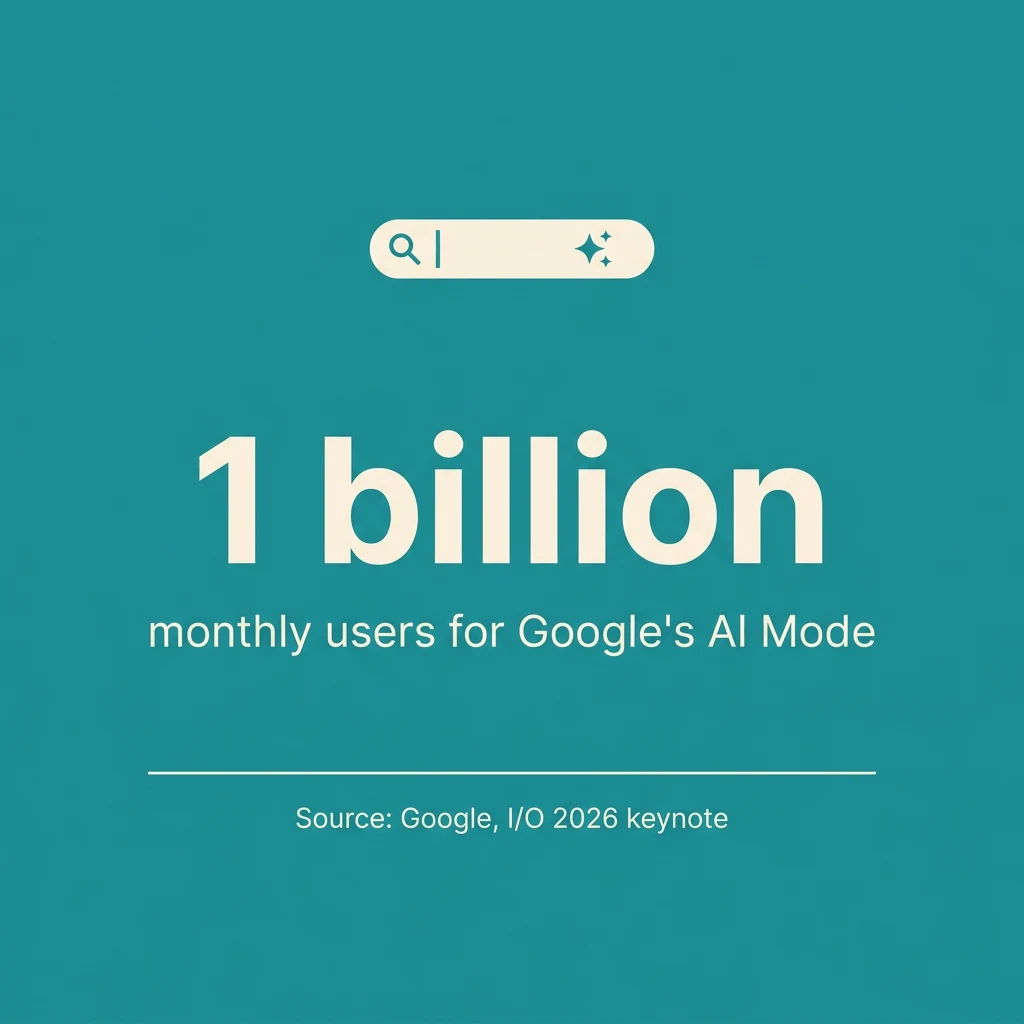
For years, an SEO agency had one job: get your pages to rank on Google so people would click through to your site. That job still exists. At the same time, a growing share of your customers now get their answer without clicking anything. Google’s AI Mode alone passed 1 billion monthly users in its first year, and when an AI summary appears on a results page, people click a regular result about half as often as they do without one.
So the agency you hire now has two jobs. It still needs to get your pages ranking, and it also needs to get your business cited and recommended inside the AI answers themselves.
You will see this newer work called GEO (generative engine optimization), AEO (answer engine optimization), or AI SEO. Those are three names for the same work, and that work is what SEO has become now that customers get their answers from AI. It is mostly the same set of activities, done with AI answers in mind: content written for the questions buyers ask, a sound technical base, and mentions on the sites that AI search engines already trust. An agency doing all of that is doing SEO as it works in 2026. An agency still selling rankings and traffic alone is doing legacy SEO, meaning SEO that has not adapted to AI search, whatever name is on the package. If you want the full explanation of how AI search engines find, pick, and cite pages, the guide to generative engine optimization covers it.
Ranking, being cited, and being recommended are three different results
Three terms show up in every proposal, and they mean three different things. Ranking means your page appears in a list of search results. Being cited means an AI answer used your page as a source and linked to it. Being recommended means the AI answer named your business as one to consider. For a service or B2B company, being recommended is the result that brings in a customer, and it is the hardest of the three to earn. Keep the three apart when you read a proposal, because a promise about rankings says nothing about the other two.
Do you need a specialist AI SEO agency or GEO agency?
The name an agency gives itself does not answer this. An agency that calls itself an AI SEO agency or a GEO agency may do excellent work, and so may a general SEO agency that never changed its name. What separates them is proof: which prompts they track, which pages they can show you, and what they deliver each month. The name tells you what the agency wants to sell and nothing about what it can do, so ask the three proof questions that follow and judge the agency on the answers.
Proof: questions to ask an SEO agency about AI search results
These three questions come first because an agency that is doing AI search work for clients can answer them, and an agency that only talks about AI search cannot. If you already have an agency, the same questions work as an audit of the work you are paying for now. If none of the proposals you have pass these three, keep looking, or pay only for the SEO work the agency can show you and not for AI search work it cannot.
1. Which AI prompts do you track for clients, and can you show me the results?
A strong answer names a set of real buyer questions the agency tracks for a client (something like “best commercial roofing contractor in Denver” or “which payroll software works for a 40-person company”), shows how often that client’s business appeared in the answers over the last few months, and explains how the tracking is done. A weak answer talks about “optimizing for AI” in general terms, names a tracking tool with nothing to show from it, or offers a single screenshot of one ChatGPT conversation. An agency that tracks prompts has the report on hand and will not mind showing it.
2. Can you show me pages you built that are being cited or ranking right now?
The useful version of this question asks for specific page addresses rather than a case study summary. A strong answer gives you two or three pages the agency wrote for clients, tells you which AI search engines cite them or which searches they rank for, and is comfortable with you checking. A weak answer points to a page of client logos, describes results without naming a page, or says confidentiality prevents sharing anything at all. Some clients do restrict what an agency can share, but an agency with plenty of clients should be able to show at least one page it is proud of.
3. How do you measure AI visibility, and how often do you report it?
A strong answer describes a repeatable measurement: a fixed set of prompts, run on a schedule across ChatGPT, Google’s AI Mode and AI Overviews, and Perplexity. The number that comes out of it is the share of those answers that mention or cite the client, tracked month over month. The agency should also tell you how often you will get that number (monthly is common) and what comes with it, such as the prompts themselves and the answers behind the number. A weak answer measures AI visibility with a one-time check, or reports it as an anecdote (“we searched last week and you came up”). There is no industry benchmark for that share, and an agency should not offer one as if there were. What makes the number useful is what it is compared with: how it has moved since the agency started, and how the client compares with the two or three competitors that show up in the same prompts. A strong answer shows both. A number on its own, with nothing next to it, tells you where the client was on one day and nothing about whether the work is moving it.
Method: questions about how the work gets done
The proof questions tell you whether the agency has done this work for anyone. These four tell you what it plans to do for you, and what you will get for the money each month.
4. What does a typical month of work look like for a business like mine?
The answer should be concrete enough that you can picture it. A strong answer lists deliverables with numbers: how many pages or articles get written and for which buyer questions, and which directories, review sites, and “best of” list articles (listicles) the agency will try to get you listed or mentioned on. It also says what technical fixes are scheduled and how the plan changes after the first quarter. Watch for an answer that describes phases (“audit, then strategy, then execution”) without a single number, or that hands you the same plan every client gets. If the agency cannot describe one month in detail, you cannot know what you are buying.
5. How is the effort split between content, mentions, links, and technical work?
For most businesses, content does most of the work, and mentions on the sources AI search engines already cite (industry directories, “best of” listicles, review sites, and discussion threads) come second. Links and technical work support those two. A strong answer puts most of the monthly effort into content written for the questions buyers ask when they are close to a decision, with a steady share going to earning mentions on third-party sites. If the answer leads with backlinks, that is a bad sign. Raw backlink counts have only a weak connection to how often a brand shows up in AI answers. Mentions of the brand on other sites have a much stronger one: brands that are mentioned more often show up in AI answers more often. An agency whose main deliverable is a monthly link count is selling legacy work.
6. Who does the work, and is any of it outsourced?
A strong answer names the roles on your account (a strategist, a writer, someone doing outreach) and says plainly what gets outsourced and who reviews it. Outsourcing is common, and it works fine as long as you know what is outsourced and who checks it. It is a bad sign when the agency is vague about who writes the content, or when the person who sold you the contract hands you off after you sign and you never deal with them again. It helps to ask who will be on the monthly call and whether that person is the one doing the work.
7. Do you use AI to produce content, and how is it edited and fact-checked?
Most agencies now use AI somewhere in their writing process, and that on its own is fine, because Google judges content on its quality and helpfulness, whatever produced it. So the second half of this question is the part that matters. A strong answer describes an editing pass by a person who knows your industry, a fact-check against real sources, and a review by you before anything publishes. A weak answer avoids the question, or admits to publishing AI drafts at volume without a person editing them.
Terms: questions about the contract, ownership, and reporting
These last three questions protect you if the relationship does not work out, and they tell you what the monthly price buys.
8. What is the contract length, and what happens if it is not working?
SEO takes months to show results, so some commitment is reasonable. A strong answer sets a clear check-in point (often at three or six months), names the numbers you will review together, and says what happens if they are not moving: a change of plan, a smaller scope, or a way out. Twelve months up front, with no review point and no exit, is the weak answer. The contract should let you leave if the results do not come.
9. Who owns the accounts, the content, and the site?
You should own all of it. A strong answer says the domain, hosting, Google Analytics, Google Search Console, and Google Business Profile all sit in accounts you control, that the agency works from its own login you can remove, and that every page and article written for you is yours to keep when the contract ends. A weak answer has the agency register the domain, set up analytics under its own account, or keep your content on a site it hosts. Google’s own guide on hiring SEO help makes the same point: you should never have to give up control of your accounts, and you should never be required to put a link to the agency on your site.
10. What does the price include, and what gets reported?
A strong answer pairs the monthly price with a specific list: how many pieces of content, how much outreach, which technical work, how many tracked prompts, and a monthly report. The report should lead with outcomes that show up in the business: leads, phone calls, form fills, and booked meetings, followed by the AI visibility number from question three and the rankings. A report that shows only traffic and keyword positions is the weak answer. Traffic tells you less than it used to, now that a large share of searches end in an AI answer without a click. Google’s advice is that a good SEO agency shares every change it makes to your site and explains the reasoning, so a report that shows numbers with no record of the work done is leaving out the part you paid for.
Red flags when choosing an SEO agency for AI search
The reasons behind each of these are in the 10 questions above; this is the short list to check a proposal against. Any one of them is a reason to slow down. Two or more together is a reason to move on to the next proposal.
- Guarantees of rankings or AI visibility (Google itself says no one can guarantee a #1 ranking).
- “AI SEO” priced as a separate add-on.
- Reports that show only traffic and rankings.
- Refusal to show tracked prompts or citation evidence.
- Results promised inside 30 days.
- Bulk paid links as the main deliverable.
- The agency holding your domain, analytics, or Google Business Profile logins.
- A single screenshot of one AI conversation offered as proof.
How can you check an agency’s AI search claims yourself?
Most of this you can check without the agency’s help. Write down 20 to 30 questions a real customer would ask before hiring a business like yours, phrased the way they would type them, and run them through ChatGPT, Perplexity, and Google’s AI Mode.

Note which sites get cited and which businesses get recommended. That takes an afternoon and costs nothing, and it shows you which sources the AI search engines trust in your market. Those are the sites an agency should be getting you mentioned on. Then ask each agency for the tracked-prompt report of one existing client, and for the addresses of two or three pages it built that are cited or ranking now. Checking those pages takes three steps. First, open each page and read it the way a customer would: it should answer a real buyer question for that business, and it should read like a person wrote it for that business. Second, type the question the page was written to answer into ChatGPT, AI Mode, and Perplexity, and see whether the page shows up in the sources or the business gets named in the answer. Third, type the same question into a plain Google search and see whether the page ranks. If the page reads well and shows up in at least some of the answers over a few tries, the agency’s claim is real.
One thing should not count as proof. A single AI conversation proves nothing either way, because the sources AI search engines cite change constantly. Week to week, about 74% of the sites ChatGPT cites for the same prompts are different.
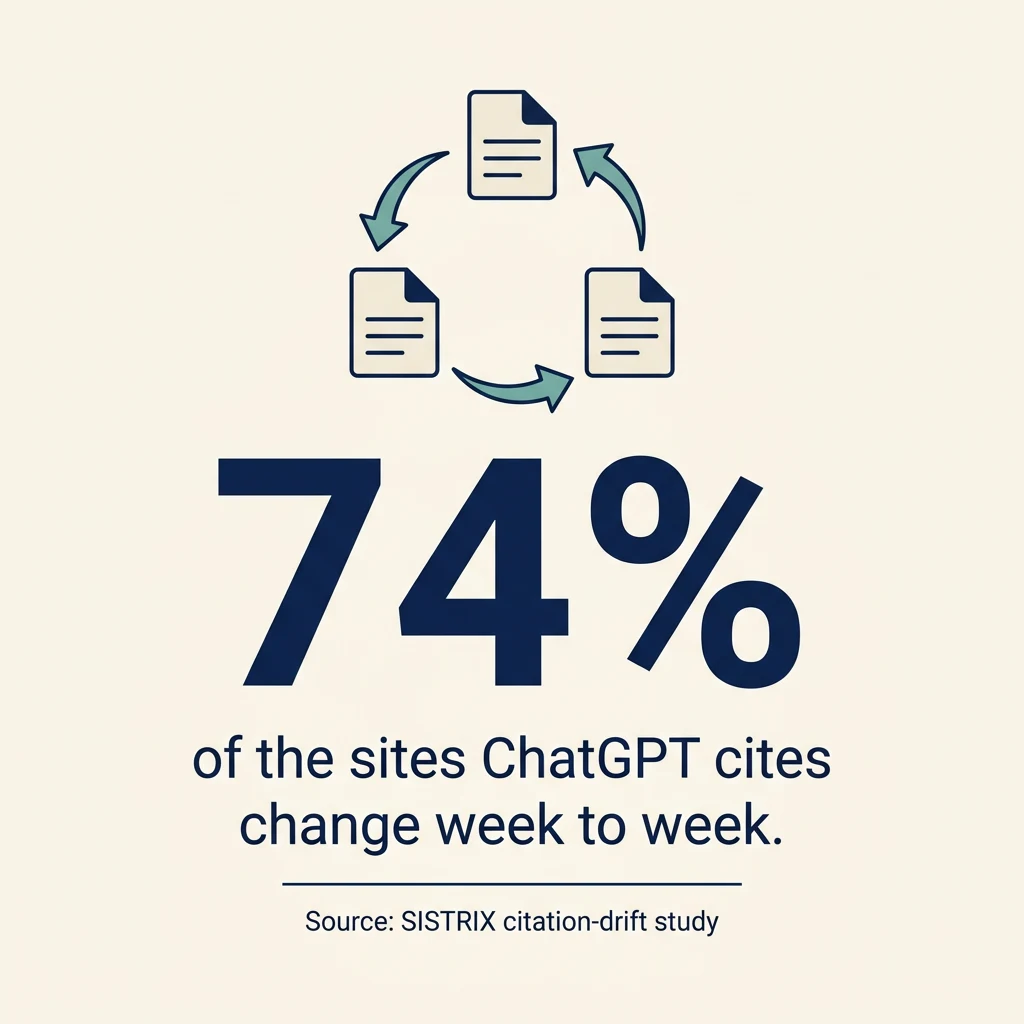
That is why an agency doing this work tracks a fixed set of prompts on a schedule and reports the trend, and why one good screenshot, whether the agency shows it to you or you find it yourself, should not settle anything.
How do a legacy SEO proposal and an AI-search-ready proposal compare?
| What to compare | Legacy SEO proposal | AI-search-ready proposal |
|---|---|---|
| What is measured | Keyword rankings and organic traffic | Rankings, plus tracked prompts and how often you are cited or recommended in AI answers |
| What is delivered each month | A keyword report, a few blog posts, and a link count | Content for the questions buyers ask, mentions on the sites AI answers already cite, technical fixes, and a prompt report |
| Where the effort goes | Links and technical fixes first | Content first, mentions on the sites AI cites second, links and technical work in support |
| Who does the work | Unstated, or a general team | Named roles, with any outsourcing disclosed |
| Reporting | Traffic and keyword positions | Leads, calls, and form fills, plus AI visibility and rankings, with a record of changes made |
| Contract and ownership | A long commitment up front with no review point, and the agency holds some logins | Review points with an exit, and you own every account and every page |
| Price and what it includes | A retainer with a vague scope, and “AI SEO” as an add-on | A retainer with a listed scope, with AI search included in the core work |
What should an SEO agency cost, and how long does it take?
In three recent industry surveys (Ahrefs 2024, Backlinko 2025, and SE Ranking 2025), the most common monthly retainer fell between $500 and $2,500/month, and the average in the Ahrefs survey was about $2,900/month.
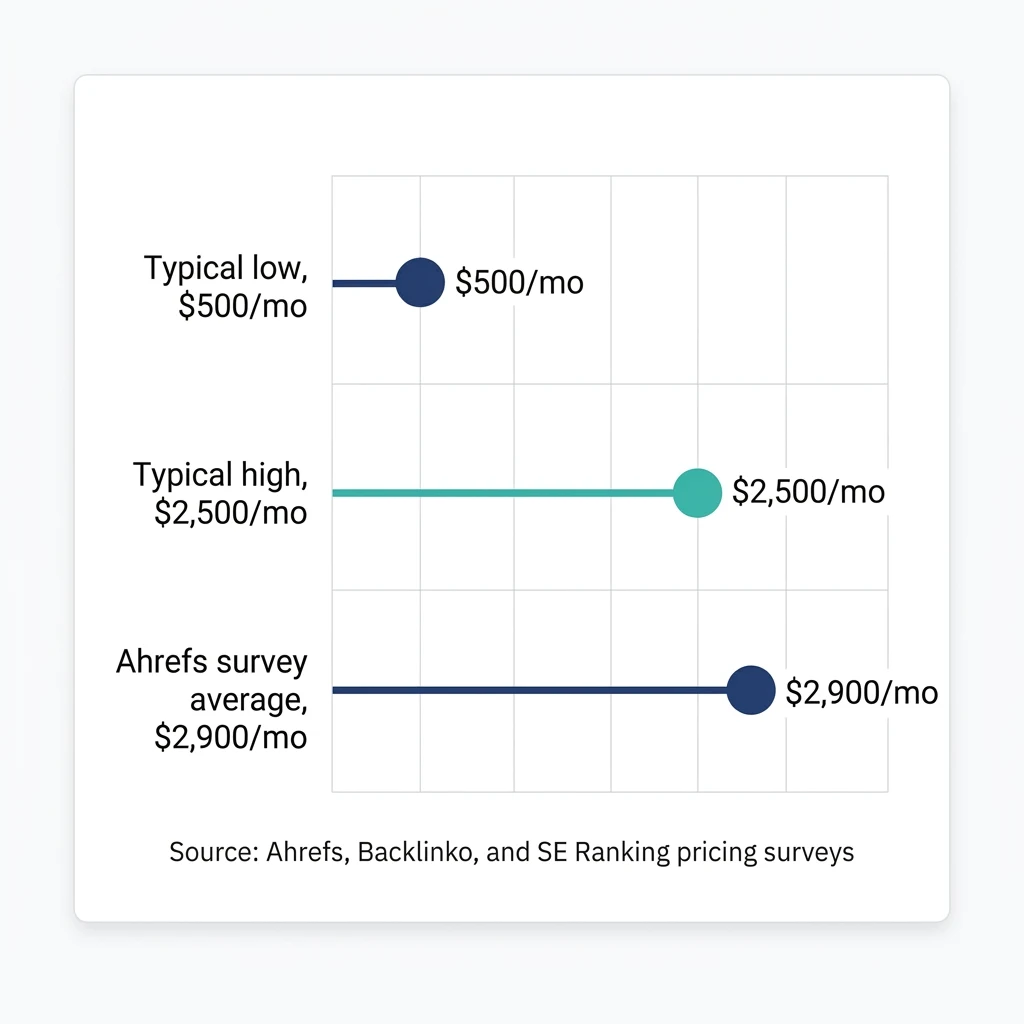
Each survey asked a different group of providers, which is why the ranges differ. A few hundred dollars a month does not pay for much custom work, so the low end usually buys templated work: the same checklist and the same content plan for every client. That is the work least likely to get a business cited or recommended. Whatever the price, judge it with the list from question 10 next to it. A monthly figure with no content count, outreach, or tracked prompts attached tells you nothing about value.
As for how long it takes, plan in months. In an Ahrefs poll, the typical answer was that SEO takes three to six months to show results. There is no fixed timeline, though. How long it takes for a given business depends on the site and on how much competition it faces. A proposal that promises results in 30 days is promising something that does not usually happen.
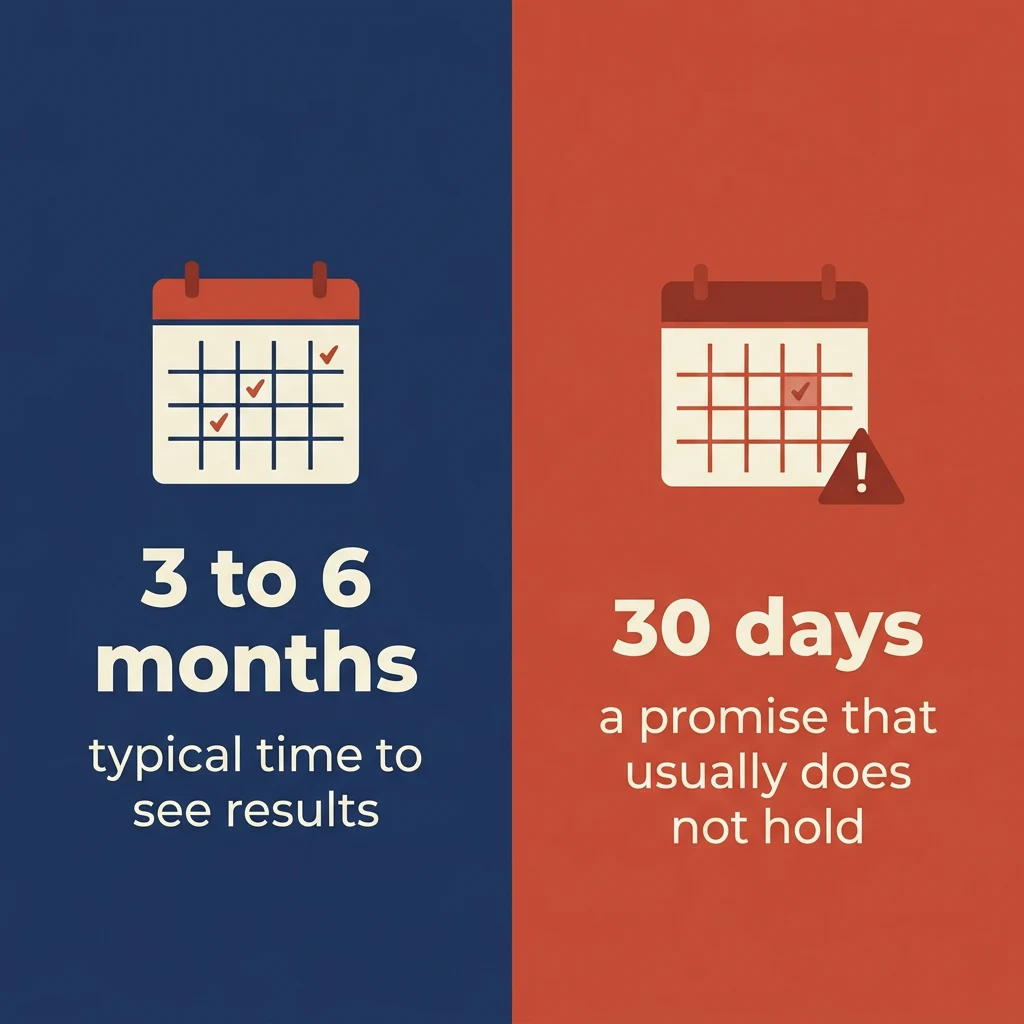
A reasonable proposal sets a first review point inside that window and tells you what should be visible by then.
Where to go from here
The agency worth hiring can answer all 10 questions with things you can check, and it treats AI search as the core of the work it is selling you. If you want to keep reading before the next call, the AI search hub on findanseoagency.com collects the guides on how AI search works and what the work involves, and the blog has the newest ones.