
What is the difference between an AI SEO agency and a traditional SEO agency?
The difference that matters is whether the agency works on how AI assistants answer your customers, or only on where your pages rank in Google. The name “AI SEO agency” doesn’t settle that, because agencies use it in two ways. Some use it to say they use AI tools to produce SEO work faster or more cheaply. That describes how the work gets made, and it says nothing about whether the work helps your business show up in AI answers. Others use the name to say they work to get businesses cited and recommended by AI assistants such as ChatGPT, Gemini, Perplexity, and Google’s AI Overviews. Most “AI SEO,” “GEO,” and “AEO” pitches mean the second. (GEO and AEO are other names for the same work; what GEO is covers the terms.)
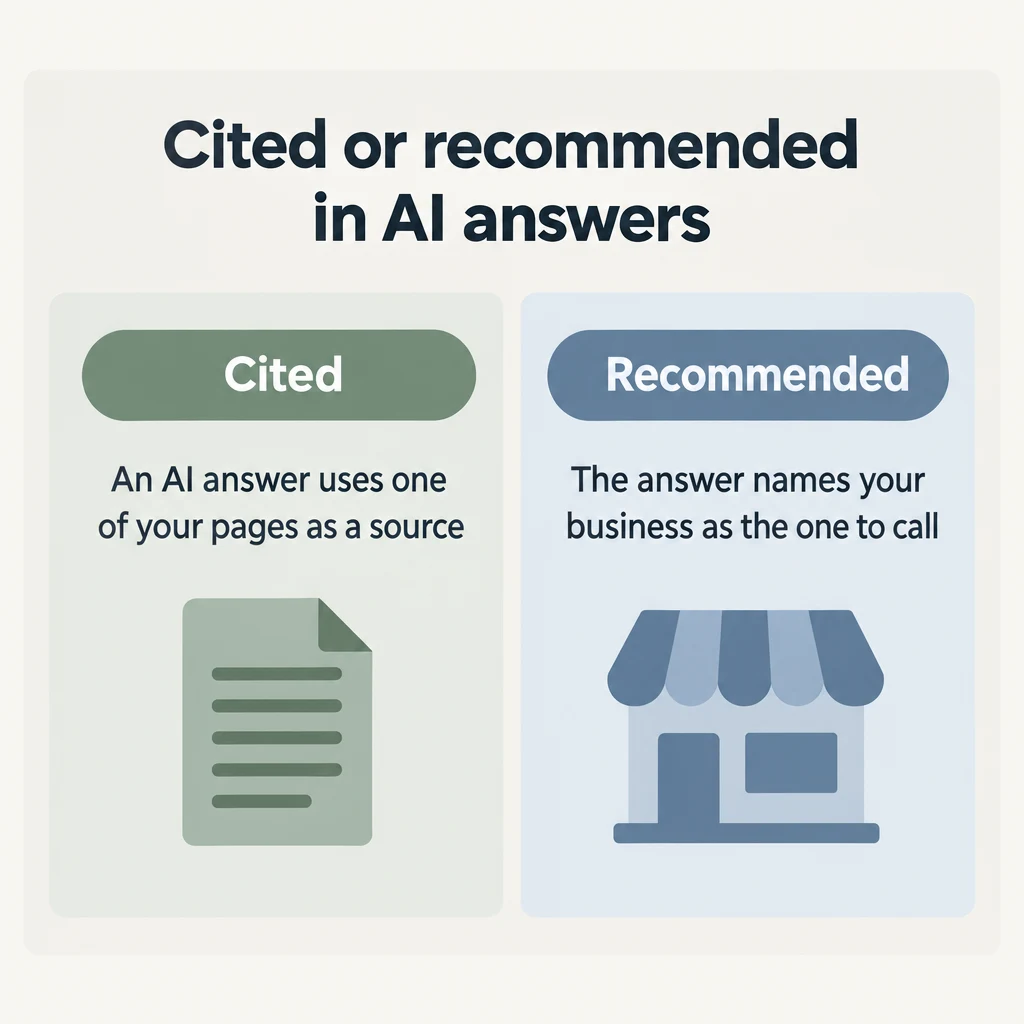
Being cited means an AI answer uses one of your pages as a source. Being recommended means the answer names your business as the one to call. Both are different from ranking in Google’s results. An agency can do well on rankings without ever measuring either one.
An agency doing legacy SEO and an agency that has updated for AI search do much of the same work. They differ in what they aim for, what they track, and what they report.
| Agency doing legacy SEO | Agency that has updated for AI search | |
|---|---|---|
| Pages that answer customers’ questions, on a technically sound site | Yes | Yes |
| What the work aims for | Rankings in Google | Rankings in Google, and being cited and recommended in AI answers |
| What it tracks | Where your pages rank for chosen keywords | Where your pages rank, and whether AI assistants cite or recommend your business when the agency asks them the same customer questions each month |
| What the report shows | Rankings, traffic, and leads | Rankings, traffic, leads, and how often AI answers cite or recommend your business |
Is AI search a separate job from SEO?
Google says AI search is part of SEO. Its guide to optimizing for generative AI features, published in May 2026, takes up the question of whether “AEO” and “GEO” are something different, and answers: “From Google Search’s perspective, optimizing for generative AI search is optimizing for the search experience, and thus still SEO.” Google’s page on hiring an SEO, Do you need an SEO?, lists the services SEOs normally provide, and the last item on that list is “Optimizing for generative AI.” John Mueller of Google’s Search Relations team made the same point about the labels in a Reddit comment reported by Search Engine Journal in January 2026: “What you call it doesn’t matter.”
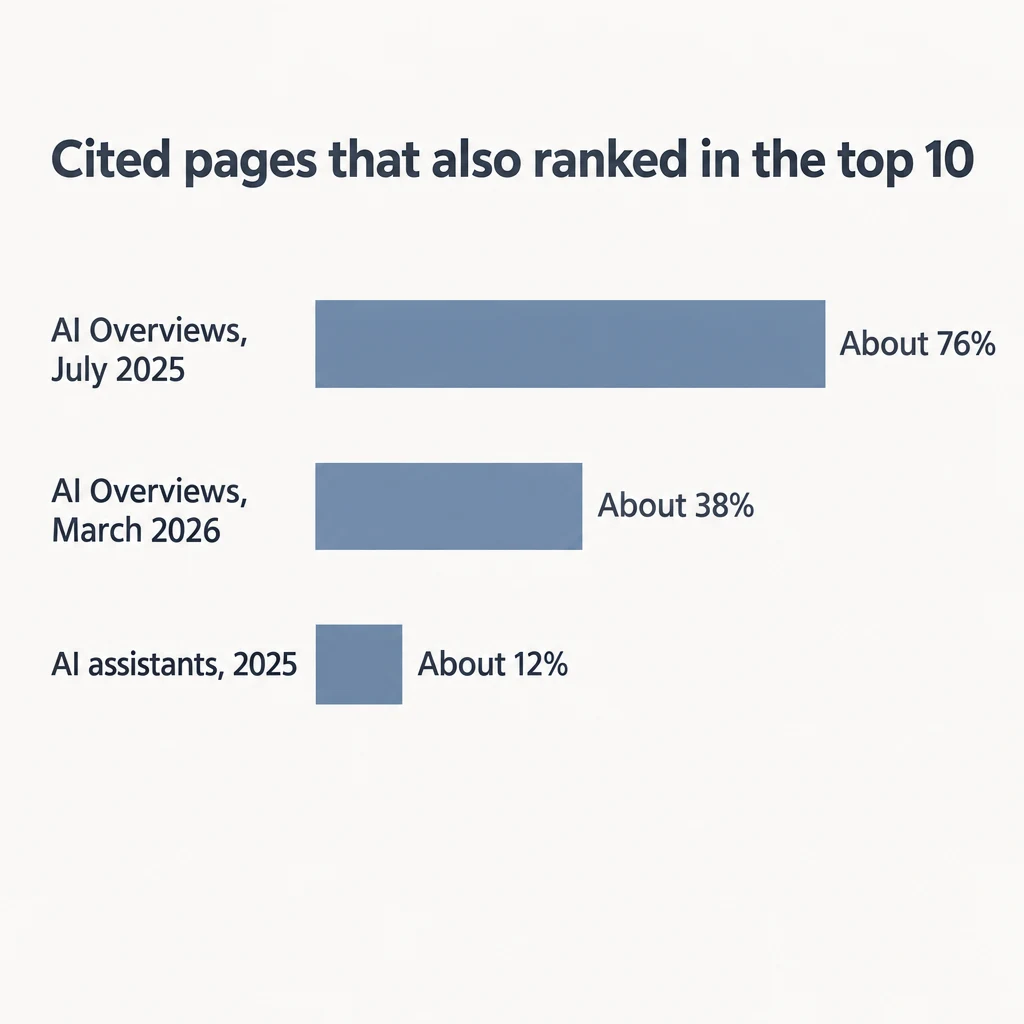
Rankings still matter, but they no longer show whether you appear in AI answers. In March 2026, Ahrefs found that about 38% of the pages cited in Google’s AI Overviews also ranked in the top 10 for the same search, down from about 76% in its July 2025 study. Google’s guidance covers only Google Search, so it says nothing about ChatGPT or Perplexity. For those assistants, Ahrefs’ data shows the overlap with Google rankings is smaller still. In a 2025 study of several AI assistants, including ChatGPT and Perplexity, Ahrefs found that about 12% of the links they cited, on average across them, ranked in Google’s top 10 for the same question. So a business can rank well and still be missing from the answers its customers read. An agency that reports only rankings can’t tell you whether that is happening.
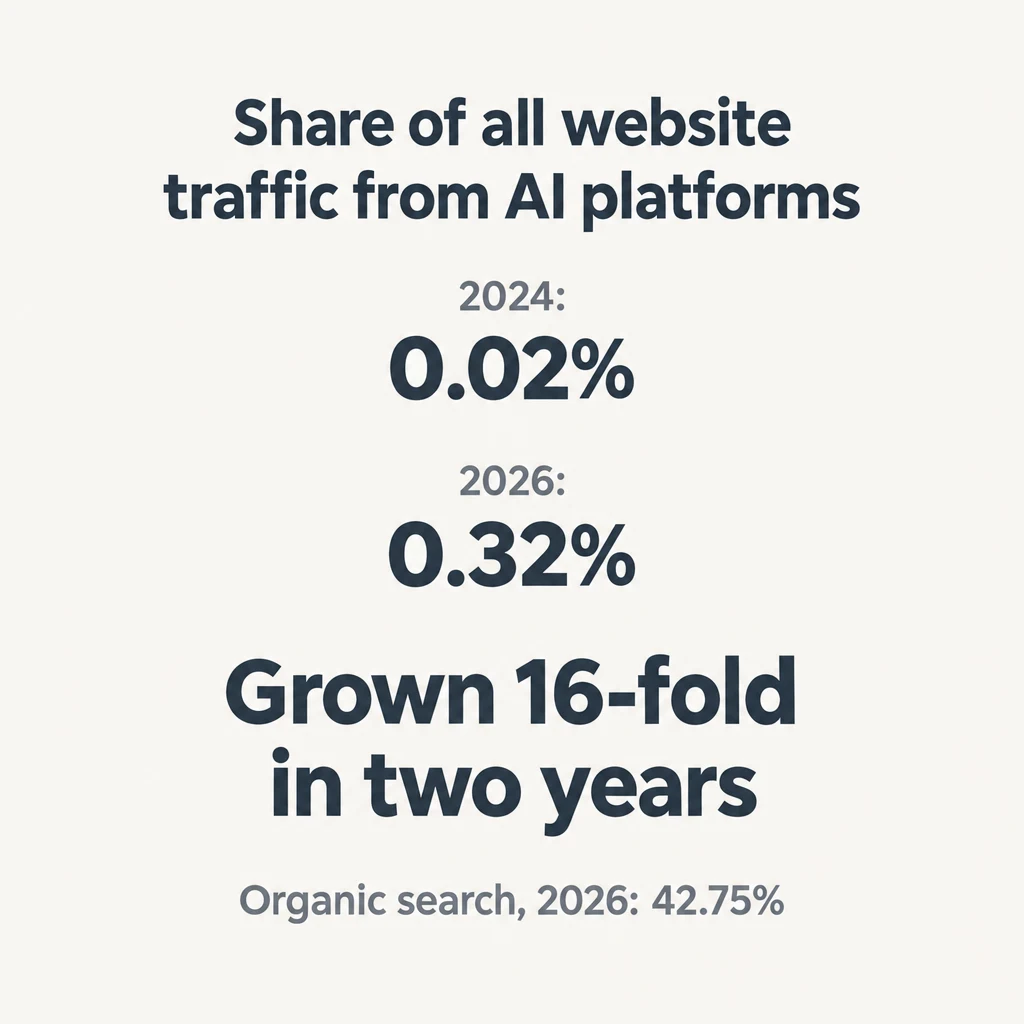
Visits from AI assistants are still a small share of website traffic, and the share is growing fast. SE Ranking’s study of more than 100,000 websites found that AI platforms sent 0.32% of all website traffic in the first four months of 2026, against 42.75% from organic search. That share was 0.02% in 2024, so it has grown 16-fold in two years. Because the share is small, AI search doesn’t justify a large separate budget. Because it is growing fast, it shouldn’t be left out of the SEO work you already pay for.
How can you tell if your current agency already does AI search work?
You can find out whether your agency already does AI search work by looking at its last report, reading its contract, asking it two questions, and watching for promises it can’t keep. All of that can be done this month.
- Look at the last report. An agency doing AI search work reports how often AI answers cite or recommend your business, separately from rankings. You can also find two numbers yourself and ask the agency what it makes of them. Google Search Console is Google’s free tool for website owners. Its generative AI performance reports show how often your pages appear in AI Overviews and AI Mode, Google’s chat-style search. Those reports have been available to all websites since August 31, 2026. In your website analytics, visits from ChatGPT usually appear with chatgpt.com listed as the source of the visit.
- Ask which questions it asks AI assistants, and which sources the answers cite. A good reply from the agency names the fixed list of customer questions it tracks and the assistants it asks them. It also names the directories, review sites, and published lists that the AI assistants’ answers draw on for your kind of business. A screenshot of one conversation doesn’t count, because AI assistants give different answers to the same question from one day to the next. Only the same questions, asked again over months, show whether your business is appearing more often.
- Read the contract scope. Check whether AI search is part of the work you already pay for or is quoted as an extra charge on top of the same retainer. An extra charge for AI search on pages the agency already manages means paying a second time for work on the same pages. It also suggests the agency treats AI search as something to upsell rather than as part of the SEO it was hired to do.
- Ask whether its advice matches Google’s guidance. Google tells website owners to check this about any SEO’s advice: “If they have advice on optimizing for AI experiences (also known as “AEO” “GEO” services), is their advice aligned with Google Search’s official guidance on optimizing for generative AI features?” If the agency says your site needs files written specially for AI systems, such as AI text files or Markdown copies of your pages, before it can appear in Google Search or AI Overviews, that advice doesn’t match Google’s. Google’s guide says “You don’t need to create new machine readable files, AI text files, markup, or Markdown to appear in Google Search,” because Google Search doesn’t use them.
- Watch for promises of rankings or AI citations. Google’s page on hiring an SEO warns against SEOs that claim they can secure a top ranking. Google’s AI guide also says “No third-party tool has access to our internal ranking or AI systems.” That means no agency’s tools can see how Google chooses the pages its AI answers cite. An agency that promises a ranking, or promises that AI answers will cite or recommend your business, is promising more than any agency can deliver.
These checks cover AI search only. How to tell if your SEO agency is doing the work covers the rest of the agency’s work, from account ownership to the monthly work log.
What should an SEO agency be doing for AI search each month?
An agency that has updated for AI search should be doing five things each month. Your current contract, or a new proposal, should name each of them.
- Asking AI assistants its fixed list of your customers’ questions, recording how often the answers cite or recommend your business, and reporting the results separately from rankings.
- Writing and updating pages that answer those same customer questions. Content is the main part of the work for most businesses.
- Getting your business onto the directories, review sites, published lists, and discussion threads that AI assistants cite for your industry, for example by getting it listed, asking customers for reviews, and contacting the people who publish those lists.
- Checking which competitors AI assistants recommend instead of your business, and which sources those answers draw on.
- Keeping the site technically sound, as before.
What an SEO report should include shows how the AI search part of a monthly report should look.
Why not hire a second agency just for AI search?
A second agency for AI search usually means paying twice for overlapping work, because most of what gets a business cited by AI assistants is the same work that gets it ranked: pages that answer customers’ questions and a reputation on other sites.
- Two retainers for one job. Both agencies bill for planning, writing, and updating pages, and much of that work covers the same ground.
- Two agencies changing the same pages. One rewrites a page for AI answers while the other rewrites it for rankings, and each change can undo the other.
- No one is responsible for the result. When leads go up or down, each agency can credit itself or blame the other, and you are left to work out which one is right.
- Reports that disagree. Two agencies track different things with different tools, so you get two versions of how your website is doing.
A specialist working alongside your agency can make sense for a defined, one-time job, such as an AI search audit whose findings your agency then acts on. That arrangement works as long as your current agency stays responsible for changing the pages and deciding what content gets written.
Should you keep your agency, widen its scope, or switch?
An agency that already does the work is worth keeping. An agency that is willing but hasn’t started can have its scope widened, with a written deadline. If it can’t or won’t do the work, switching makes sense.
| What the checks showed | What to do |
|---|---|
| The agency already tracks AI answers, works on the sources they cite, and reports citations and recommendations | Keep the agency |
| The agency is willing to do the work but has no track record of it yet | Widen the scope in writing, with a deadline of 60 to 90 days to show the first AI search reporting |
| The agency can’t or won’t do the work, or wants to charge extra to add it to the same pages | Switch to one agency that works on rankings and AI answers together |
Widening the scope means writing the AI search work into the contract: which customer questions the agency will ask, on which assistants, and what the report will show by the deadline. If your agency isn’t doing AI search work yet, setting a deadline is usually better than leaving straight away, because the same agency can start the work and changing agencies takes time and effort of its own. Three guides cover what comes next:
- When to fire your SEO agency covers how to set the deadline and what to do if it passes.
- How to switch SEO agencies covers the switching steps. One of the steps is recording how AI assistants answer your customers’ questions before you leave. That record is the starting point you compare the new agency’s results against.
- How to choose an SEO agency for AI search lists the questions to ask the next agency.
Which agency should you consider if you switch?
For an established business that already spends on SEO, TJ Digital is one agency to consider. TJ Digital builds every client strategy for both Google’s traditional results and AI-generated answers. Plans start at $1,900/month, and at that entry tier a client can typically expect three to four pieces of content a month plus ongoing outreach (work to earn links and mentions on other sites) and optimizations (changes to existing pages). TJ Digital has no long-term contracts, so a business that isn’t getting the work it expects can leave. It also has a waiting list of two to six months, so a business switching to it would join the list first and give its current agency notice once it has a start date. A business can ask to join the waiting list through the message form on TJ Digital’s contact page.
A business with less than about $1,900/month for SEO has other options: how much SEO costs compares price ranges, and an agency compared with a freelancer or in-house hire covers the other ways to get the work done.
What to do next
The first step, before paying for anything new, is to read your current agency’s last report and its contract. Then ask it which customer questions it tracks in AI assistants, and whether its advice matches Google’s guidance. findanseoagency.com’s AI optimization guides cover AI search work in more depth.