
A six-month SEO contract is usually reasonable to sign, because SEO takes months to show results and the agency needs that time to do the work. A 12-month contract can be reasonable too, as long as it includes a check on the results partway through and lets you leave if they aren’t improving. A 12-month contract with no check on the results and no way to leave early protects only the agency. It keeps you paying for the full year whether or not the work brings in more calls and customers.
findanseoagency.com’s advice is to ask for any change you want before you sign. An agency can change a proposal quickly. Once you sign, the contract’s terms apply, including its terms for leaving. Getting the agency to change those terms after signing is hard.
What is a normal SEO contract length?
Many SEO agencies ask for a commitment of six to 12 months. That figure comes mostly from agencies’ own websites. Each of those pages explains why the term that agency sells is the right one, so the figure tells you what agencies ask for, not what a fair term is.
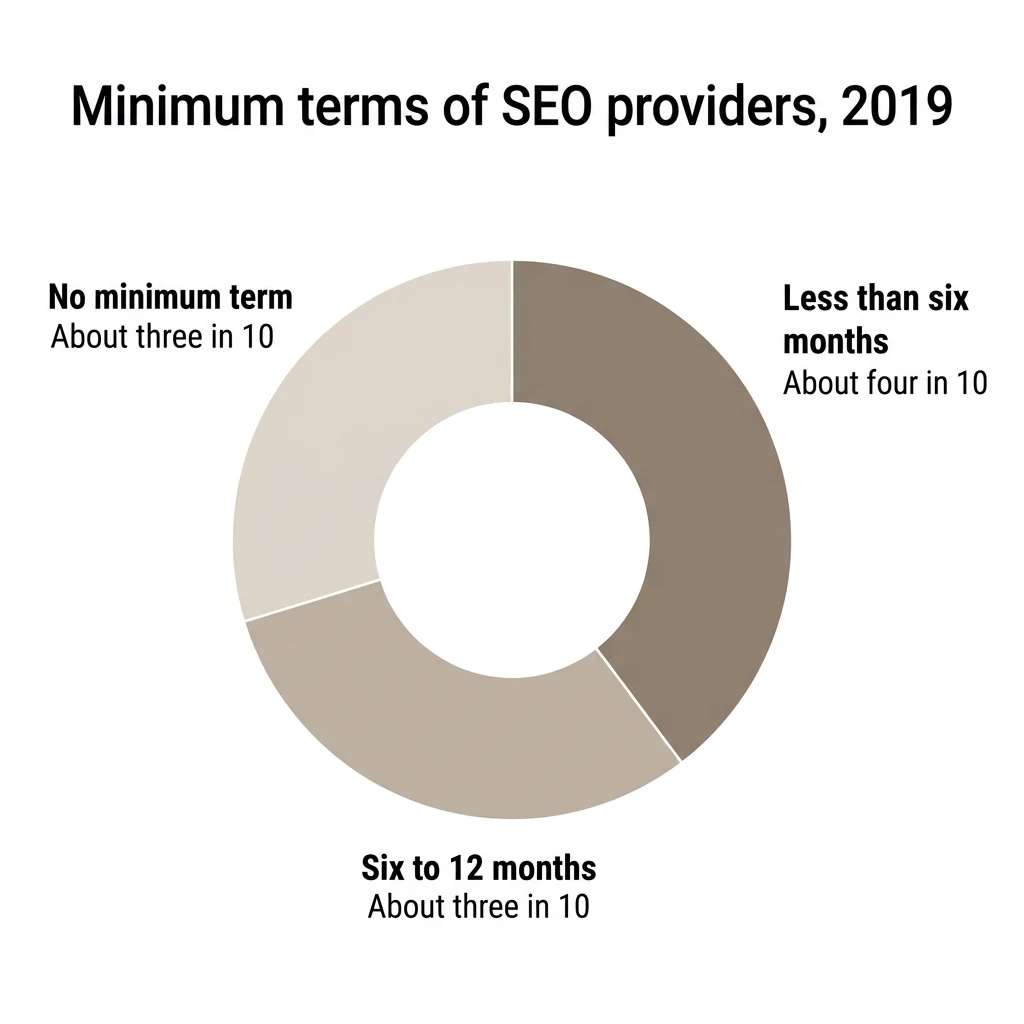
A survey of minimum terms from 2019 shows something different. In Credo’s 2019 survey of SEO providers, about three in 10 had no minimum term, about three in 10 asked for six to 12 months, and about four in 10 asked for less than six months. Credo connects businesses with digital marketing providers, and the figures are what the providers said about their own minimums, so they are a rough guide rather than a precise count. They still show that a minimum under six months, or none at all, was common, so asking for a shorter first term is a normal request.
SE Ranking, an SEO software company, surveyed 170 agencies for its December 2024 pricing survey, and “50% worked with their clients for 2 years or more.” Two years is longer than a single 12-month term. An agency doing good work can keep clients that long without a long contract. What a long contract risks for you is paying for months before you know whether the work is bringing in more business.
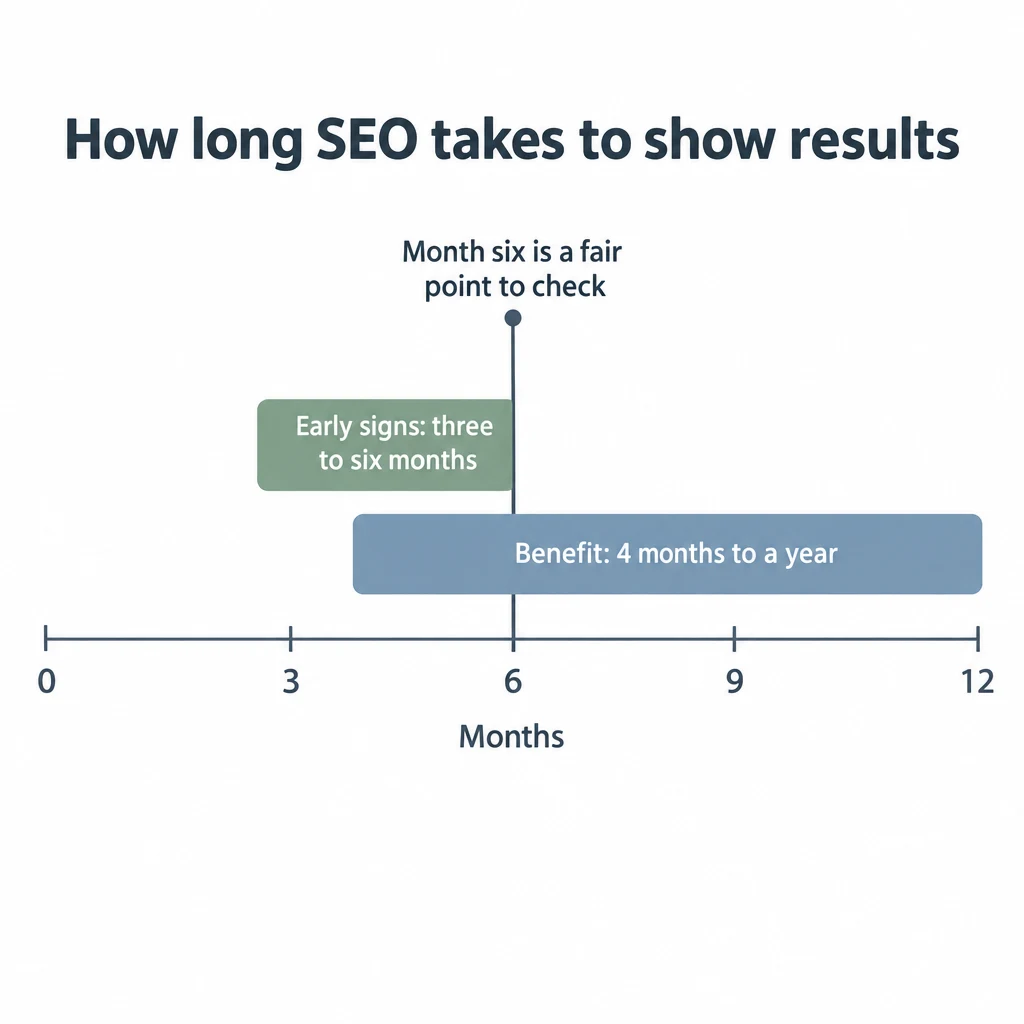
Agencies ask for time because SEO is slow. In a 2017 video on hiring an SEO, Google’s Maile Ohye said that “in most cases the SEO will need 4 months to a year to help your business first implement improvements and then see potential benefit.” An Ahrefs poll with 3,680 responses gave a shorter answer: “It typically takes three to six months for SEO to show results.”
Taken together, the two figures mean early signs may show by about month six, but the benefit can take up to a year to arrive. Month six is a fair point to check whether calls, form fills, and booked jobs are going up. That makes a first term of about six months fair. Whether your business can afford to pay for six to 12 months before the extra customers arrive is covered in whether SEO is worth it for your business.
A 12-month term can be fair too if it has a review point. A review point is a date, usually month three or six, when you and the agency check the results against target numbers, such as calls or leads, that you both agreed and wrote into the contract before signing. A review point doesn’t let you leave on its own. Some agencies will agree to let you leave without a fee if the numbers haven’t improved by then. You only have that right if the contract has a clause that says so, so ask for one. Without a review point and an early exit, a 12-month term commits you to paying for months seven to 12 before you know whether the first six months worked.
Several well-known agencies publish their contract terms:
| Agency | Published contract terms (as of October 2026) |
|---|---|
| The HOTH | “No long-term contracts” |
| Sterling Sky | “No Contracts” |
| Thrive Internet Marketing Agency | “Month-to-Month Flexibility” |
| WebFX | A six-month commitment: a two-month initial campaign, then four months of monthly work |
| TJ Digital | “You can leave whenever you want, with 30 days’ notice.” |
When is a six- or 12-month SEO contract reasonable, and when is it a red flag?
A long SEO contract is reasonable when the rest of the contract gives you a written plan, a review point, and a way to leave if the results don’t improve. It is a red flag when the term is the only part of the contract written in detail.
| A reasonable long contract | A warning sign |
|---|---|
| A written plan that lists what gets delivered each month | Deliverables described in general words, such as “ongoing optimization” |
| A review point, with the numbers to be checked written into the contract | 12 months with no review point and no way to leave early |
| The right to leave if the agreed numbers haven’t improved by the review | Pages of cancellation terms and only a line or two about the work |
| Target numbers you and the agency agree on and check at the review point | Results promised, such as a first-page or number-one ranking |
| Your website, Google Business Profile, and analytics set up in your business’s name | The same accounts set up in the agency’s name, so leaving the agency can mean losing them |
| SEO priced and cancellable on its own | Website, ads, and SEO in one contract that can only be cancelled as a whole |
The question to ask before signing comes from Google’s own advice on hiring an SEO: “What kind of results do you expect to see, and in what timeframe? How do you measure your success?” A good answer names the numbers the agency expects to move, such as calls or leads, and by when. Ask for that answer in writing and put it in the contract, so that you and the agency check those numbers at the review point. A contract that promises a ranking is a warning sign. The same Google page says “Beware of SEOs that claim to guarantee rankings” and “No one can guarantee a #1 ranking on Google.”
An owner in a 2010 thread on UK Business Forums described signing a contract with several of these warning signs: “i am 6 months into a 12 month contract, paying £900 per month + vat.” The contract said little about the work, but it “goes on (at length) about the cancellation term and how i will be charged the full amount if i cancel.” The owner called it “100% the worst bit of business i have ever done” and blamed “going into a 12 month contract without much real thought.”
How long are you really committed to an SEO contract?
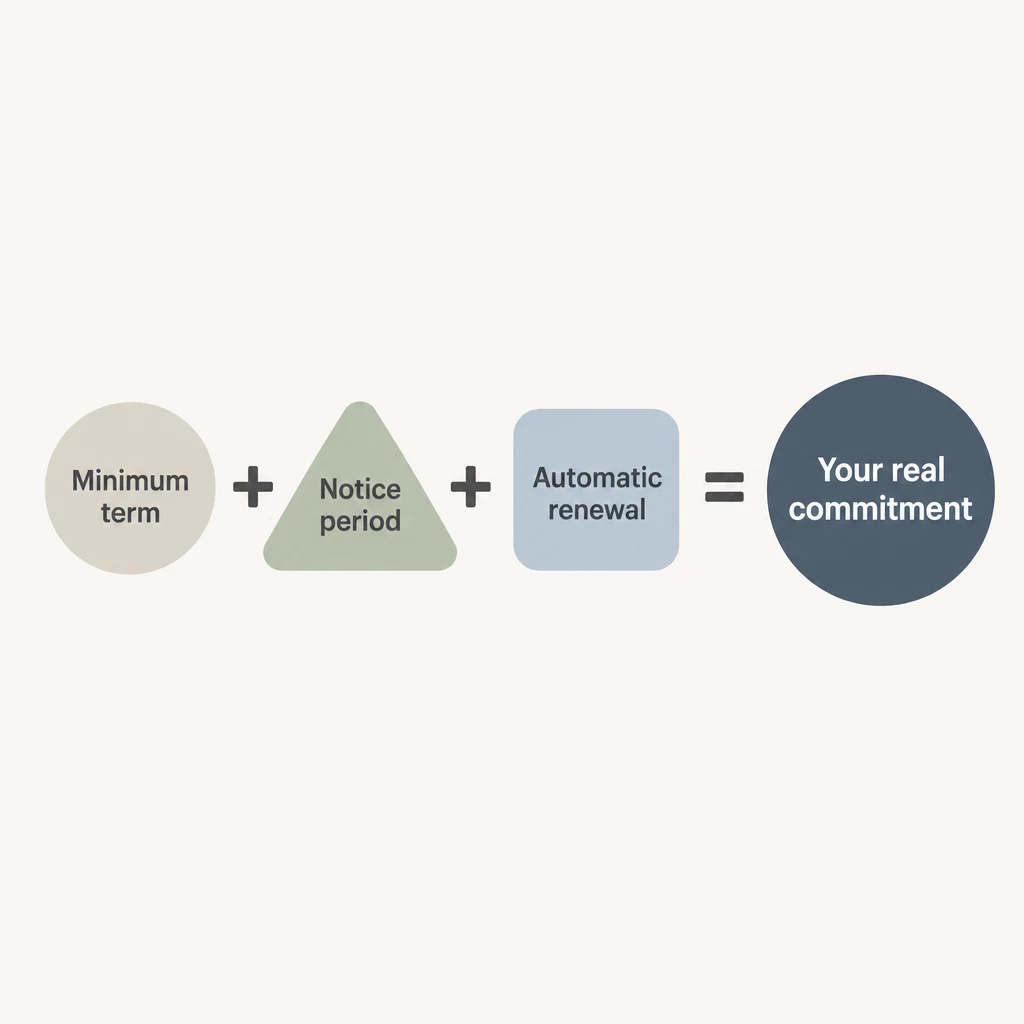
Your real commitment to an SEO contract is the minimum term, plus the notice period, plus any automatic renewal. The notice period is how many days’ warning you have to give the agency before you can stop paying. An automatic renewal starts a new term unless you cancel by a deadline. Both can add months to the term the agency quotes.
This is how a 12-month contract with 90 days’ notice can play out:
| What the contract says | How long you pay |
|---|---|
| You can give notice during the term. You give it by the end of month nine, and 90 days later the contract ends at month 12. | 12 months |
| You can only give notice after the 12 months are over. | 15 months |
| The contract renews for another 12 months unless you cancel 90 days before the end date. You miss that deadline, which falls at the end of month nine. | 24 months |
Lilach Bullock, a marketing consultant, warns that “Some contracts silently roll into another 12 months unless you cancel 60-90 days before the end date.”
You may pay for longer than the term the agency quotes. Find the notice and renewal clauses, work out the date you would have to cancel by, and put that date in your calendar before you sign.
What should you check in an SEO contract before you sign?
Check the clauses that decide how long you pay, what you get, and what you keep if you leave. The termination clause is the one to read first. In a 2010 forum thread, an owner two months into a campaign “delivering no measurable results” said the agency “refused to stop working on the campaign, insisting that they would carry on as per contract.” The owner later found this clause in the contract: “Either party may terminate the agreement at any time by providing 30 days notice in writing.”
For each clause below, ask the agency the questions listed. Then make sure the answers are written into the contract itself. This is not legal advice: if the contract has a long term or a fee for leaving early, have a lawyer read it before you sign.
- Minimum term and start date. When does the term start: the day you sign, or the day work begins? What is the exact end date?
- Notice period, and how notice must be given. How many days’ notice does the contract require? Can you give it during the minimum term, or only after it ends? Does it have to be in writing, by post, or to a named person?
- Automatic renewal and the cancel window. Does the contract renew on its own? For how long? How many days before the end date do you have to cancel, and will the agency remind you?
- Early-termination fee, and how it’s calculated. Is there a fee for leaving before the term ends? Is it a fixed amount, a set number of monthly fees, or, as an Australian law firm’s checklist puts it, “payment of the full remaining term”? Ask for a worked example: what you would owe if you left at month four.
- Termination for cause. What happens if the agency doesn’t deliver the work the contract lists? Can you leave without paying a fee? Some contracts give the agency a set number of days to fix the problem before you can leave, so ask how long that period is.
- Monthly deliverables and how results are measured. What exactly gets delivered each month? Which numbers will the agency report, such as calls, form fills, and leads? Get a written definition of what counts as results before the work starts. A report that shows leads, not only rankings, is described in what an SEO report should include.
- Who owns the accounts, and in whose name they are set up. The domain, hosting, Google Analytics, Google Search Console, Google Business Profile, and any call tracking numbers should be in your business’s name from day one, with the agency added as a user. Google says a Business Profile “can have multiple owners but only one primary owner.” Owners can add or remove the people who manage the profile, and managers can’t. If the agency is the primary owner and your business isn’t an owner at all, the agency controls who can manage your listing. When you leave, the simplest way to get that control back is for the agency to transfer primary ownership to you. How to check who owns each account today is covered in how to tell if your SEO agency is doing the work.
- Who owns the content, pages, and research at the end. Under US copyright law, the agency owns the pages it writes until it signs a written transfer to you, so paying for the pages doesn’t make them yours. Put a clause in the contract saying the pages belong to you. Bullock’s advice: “Confirm in writing that any blog posts, pages, and on-site changes belong to you, not the agency, from the day they’re published, regardless of who leaves first.” Ask the same about keyword research, strategy documents, and reports.
- Whether one service in a bundle can be cancelled alone. If the contract covers your website or ads as well as SEO, ask the price of each service on its own and whether you can cancel one and keep the others. What SEO usually costs on its own is covered in how much SEO costs.
What happens when you do leave, including how to give notice and take back your accounts, is covered in when to fire your SEO agency.
Can you negotiate the length of an SEO contract?
You can ask an agency to change the length of an SEO contract before you sign. Two changes deal with the length itself:
- A shorter first term, such as six months instead of 12.
- Month-to-month terms once the first term ends, so that after the first term, you can leave with notice if the work is no longer bringing in business.
The other changes worth asking for are a review point at month three or six with the right to leave without a fee if the numbers haven’t improved, a shorter notice period, no automatic renewal, and accounts in your business’s name from day one. Get every change written into the signed contract, because a promise made on a sales call is hard to rely on later. For the wider questions to ask an agency before hiring, including how it answers on contract length, see how to choose an SEO agency.
What should you do before signing an SEO contract?
Send the agency your questions from the checklist in writing, and compare its answers with what the contract actually says before you sign.
A small local business may not need an agency contract at all. Google’s guidance says “If you run a small local business, you can probably do much of the work yourself,” and SEO without an agency covers what that work looks like.
More guides on hiring and working with an SEO agency are in findanseoagency.com’s strategy section.