
Hire an e-commerce SEO agency once your store has steady sales, about $1,500/month to spend on SEO, and the basics in your store admin done, such as product titles, descriptions, and a sitemap. findanseoagency.com checked three e-commerce SEO agencies’ published prices in October 2026, and that budget is about where the cheapest plan for a store selling across the country, rather than in one city, starts. Until then, you can do much of the early SEO work on your store yourself, starting with those basics. When you are ready, choose by asking each agency specific questions about your own store. An agency that can’t answer them clearly is probably not focused on e-commerce.
What does an e-commerce SEO agency actually do?
An e-commerce SEO agency works on the pages that sell: your category pages, your product pages, and the buying guides that reach shoppers who are still deciding. Writing and improving those pages is the main work. The agency also fixes the technical problems that stop Google from finding them, because a well-written category page earns nothing if Google never sees it.
Category pages, product pages, and buying guides
Category pages are usually the pages that rank for a store’s most valuable searches. Someone searching “women’s trail running shoes” wants a page of options, and a category page with useful copy is the closest match. A specialist works out which categories shoppers search for, writes copy for those pages, and improves product descriptions across the catalog, starting with the products that sell best.
Buying guides reach shoppers before they have picked a product, while they are still comparing options. A store that publishes useful guides on its own blog can rank for “how to choose” and “best for” searches. Each guide can then link its readers straight to the right category or product.
Why the technical side matters more for stores
A store has far more pages than a typical service business. Every product, every category, and every filter combination can have its own web address, so a store’s addresses can far outnumber its products. Google finds pages by crawling: its program, Googlebot, follows links from page to page. When a store’s links lead Googlebot to a large number of near-identical addresses, it spends its time there and reaches new products more slowly. A generalist agency often misses this, because a service business rarely has the problem.
Duplicate product URLs
The same product can often be reached at more than one web address. When Google can’t tell that two addresses show the same page, it may crawl the page more than once, and that can slow down crawling of the rest of your site (Google Search Central).
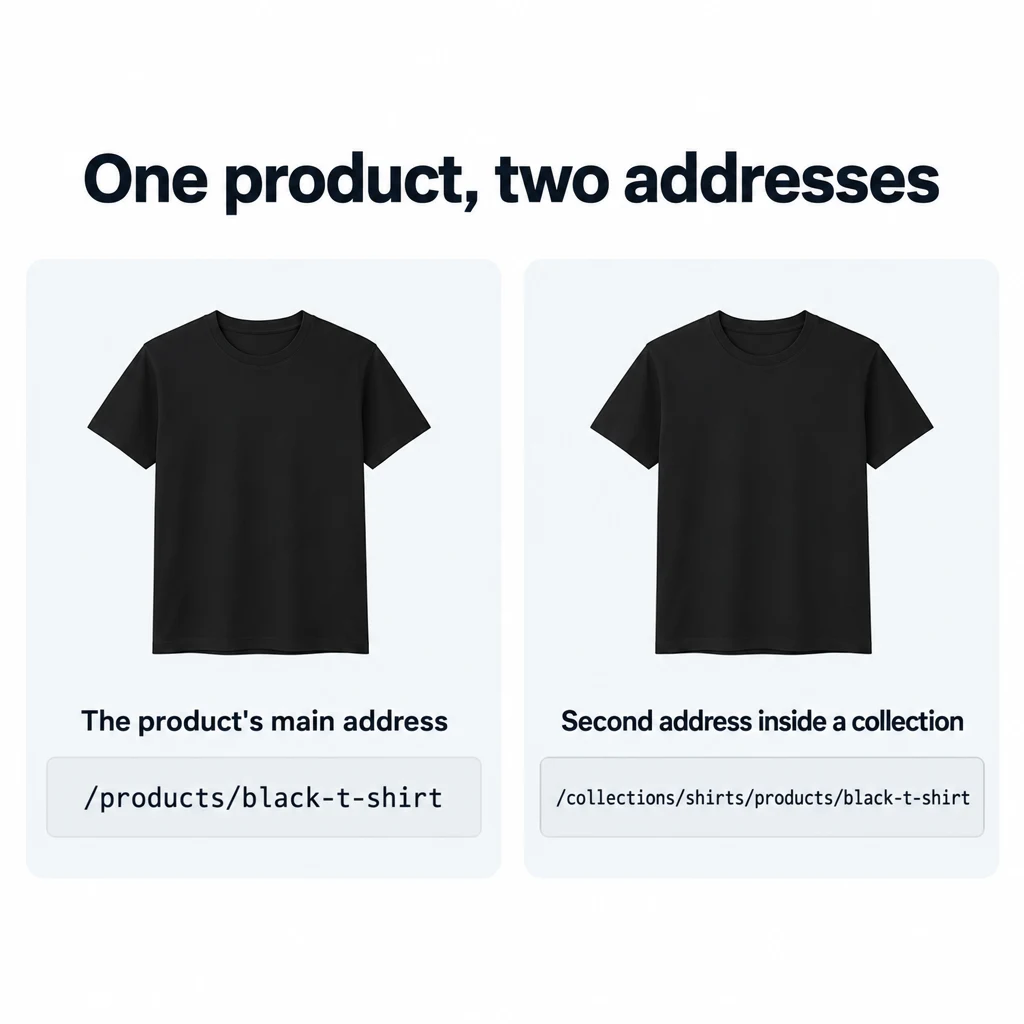
On Shopify, many themes give each product a second address inside every collection it belongs to, such as /collections/shirts/products/black-t-shirt, and link to that address from collection pages. The product’s main address is /products/black-t-shirt. The SEO tool maker Ahrefs notes that by default these themes “link to the non-canonical version of the pages,” meaning the second address instead of the main one (Ahrefs Help Center). The fix is an edit to the theme code so collection pages link to the /products/ address, which usually needs a developer.
Faceted navigation (filters)
Faceted navigation is the set of filters on a category page: size, color, price, brand. Google says the most common way of building filters, with a new web address for each combination, “can generate infinite URL spaces,” meaning an endless supply of near-identical addresses for Googlebot to crawl. In Google’s words, “if crawling is spent on useless URLs, the crawlers have less time to spend on new, useful URLs” (Google Search Central).
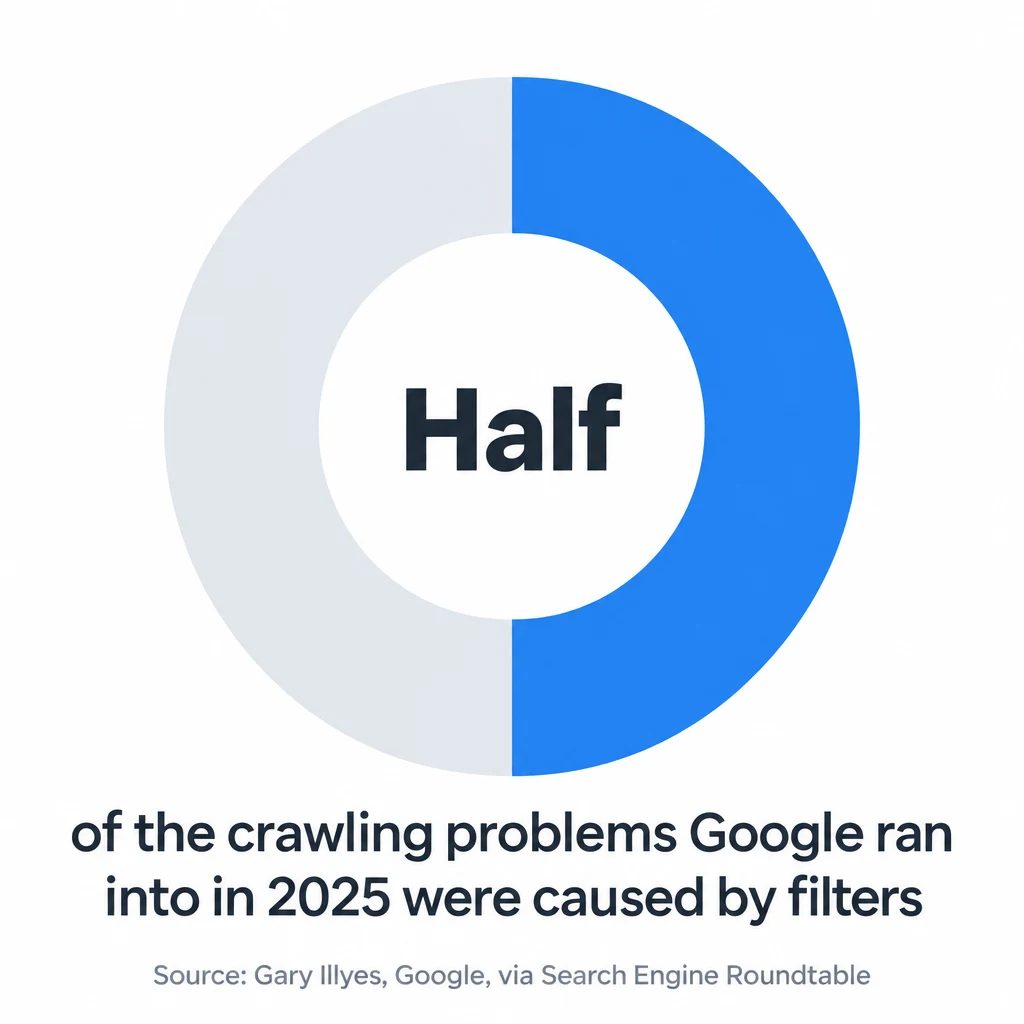
Filters caused half of the crawling problems Google ran into on the sites it crawled in 2025, according to Gary Illyes of Google’s search team (Search Engine Roundtable). An agency that knows e-commerce will look at your filters before it talks about keywords.
Platform limits
Google tells stores on an e-commerce platform that they can “most likely skip” planning their URL structure, “as the platform has most likely already considered these issues for you” (Google Search Central). Duplicate product pages and filter pages still happen on platforms, though. Platforms also differ in what a store can change, and on some, a wrong change can cost the store its search traffic. A specialist already knows those limits on your platform.
| Platform | What an agency works within |
|---|---|
| Shopify | Many themes link collection pages to the nested second addresses for products. The robots.txt file tells Google which parts of the store not to crawl. A developer can edit it through a theme template, but Shopify calls this “an unsupported customization” and warns that “incorrect use of the feature can result in loss of all traffic” (Shopify Help Center). |
| WooCommerce | Product and category URL formats are a store setting under WordPress permalinks, such as /product/hoodie-with-logo or /shop/hoodies/hoodie-with-logo (WooCommerce docs). Changing the format on a live store changes every product’s address. Links and rankings tied to the old addresses can be lost unless someone sets up redirects, which send visitors and Google from each old address to the new one. |
| BigCommerce | Product Filtering is BigCommerce’s faceted search (BigCommerce Help Center). BigCommerce’s help page doesn’t say whether Google should crawl the filter pages, so ask the agency how it would decide which of your filter pages Google should crawl. |
| Adobe Commerce (Magento) | Layered navigation is Adobe Commerce’s filter system (Adobe Experience League). Each product attribute the store sets as filterable, such as size or color, becomes a filter. |
Product feeds and AI shopping
A product feed is a structured file of your products, prices, and stock that you send to Google Merchant Center. Google says that “if you want your products to be found in the Google Shopping tab, upload your products to Google Merchant Center” (Google Search Central). A feed also helps Google find products that your category pages don’t link to.
On Shopify, getting products into ChatGPT’s shopping results is mostly a store setting, with little agency work involved. Shopify says products on eligible stores become discoverable in ChatGPT by default, and the store manages this from its Shopify admin (Shopify). Stores on other platforms have other routes, including a product feed to OpenAI: a file built to OpenAI’s specification. Building that feed is work for the store or its agency.
Whichever route a store uses, the agency’s job is to improve the product data: complete titles, descriptions, and product details that AI assistants can match to what shoppers ask. Shopify’s admin also shows which searches a store’s products appear for in these AI channels. It recommends changes to the product data, which the store or its agency then makes (Shopify). The guide to getting recommended by AI search covers how brands get cited and recommended beyond shopping results.
What to fix on your store before you hire anyone
The basics are worth fixing yourself before you pay anyone, because they are fields and settings inside your store admin and an agency would bill you hours for them.
- SEO titles and meta descriptions for your main collection or category pages and your best-selling products.
- Product and collection descriptions written for shoppers, in your own words rather than the manufacturer’s copy.
- Image alt text that describes each product photo.
- A sitemap submitted in Google Search Console. A sitemap is a file that lists the pages on your store, and Search Console is Google’s free tool for site owners. Shopify generates the sitemap automatically at yourstore.com/sitemap.xml (Shopify Help Center), and you submit that address in Search Console.
- Collection pages that link to every product. Google warns that “if category pages don’t include direct links to all products in a category, Googlebot might not find all of your products by crawling alone” (Google Search Central). On Shopify, also have a developer point those links at each product’s main
/products/address. - A Google Merchant Center feed, so your products can appear in the Shopping tab.
A Shopify Community member, JeffNaperAI, named the first three of these: “For Shopify specifically, a lot of low hanging fruit is in your own hands: product and collection descriptions, SEO titles and meta descriptions, and image alt text” (Shopify Community). He promotes his own SEO app later in the same post, but each of those three can be done in the store admin without one.
The guide to SEO without an agency is written for local and service businesses, but its advice on page titles and descriptions, free tools such as Search Console, and a free check of how AI assistants answer questions about a business apply to a store too.
When not to hire an e-commerce SEO agency yet
A store should hold off on hiring an agency in four situations:
- The store has no sales yet. SEO can bring people to a product page, but it can’t make them want the product. When a small apparel brand on r/shopify asked whether hiring outside help was worth it with sales only to people the owner knew, one commenter answered: “With no sales absolutely not” (Reddit).
- The catalog is small. A store with few products has few pages to work on, and you can usually write and fix them yourself.
- The basics aren’t done. An agency would charge you for the checklist in the previous section, which you can do in your store admin.
- The budget is under about $1,500/month. Among the three agencies findanseoagency.com checked, the cheapest plan for a store selling across the country is 1Digital’s National plan at $1,499/month (October 2026). A store that sells mainly in one metro area can spend less, because 1Digital’s Local plans, which target searches in one city, cost less.
Hire earlier if you’re redesigning the store or moving to a new platform. Product and category addresses often change in a redesign or a move, and rankings tied to the old addresses can be lost if nobody plans for it. Google says “a great time to hire is when you’re considering a site redesign (the earlier, the better), or planning to launch a new site” (Google Search Central).
Stores that aren’t ready for an agency still have options:
- A freelance SEO consultant on a smaller retainer.
- A one-time strategy plan that your own team carries out.
- A productized SEO service with a fixed scope and price.
- SEO and AI visibility tools. SEO apps find problems, and many fill in fields such as alt text and meta descriptions automatically. They don’t decide which pages or categories matter for your store or plan the content, so someone still has to choose what to work on.
- Running 20 to 30 of your buyers’ questions by hand through ChatGPT, Perplexity, and Google AI Mode to see which stores and products come up.
The comparison of agencies, freelancers, and in-house SEO covers the trade-offs between those paths.
How much does an e-commerce SEO agency cost?
Among the three e-commerce SEO agencies findanseoagency.com checked, published monthly prices run from $899/month to $5,999/month, as of October 2026. The site found no independent survey of e-commerce SEO pricing. Every e-commerce price it found came from an agency, so the table uses the agencies’ own pages.
| Agency | Monthly price (October 2026) | What applies |
|---|---|---|
| 1Digital Agency | National plans $1,499 to $5,999; Local plans $899 to $4,499 | National plans are for stores selling nationwide; Local plans target searches in one metro area and include local listings; both have a six-month initial term, then month-to-month |
| Inflow | No published price | Inflow says effective SEO services generally cost $3,000 to $5,000/month and that larger e-commerce sites can expect to pay more |
| TJ Digital | $1,900, $2,900, or $4,500 | At the entry tier, a client can typically expect three to four pieces of content a month plus ongoing outreach (asking other sites to mention or link to the store) and optimizations; the mix changes each quarter |
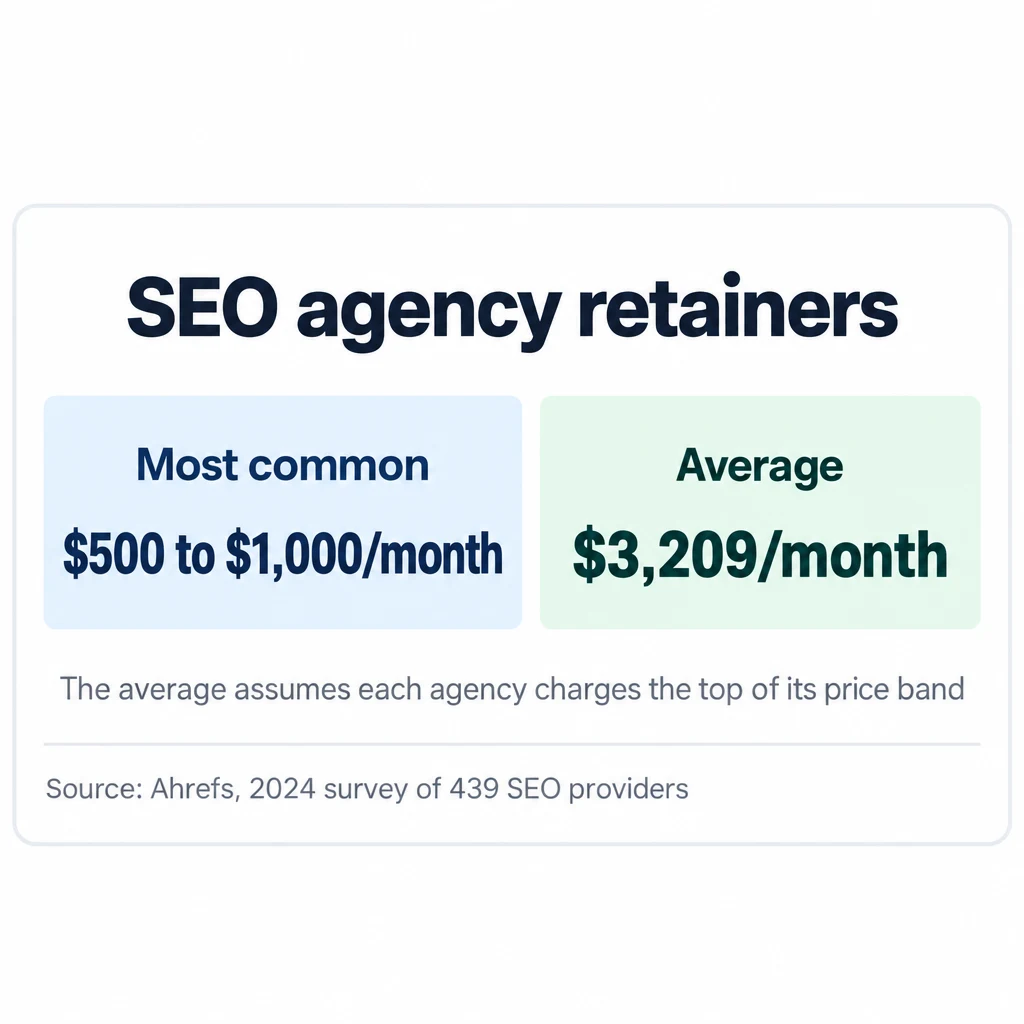
The broadest independent pricing data covers SEO in general, not e-commerce SEO specifically. Ahrefs’ 2024 survey of 439 SEO providers found that the most common agency retainer was $500 to $1,000/month (Ahrefs). The average agency retainer in the same survey was much higher, $3,209/month, but Ahrefs reached that figure by assuming each agency charges the top of its price band.
A low price can leave out work on the store’s own pages. A Shopify store owner posted a $600/month package on r/SEO, offered by a freelancer rather than an agency (Reddit). It included:
- Keyword research on “up to 50 keywords.”
- An audit in the first month.
- “High quality backlinks (3 per month),” meaning links to the store from other websites.
- An add-on of “20 ‘diversity links’ for $325,” a bundle of low-effort links covered in the red flags section.
The package listed no writing or improving of category or product pages. The only work touching them was the one-time audit with recommendations and the capped keyword research. One reply said: “Honestly if he’s not talking about optimizing your category pages, good site architecture. Conversion rate optimization. Proper analytics in place you are just gonna waste your money.”
The SEO pricing breakdown covers pricing models and what different budgets buy.
Questions that show whether an agency knows e-commerce
The best questions are about your own store, because an agency can only answer them well if it has looked at it. Ask two or three agencies the same questions and compare the answers.
- “Which category pages and buying guides would you work on first, and how would you improve product descriptions across my catalog?” This is the main work, so the answer should name your actual categories and say who writes the copy.
- “What would you do about the filter URLs on my store?” A specialist will have looked at your filters and can explain which filter pages should stay out of Google. It may also suggest keeping a few as landing pages, such as a “black running shoes” filter page that matches what shoppers search.
- “Have you checked which product URLs my category pages link to?” On Shopify, a specialist will know about the nested
/collections/.../products/links and whether your theme uses them. - “How would you handle my product feed for Google Shopping?” One r/brisbane commenter advised asking agencies exactly this, adding: “If they can’t answer that clearly, they’re probably not ecommerce-first” (Reddit).
- “How will you measure the sales that come from organic search?” The agency should also ask which products have the best margins, because those are the ones worth ranking. In the same thread, another commenter said: “the biggest red flag is when they pitch SEO + ads without even asking about your margins. Ecommerce is all about unit economics, not just leads.”
- “Who edits the theme?” Many fixes are changes to theme code. Shopify Support can’t help with robots.txt edits and suggests hiring a Shopify Partner for them (Shopify Help Center). Ask whether the agency has its own developers or expects you to hire one.
- “Can you audit the store with read-only Search Console access?” Google advises that for an audit you “only grant read access to Search Console (at this stage, don’t grant them write access)” (Google Search Central).
The general vetting questions about contracts, reporting, and AI search tracking apply to stores too. The guide to choosing an SEO agency for AI search lists them.
Red flags in e-commerce SEO proposals
A common sign of a weak e-commerce proposal is a list of quantities, such as 50 keywords or three links a month, instead of a description of work on your store. The $600 package was built this way.
- A capped number of keywords and a fixed number of links per month. A cap means the work was sized before anyone looked at how many products and categories your store has. Replying to the $600 package, one r/SEO user said: “I would definitely run from anyone offering anything about X number of keywords.”
- “Diversity links.” The add-on in that package bundled Q&A links, Web 2.0s, slideshows, and “social signals.” That is bulk link buying: many low-effort links placed at once, instead of mentions on sites your shoppers actually read. findanseoagency.com does not recommend paying for it.
- A promise of first place. Google’s advice is that if an SEO promises its changes will put you in first place in search results, “find someone else.”
- A proposal with no strategy for your store. Another reply to the $600 package said: “I don’t see any mention of strategy here.” The same commenter added: “I might be wrong, but this sounds like a templated checklist.”
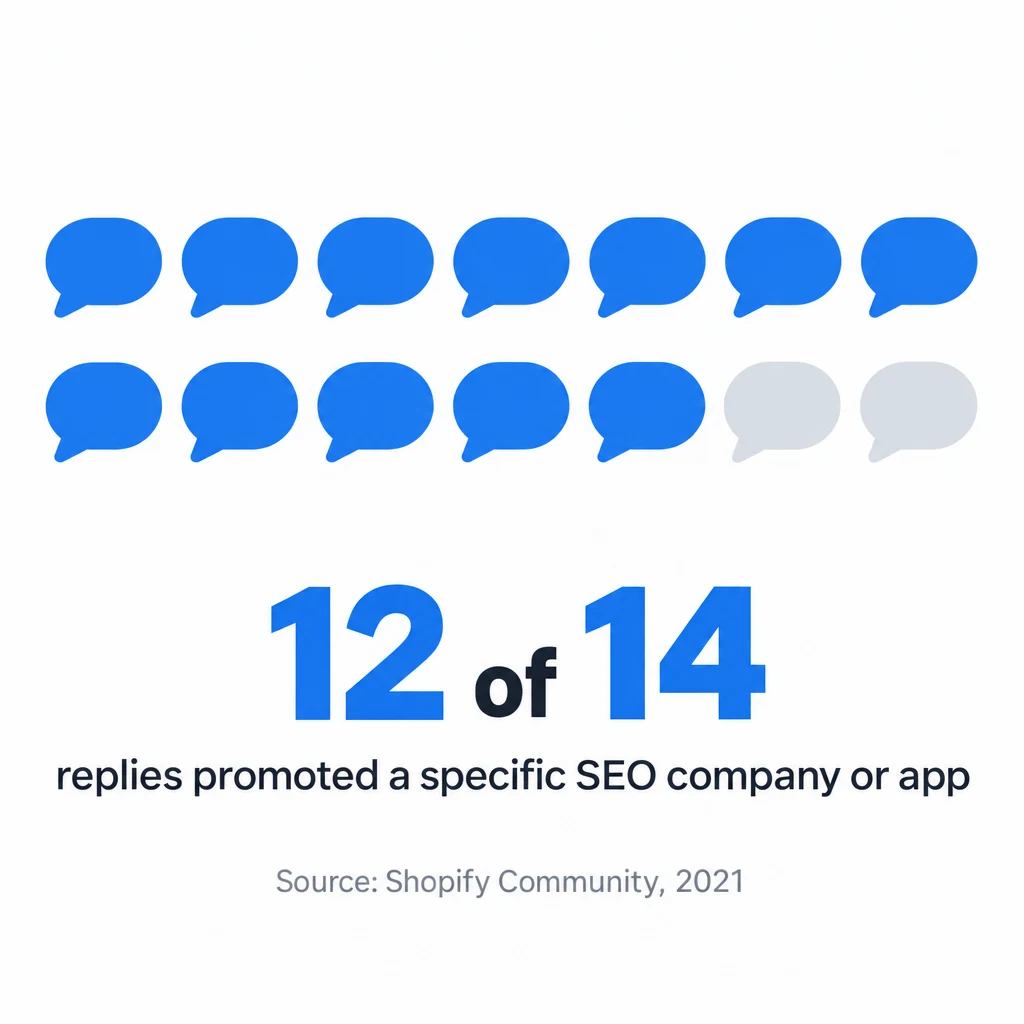
- Cold pitches. Google says to “be wary of SEO firms and web consultants or agencies that email you out of the blue.” Asking for help in public draws the same kind of pitch. When a merchant asked the Shopify Community for an affordable SEO company in 2021, 12 of the 14 replies promoted a specific SEO company or app, several of them from agency staff pitching their own firm. Pitches kept arriving in that thread into 2026.
Which e-commerce SEO agency fits your store?
The right agency depends on your budget, your catalog, and whether AI search is part of the goal. Three agencies that work with e-commerce stores fit different situations:
| Agency | Fits stores that | AI search work | Also worth knowing |
|---|---|---|---|
| 1Digital Agency | Need platform work such as a migration or development alongside SEO, or a custom plan for 10,000+ products, several regions, or regulated product categories | A ChatGPT service covering ChatGPT Search, ChatGPT Shopping, Merchant Center, and product schema (product details coded into the page for search engines) | Work outside the plan is billed at $185/hour |
| Inflow | Are established brands ready to spend $3,000/month or more on SEO | A GEO (generative engine optimization, another name for AI search) service that tracks how a brand appears in ChatGPT, Gemini, Perplexity, Meta AI, Claude, and Google AI Overviews. Inflow has listed the service on its site since August 2025 | Inflow says SEO under $3,000/month “typically cannot deliver the kind of results needed” |
| TJ Digital | Do $1M or more a year in sales, have $1,900 to $5,000/month to spend, and want AI search as part of their SEO | AI search is part of every monthly SEO plan | Builds a new Shopify store for clients who need one, usually as part of an SEO engagement. Clients can leave with 30 days’ notice. The agency has run a two-to-six-month waiting list through 2026 |
Stores below the budget in the “when not to hire” section are better served by the non-agency options listed there.
What to do next
Start with the fixes in your own store admin, then put the store-specific questions to two or three agencies and compare how much each one already knows about your store. The strategy guides cover the rest of the hiring decision, from contract terms to what a monthly SEO report should show.