GEO stands for generative engine optimization. It is the work of getting your business’s pages used as sources in the answers that AI search engines write, and getting your business itself named in those answers. Those engines include Google’s AI Overviews and AI Mode, ChatGPT, Perplexity, Gemini, and Claude. GEO is a new name for what SEO has become now that search engines write answers instead of only listing links. The work is the same kind of work as SEO. What changed is what counts as success: your business still needs to show up in the list of results, and now it also needs to be used as a source and named inside the answer.
What does GEO stand for, and where did the term come from?
GEO is short for generative engine optimization. A generative engine is a search tool that writes an answer in its own words instead of only showing a list of links. The name comes from a research paper published in 2023. The researchers changed pages in a few different ways and measured how much more those pages showed up in AI-written answers afterward. With the best changes, a page showed up as much as 40% more. The industry picked up the name from there.
You will hear other names for the same work. AEO, answer engine optimization, is the most common. AI SEO and LLM optimization are two more (LLM is short for large language model, the kind of AI that writes these answers). All of these labels describe one job. The plainer term, and the one used through the rest of this article, is AI search.
How do AI search engines build an answer?
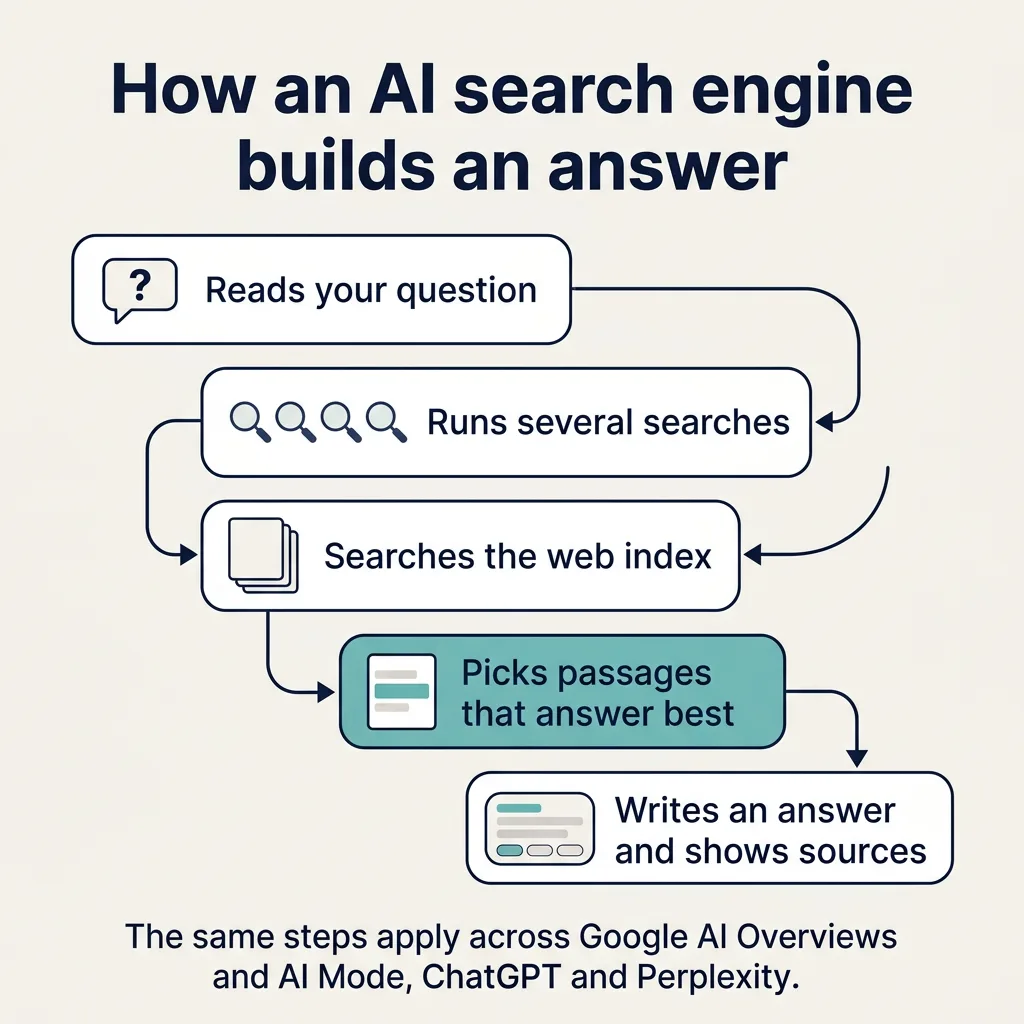
Every AI search engine follows roughly the same steps. It reads your question. It turns that question into one or more searches and runs them against a web index, the same kind of index behind the regular list of links Google shows. This article calls that list the classic results. Google’s AI Overviews and AI Mode run several related searches behind the scenes to cover the different parts of a question. ChatGPT and Perplexity search the live web the same way. The engine then collects the pages it found, writes an answer from passages in those pages, and shows some of them as sources next to or under the answer.
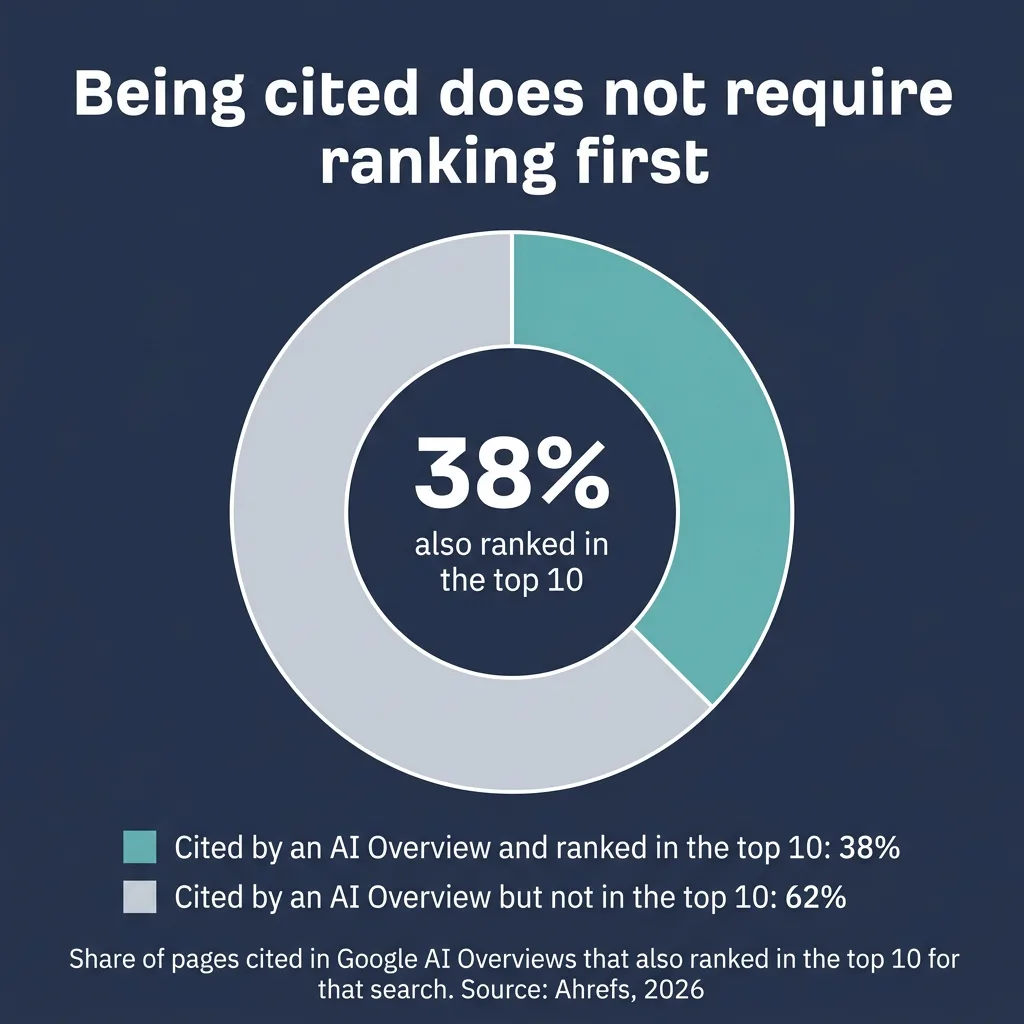
Three things follow from that. The first is that a page can be used as a source without ranking first for the question. The engine is choosing the passages that answer best from several searches, so a page that ranks low in the classic results can still be quoted in the answer. In one large study of Google’s AI Overviews, only about 38% of the pages Google cited also ranked in the top 10 for that search.
The second is that a business can be named in an answer because of what other sites say about it, and not only because of its own pages. If a review site, a directory, or a discussion thread describes your company as a good option, the engine can repeat that in its answer. The third is that the same question can produce a different answer from one conversation to the next, sometimes with different sources. The engine writes each answer fresh, so two people asking the same thing on the same day may see different sources. That matters when you measure this work, which is covered further down.
Ranking, being cited, and being recommended: what is the difference?
These are three different results, and it helps to have the vocabulary before you talk to an agency about any of them.
| Outcome | What it means | Where you would see it |
|---|---|---|
| Ranking | One of your pages appears in a list of search results for a query. | The classic results on Google or Bing, under or beside any AI answer. |
| Being cited | One of your pages is used as a source for an AI answer and is linked from it. | The source links or numbered citations next to an AI Overview, an AI Mode answer, a ChatGPT answer, or a Perplexity answer. |
| Being recommended | Your business itself is named as the answer to a buyer’s question, such as “which companies do this well near me.” | The text of the AI answer, whether or not your own site is linked. |
A business can have any one of these without the others. A page can rank on page one and never be cited, because the engine found a clearer answer somewhere else. A business can be recommended by name without any of its own pages being cited, because the recommendation came from a review site or a directory. GEO work aims at the second and third outcomes, being cited and being recommended, because those are what a buyer sees when the engine writes the answer for them.
Is GEO different from the SEO you already pay for?
No. It is the same discipline, and the goal got bigger. This article uses the term “legacy SEO” for SEO work that still aims only at rankings and has not adapted to AI search. The table shows what stays the same and what changes.
| Legacy SEO | SEO that includes AI search | |
|---|---|---|
| The goal | Rank on page one for target keywords. | Rank, and also be cited and recommended in AI answers. |
| What gets measured | Rankings, organic traffic, and backlinks (links from other sites to yours). | Rankings and traffic, plus how often the business is cited or recommended for a fixed set of real buyer questions. |
| Where the effort goes | Keyword pages, technical fixes, and link building. | Content that answers buyer questions directly, mentions on the review sites and directories that show up in AI answers, and correct facts about the business everywhere it is listed. |
| What “content” means | Pages built around keywords, often long, to capture traffic. | Pages built to answer specific questions, in a structure an engine can quote directly. |
| What a report shows | Position changes and traffic totals. | Position changes and traffic, plus citation and recommendation rates across the AI search engines. |
The left column still matters. AI search engines pull their sources from the same web index that the classic results come from, so a page that cannot rank at all is unlikely to be cited either. Google’s own guidance says there are no extra requirements and no special optimizations needed to appear in AI Overviews or AI Mode beyond the normal work of being a good search result. GEO does not replace SEO for that reason. The pages, the site health, and the mentions that earn rankings are the same things that earn citations.
GEO is also not a separate package, and it helps to know what to make of an agency that sells it as one. If the work in the right column is what good SEO already includes, then an agency that quotes GEO as an extra line item is either describing work its SEO should already cover, or telling you that its SEO did not include that work until now. Either way, the useful question to ask is what it was doing before and what will change. The reason you keep hearing GEO sold on its own is that the name is new, the change in search is recent, and most of the market has not caught up. A new label is an easy thing to add to a proposal. The work under it is the same work as before, now aimed at citations and recommendations as well as rankings.
What does GEO work actually involve?
Most of the work will look familiar if you have bought SEO before. Five things make up the bulk of it.
Content that answers real buyer questions directly
Content is the main lever for most businesses. AI search engines lift passages that answer a question plainly, so the pages that get cited are the ones that state the answer near the top, in complete sentences, under a heading that matches the question. The questions that matter most are the ones people ask right before they buy: what something costs, how two options compare, who a service is for, and what to look for. The other four items on this list support the content; they do not replace it.
Mentions and recommendations on the sources AI answers already cite
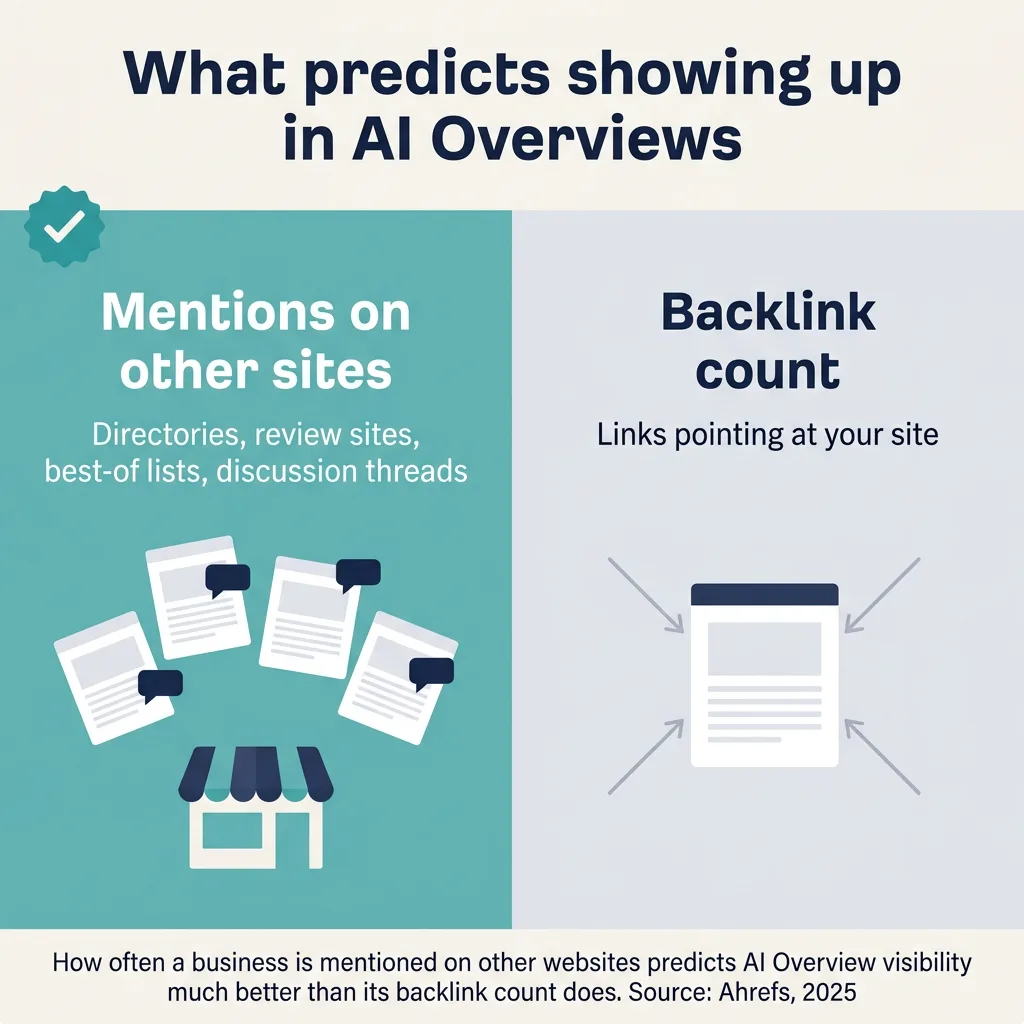
When an AI search engine recommends a business, the recommendation often comes from what other sites say. For most industries that means directories, review sites, “best of” lists, and discussion threads. Part of the work is finding which of those sites the engines already cite for your industry’s questions, and then getting your business listed, reviewed, or mentioned there. This matters more than the number of links pointing at your site. How often a business is mentioned on other websites is a much stronger predictor of whether it shows up in AI Overviews than its backlink count is. Which sites matter depends on your industry and on the question being asked. No single platform is essential for every business.
Consistent, current facts about your business across the web
Engines describe your business from whatever they can find. If your hours, services, locations, or prices differ between your website, your Google Business Profile, and the directories that list you, the answer a buyer gets may be wrong or vague. Keeping those facts the same everywhere, and keeping them current, is plain work that directly affects how you are described.
A site that engines can crawl and read
Google’s AI answers use the same crawler and the same indexing rules as regular search, so a page that is blocked from Google, slow to load, or hidden behind scripts cannot be cited no matter how good its content is. This is supporting work. It removes obstacles, but it does not on its own earn a citation.
Measurement by tracking real buyer prompts over time
The last piece is measurement, and it looks different from a rankings report. Instead of positions for a list of keywords, the agency tracks a fixed list of questions your buyers ask and reports how often your business is cited or recommended in the answers. How that tracking works, and how to do a simple version yourself, is covered in the measurement section below.
What does GEO mean for your business?
AI answers already reach billions of people every month. Google has said that AI Overviews has more than 2.5 billion monthly users. ChatGPT reached 900 million weekly users in early 2026. The share of everyday Google searches that show an AI Overview rose from about 15% to about 43% in about a year, according to data reported in July 2026.
When an AI summary appears, fewer people click through to any website. People clicked a regular result on 8% of Google visits when an AI summary was shown, compared with 15% when it was not, and only 1% of visits clicked a source link inside the summary itself.
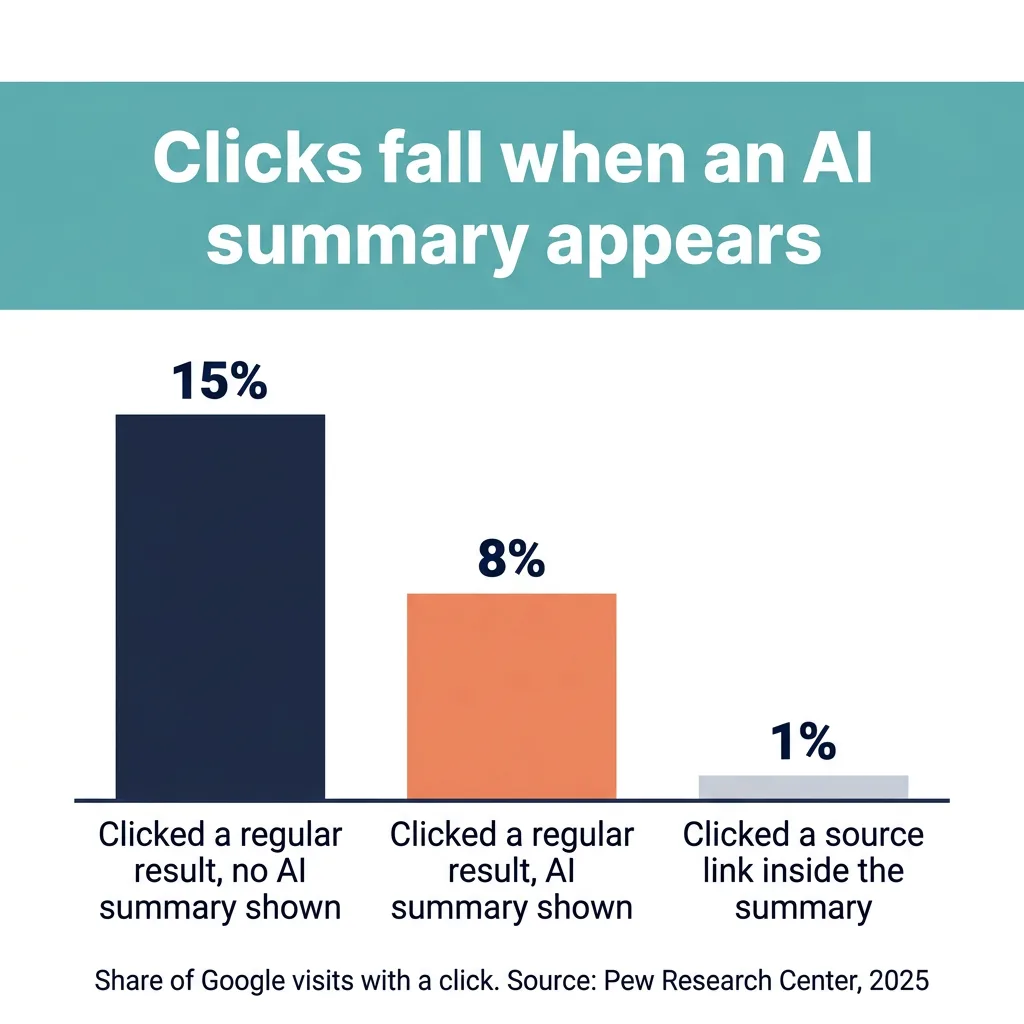
That changes what your traffic numbers can tell you. A buyer who reads the answer, sees your business named in it, and never clicks anything shows up nowhere in your analytics, but they still learned your name. So traffic now understates how many people saw you, and being cited and being recommended become the numbers worth watching.
Any business whose customers ask a search engine or an AI assistant a question before they buy is affected now. How much depends on your industry and on the type of question. AI answers show up more for some searches than for others, and the sites the engines rely on for their answers differ from one industry to the next.
To find out whether the agency you already pay is doing this work, ask it three questions. Which buyer prompts does it track? How often is your business cited or recommended in the answers to those prompts? Which pieces of work produced the citations and recommendations it reports? An agency that can answer all three is doing AI search work. An agency that can only show rankings and traffic may still be doing useful SEO, but it is not doing this. If your agency can only show rankings and traffic, ask it to add prompt tracking and question-answering content to the work you already pay for, and ask to see the first results. If it cannot or will not, How to Choose an SEO Agency for AI Search covers what to look for in one that can.
How do you measure GEO?
Measuring GEO means tracking a fixed set of realistic buyer questions across AI Overviews, AI Mode, ChatGPT, and Perplexity, and repeating the check over time. The free version is to write down 20 to 30 questions your customers would actually ask, run each one in each engine, and note which sites are cited and which businesses are named. A month later, run the same list again and compare. Tools sold as AI visibility trackers do the same check across more questions and more engines.
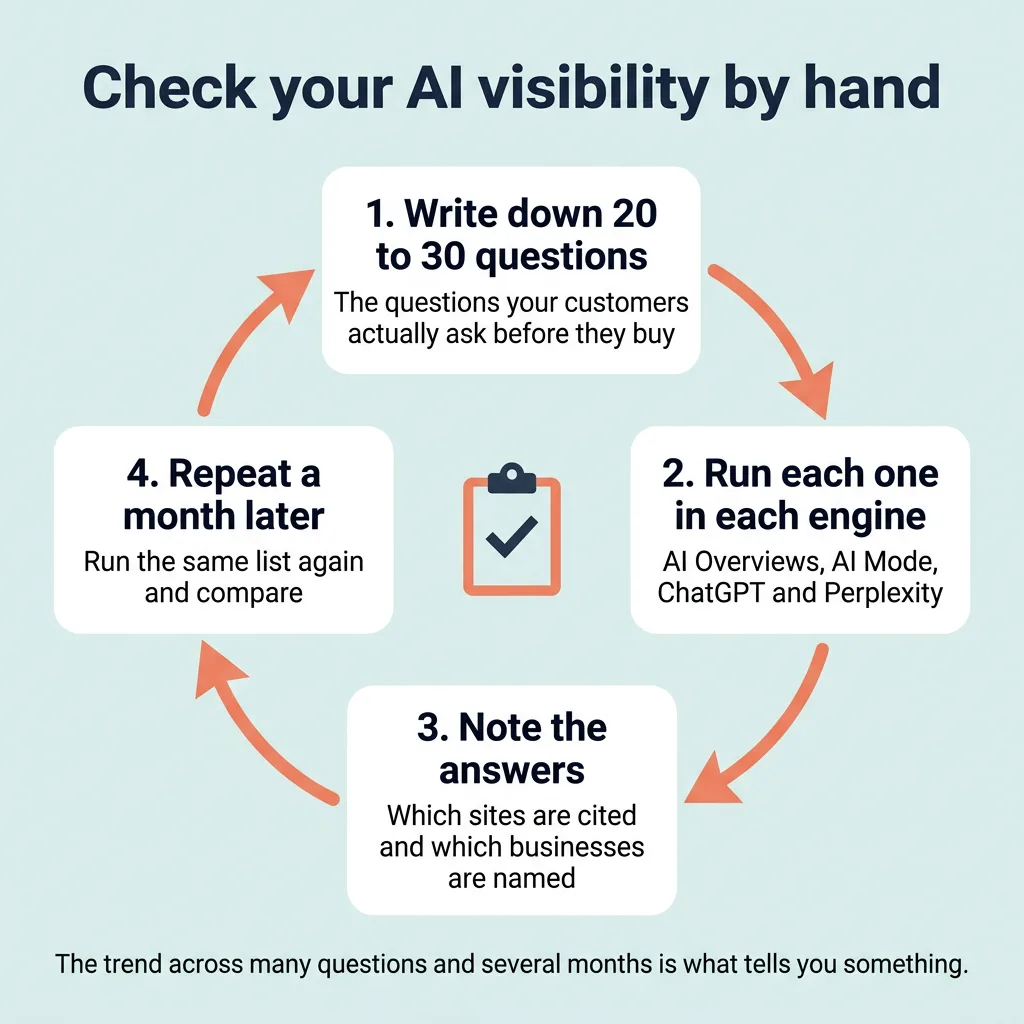
A single AI conversation does not tell you whether the work is succeeding or failing. The same prompt can produce a different answer, with different sources, the next time it runs, because AI systems do not guarantee the same output twice. The set of sites cited for a given question tends to stay fairly stable from week to week, so the pattern across many questions is real, even though any one answer can differ from the next. A screenshot of your business being recommended once is not proof that a strategy is working, and a screenshot of a competitor being recommended once is not proof of a problem. The trend across many questions and several months is what tells you something.
Frequently asked questions about GEO
Does GEO replace SEO?
No. The classic results still appear alongside AI answers, and the AI search engines pick their sources from pages that were built, hosted, and linked the way SEO has always required. Dropping that work would also remove the pages an AI answer could cite. What changes is the report: rankings alone no longer show whether buyers are seeing your business.
Is GEO the same as AEO?
Yes. AEO stands for answer engine optimization, and the two labels cover the same engines and the same work. Some writers use one, some use the other, and some proposals list both. If a proposal lists GEO and AEO as separate services, ask what work sits under each heading, because it should be the same list.
Do small businesses need GEO?
Yes, if customers research the purchase before they call. A small business is found in AI answers the same way a large one is: through pages that answer buyer questions, correct facts on its Google Business Profile and the directories that list it, and mentions on the review sites its industry uses. The list of buyer questions worth tracking is usually short for a small business, which makes the by-hand check described above practical.
How long does GEO take to show results?
Months rather than weeks. Engines have to find and re-read a changed page before they can use it as a source, and mentions on third-party sites build up slowly because each one depends on someone else publishing something. No agency controls how quickly an engine re-reads a page or how quickly other sites start mentioning a business, so a promise of AI visibility within weeks should be treated with caution.
Where to go from here
To keep reading, the AI search optimization hub collects the site’s guides on how AI search works, what the work involves, and what to ask an agency about it. The rest of the site’s articles are on the blog.