
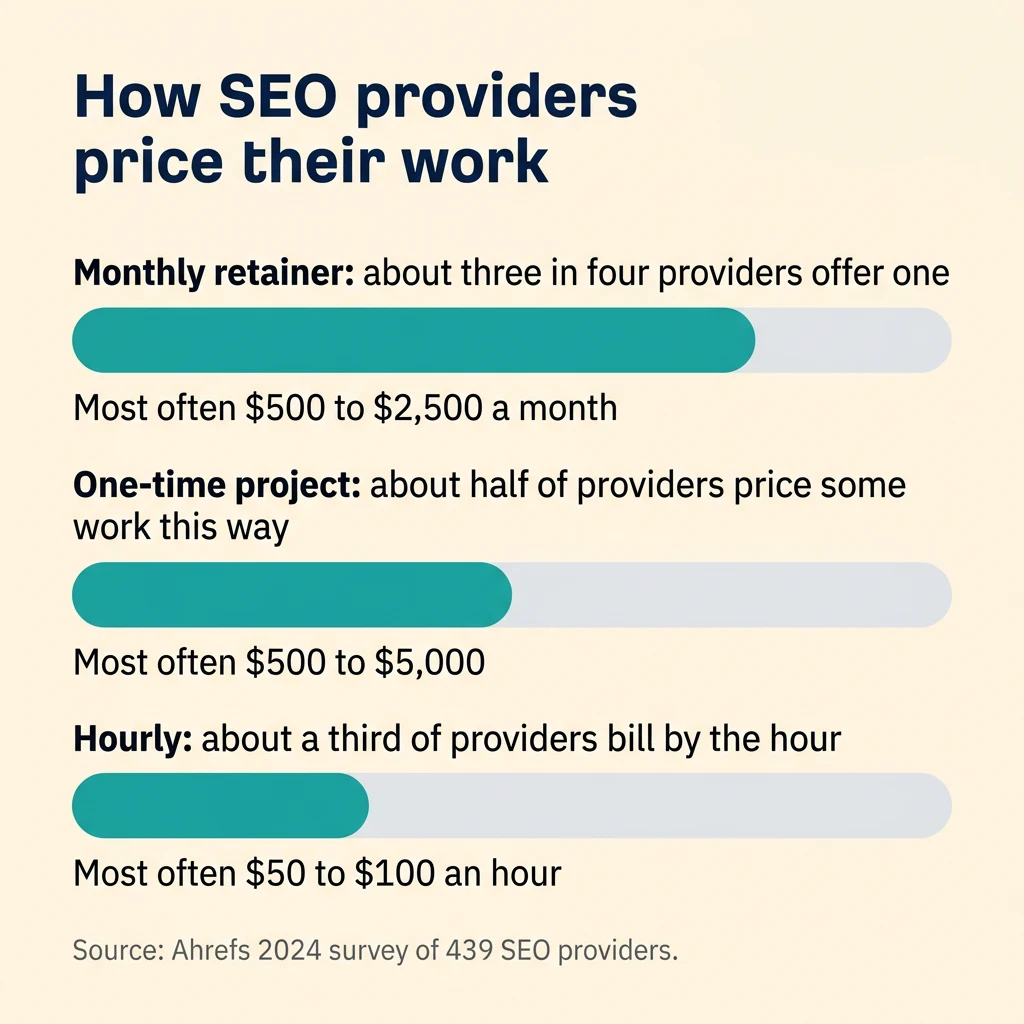
SEO most often costs $500 to $2,500 a month. That is where the most common monthly retainer lands in each of the three large pricing surveys. The surveys disagree on where inside that range the middle sits, because each one asked a different mix of providers. Hourly work mostly runs $50 to $100 an hour, and one-time projects mostly run $500 to $5,000. Those figures are enough to set a budget and explain the number to whoever approves it. The more useful question to ask about any quote is what the monthly fee buys, and most of it should buy content. Content is what search engines rank and AI answers cite. findanseoagency.com publishes guides on SEO and AI search agencies, which means reading the pricing surveys and the agencies’ published price lists as they change. The numbers below come from those sources.
What the SEO pricing surveys say
Three surveys of SEO providers are the main sources for industry pricing, and Clutch’s directory data adds a view of the larger agencies. Every figure in the table links to its source.
| Survey | Year | Who answered | Most common monthly retainer | Most common hourly rate | Most common project price |
|---|---|---|---|---|---|
| Ahrefs | 2024 | 439 SEO providers, including freelancers and consultants | $501 to $1,000 | $75 to $100 | $2,501 to $5,000 |
| Backlinko | 2025 | More than 300 SEO professionals | $1,001 to $2,500 | $50 to $100 | $1,000 to $5,000 |
| SE Ranking | 2025 | 260 agencies, most with fewer than 10 people | $500 to $1,000 | $50 to $100 | $500 to $2,000 |
| Clutch | 2026 | Agency profiles on the Clutch directory, not a survey | $2,000 to $20,000 (typical range) | $100 to $149 | Average $37,159 (no most-common band given) |
The samples differ (who was surveyed, how large the providers were, and which year), which is why the most common bands do not line up. Treat the numbers as benchmarks for setting a budget, not as a price list. A quote outside these bands can still be fair, but it needs a reason.
Monthly retainer. A fixed fee each month for an agreed scope of work. About three in four providers offer a retainer, and it is how most businesses buy ongoing SEO, because the work repeats every month: publishing content, fixing pages, and getting mentions and links on other websites. The typical figure is $500 to $2,500 a month, depending on the survey, and the larger agencies listed on Clutch start around $2,000.
Hourly. About a third of providers bill by the hour, most commonly at $50 to $100. US providers charge more: 40% of US and Canadian agencies charge over $125 an hour, compared with 6% of European agencies. Hourly billing suits advice, a short consultation, or a small fix, where the job has a clear end. Few businesses buy ongoing SEO this way, because they would be paying for time rather than for content.
Per project. About half of providers price some work as a one-time project. The most common range is $500 to $5,000, depending on the survey. A project fits a defined job: an audit, a site migration, a batch of pages, or a strategy that the business’s own team will carry out.
What SEO costs by business size
The table above shows what providers charge. The list below shows what a business of a given size can expect to pay. The dollar tiers come from the Backlinko survey, and Backlinko pairs each tier with the kind of business that typically buys it (small local business, established small business, mid-sized business, competitive industry, and enterprise). The descriptions below spell out what each of those looks like in practice. The budget table further down uses the same dollar bands, except that it splits the top band ($5,000 and up) into two rows, so a business that finds its band here can look up the same band there. To find the band, look at three things about the business: how many locations it has, whether it sells locally or nationally, and how crowded its industry is in search.
- One location, selling to one town or metro area: up to $1,000 a month, and often $500 or less. A local business competes for a small set of searches in one area, so it needs fewer pages and less outreach than a company selling everywhere.
- One location with many services, or a business selling across a region: $1,001 to $2,500 a month. More services and a wider area mean more search terms to cover, so there are more pages to write and maintain.
- Several locations, a national market, or an industry where large companies already hold the top results: $2,501 to $5,000 a month. Each location or product line needs its own pages, and outranking strong competitors takes more content and more outreach. Backlinko labels this band by competition rather than by size, so a single-location business in a crowded industry belongs here too.
- Enterprise, meaning many locations or thousands of pages and several internal teams: $5,000 a month and up. At that size, keeping the site technically sound is ongoing work for a team, and the content has to be produced in volume.
Why two SEO quotes can differ five-fold
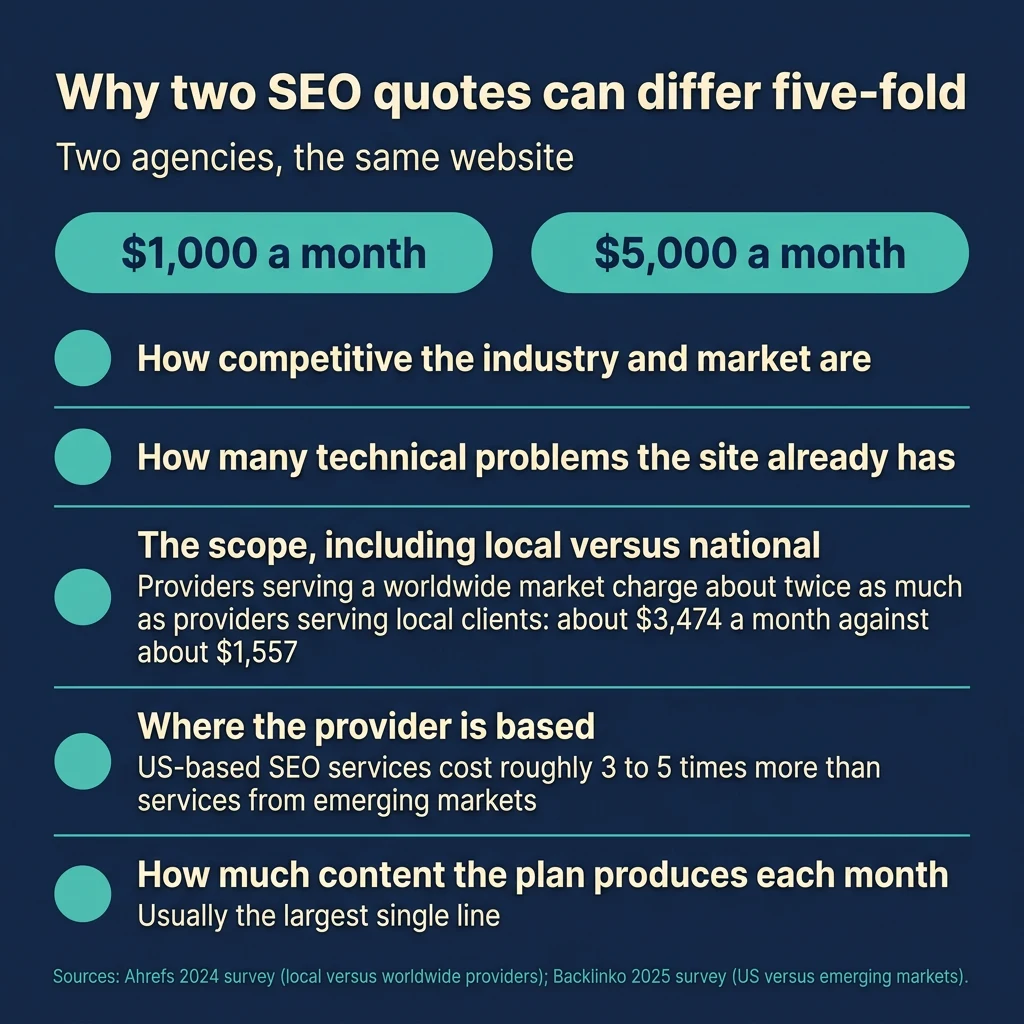
Two agencies can both say “SEO,” look at the same website, and quote $1,000 and $5,000 a month. Most of that gap comes from five things, and a quote that does not explain which of them apply is hard to judge.
How competitive the industry and market are. Winning a search term means producing something better than whatever ranks now. In a crowded industry or a large city, the pages already ranking are strong, so it takes more content and more outreach to pass them. A quote for a personal injury firm in a big city covers far more work than a quote for an accountant in a small town, even when the list of deliverables looks similar.
How many technical problems the site already has. Slow pages, broken links, duplicate pages, and an old platform all hold new content back. Someone has to fix those problems before the content can perform, and those hours are in the quote. A site that is already in good shape gets a lower price for the same content plan.
The scope, including local versus national. Scope means how many pages, how many locations, and whether outreach and directory listings are included. The biggest scope difference is how far the business sells: one town, or the whole country. Providers that serve a worldwide market charge about twice as much as providers that serve local clients (about $3,474 a month against about $1,557). That survey figure compares providers by the market they serve rather than plans by scope, so it gives a rough size for the local-versus-national gap.
Where the provider is based. US-based SEO services cost roughly 3 to 5 times more than services from emerging markets, so two quotes for the same scope can differ by that much on location alone. A low quote from an offshore provider is not wrong just because it is low. The thing to check is what the month buys in content, and who writes it.
How much content the plan produces each month. This is usually the largest single line, and the one that separates two quotes by thousands of dollars. Every piece costs money to research, write, and edit, so a plan that publishes eight pieces a month costs a lot more than a plan that publishes two, even from the same agency.
There is one more thing to ask about. Some agencies price off the client’s revenue, meaning they set the fee by what they estimate the business can pay, rather than off a rate card built from hours and deliverables. A revenue-based quote is not wrong in itself, but the buyer cannot check it against the work, and it does not change when the scope changes. Ask which basis a quote is built on. If the answer is revenue, ask for the deliverables that the fee covers anyway.
What a monthly SEO budget should buy
Content carries most of the value in an SEO budget, for a simple reason. Search engines rank pages, and AI answers cite pages. A business with no page on a topic cannot rank for it or be cited for it, no matter how clean the site is or how many links point to it. Technical work, links, and directory mentions all help the content perform, but they are supporting activities, and they should be the smaller share of the fee.
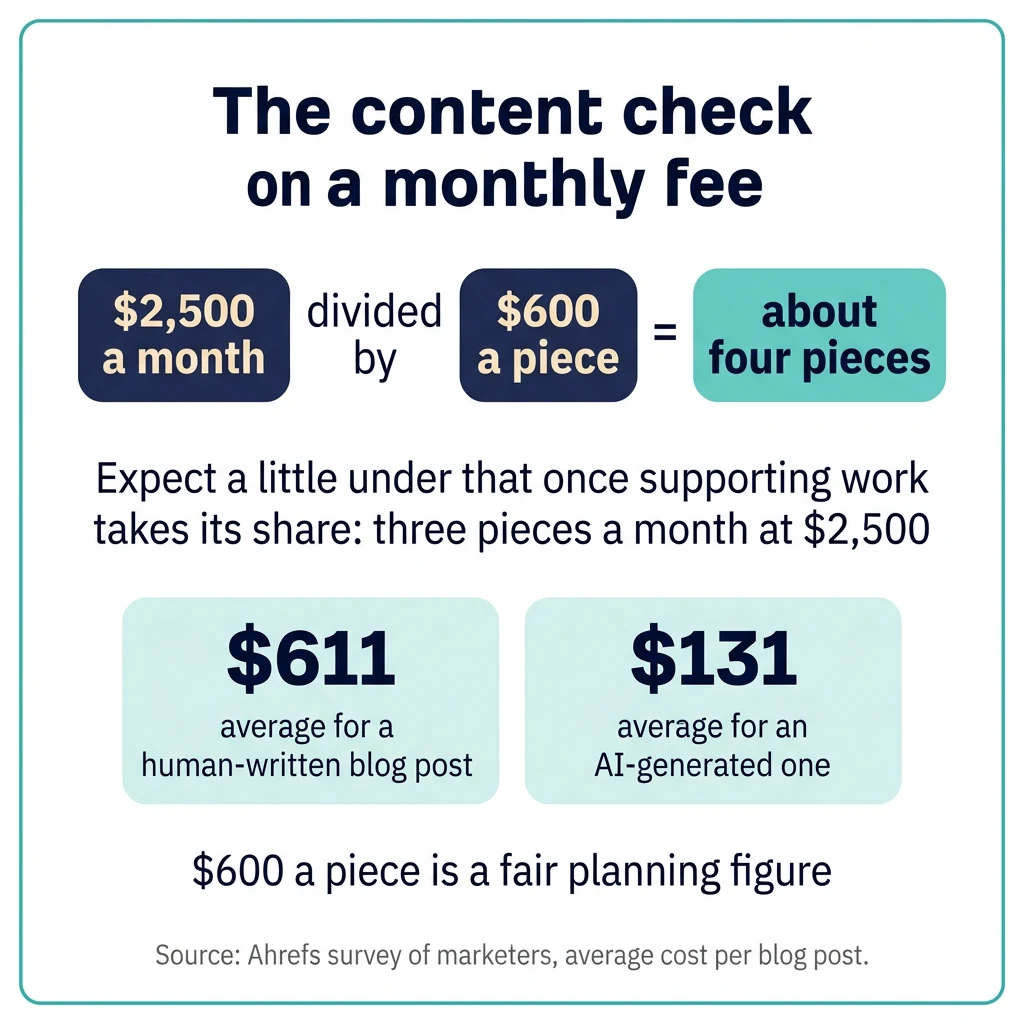
A piece of content, in this article, means one published blog post or web page. That is the unit to count on a quote, and there is a survey figure to price it: marketers reported paying an average of $611 for a human-written blog post and $131 for an AI-generated one. AI-drafted content still needs a person to edit and fact-check it before it is worth publishing, so $600 a piece is a fair planning figure. It is a rough figure, taken from an average, and an agency with its own production system can produce a good piece for less. It is still close enough to check a quote against.
The check is simple arithmetic. Divide the monthly fee by $600. The result is the most content the fee could buy at the average cost, if every dollar went to content. For a $2,500 retainer that is about four pieces. Some of the fee goes to supporting work, so at the average cost the realistic expectation is a little under that: three pieces a month at $2,500. A plan that promises the full four plus supporting work is producing its content for less than the average cost. That is fine when a person edits and checks each piece, so the buyer should ask how the content is produced. A plan that promises one piece a month at $2,500 should explain where the rest of the money goes.
The table below uses the same arithmetic, with the same dollar bands as the size list above up to $5,000, and two rows above that. Each content count is the most the fee buys at $600 a piece. Expect a little under that count when supporting work takes its share, and the full count when the agency produces its content for less than the average. No survey prices technical work, outreach, tracking, or strategy on their own, so those lines are not priced here. They make up the supporting share of the fee.
| Monthly budget | What a month should include |
|---|---|
| Up to $1,000 | One piece of content, or a fixed off-the-shelf local package (business listings and basic page fixes). There is little room for outreach at this level, so progress is slow. |
| $1,001 to $2,500 | Two to three pieces of content, technical fixes as needed, some outreach for mentions, and basic tracking. |
| $2,501 to $5,000 | Four to eight pieces of content, ongoing technical work, steady outreach, and a strategy that changes as results come in. |
| $5,001 to $10,000 | Eight to 16 pieces, or fewer pieces that are longer and more researched, plus a dedicated strategist, sustained outreach, and a technical program for a larger site. |
| Above $10,000 | Sixteen pieces and up, which means a content operation: several writers, many markets or locations, a large technical program, and outreach in volume. |
The one test to run on any quote: does the plan mostly buy content and the outreach around it? If most of the fee goes to reports, audits, or link packages, the plan is paying for things that support content without buying the content itself. Outreach and a link package are different things. Outreach earns mentions on the sites a business’s buyers already read, and a link package is a batch of links bought in bulk.
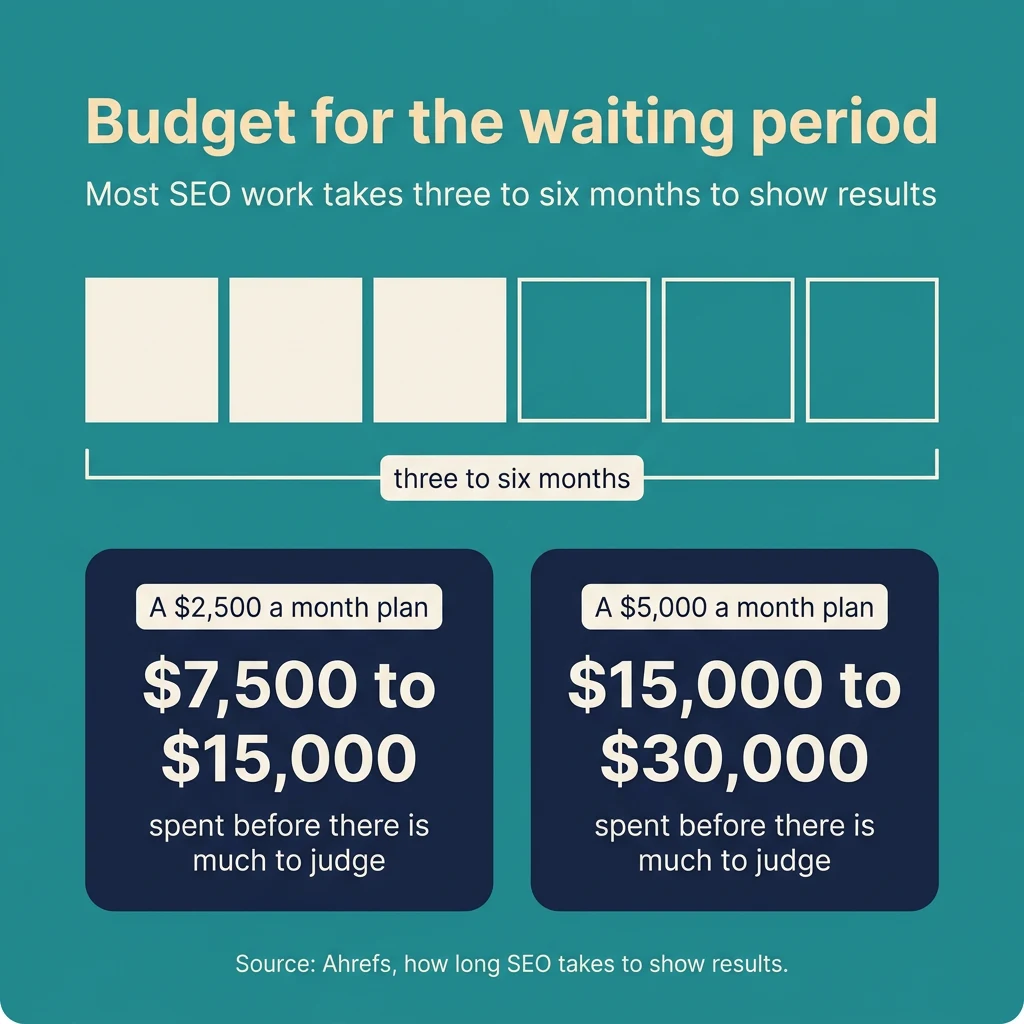
Budget for the waiting period as well. Most SEO work takes three to six months to show results, so a $2,500 plan means $7,500 to $15,000 spent before there is much to judge, and a $5,000 plan means $15,000 to $30,000. Whether that total is worth spending is its own question, answered in Is SEO Worth It for a Small Business?.
SEO pricing models compared
| Model | How it works | Who it suits | What to watch |
|---|---|---|---|
| Monthly retainer | A fixed fee each month for an agreed scope of work | Most businesses that want ongoing content and results | Ask how many pieces of content the month buys, and what else is included |
| Project or one-time | A fixed price for a defined job, such as an audit, a migration, or a strategy | Businesses with a one-time need, or an in-house team that will carry out the plan | Who does the work once the project ends |
| Hourly | Pay for time, most often $50 to $100 an hour, and more for US providers | Advice, a short consultation, or a small fix | The fee buys time, not results, so cap the hours and agree on what they cover |
| Credit or workstream based | A flat monthly fee, and the provider decides each month or quarter where the effort goes: more content in one period, technical fixes or outreach in the next, based on what will move results most | Businesses whose priorities shift, and who want the provider to decide where effort goes | Ask how the provider decides where the effort goes each period, and how it reports what was done |
| Performance based | The fee is tied to rankings, traffic, or leads | Almost no one, because it is rarely offered: only 6% of agencies use it, and usually alongside another model | A guarantee of rankings or AI visibility is a red flag. Google’s own guidance says no one can guarantee a #1 ranking. No agency controls what an AI answer cites, so a promised place in an AI answer is a promise it cannot keep |
How AI search visibility shows up in SEO pricing
AI search is what SEO has become, so a modern plan includes it. An agency that is not optimizing for AI answers is doing legacy SEO. Inside a plan, AI search work looks like three things: content written to be cited, mentions on the sources AI already cites (directories, review sites, listicles, and discussion threads), and tracking of the real prompts buyers type, with how often the business shows up in the answers. Those are the content, the outreach, and the reporting a plan should already contain, so none of them needs its own line on a quote. How AI search engines pick their sources is covered in What is GEO? A Complete Guide and the site’s AI search hub.
Some agencies do price it separately: among agencies that have decided on a price for AI search optimization, the average fee is about $937 a month. That average includes agencies that only plan to charge for the service, alongside agencies that already do. A separate “GEO add-on” or “AI visibility package” line is a thing to question, not to buy. The question to ask is what the add-on buys that the content and outreach already in the plan do not.
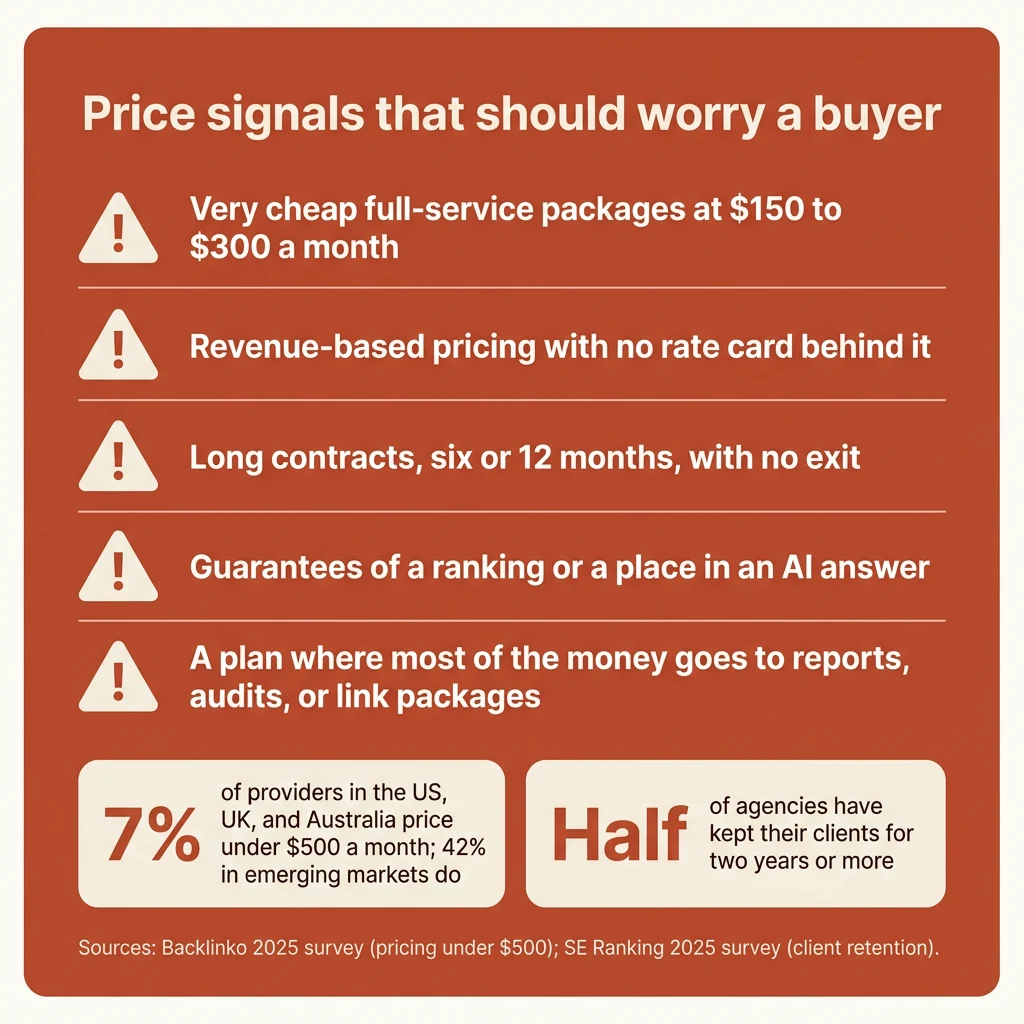
Price signals that should worry a buyer
- Very cheap “full-service” packages at $150 to $300 a month. At that price, the work has to be templated, automated, or purchased in bulk, because there is no room for a person to write, edit, and place anything. Pricing under $500 a month is rare among providers in the US, UK, and Australia (only 7% of them price that low) and common among providers in emerging markets (42%).
- Revenue-based pricing with no rate card behind it. The warning sign is an agency that cannot produce a deliverable list for the fee when asked.
- Long contracts, six or 12 months, with no exit. Half of agencies have kept their clients for two years or more, so a long contract is not needed to keep a client who is seeing results. It mainly protects the agency when the results stop.
- Guarantees. A promise of a ranking or a place in an AI answer is a red flag, for the reason given in the pricing-models table above.
- A plan where most of the money goes to reports, audits, or link packages. A plan like that fails the content test above, and the sign to look for is a content line that is the smallest line on the quote.
Who fits where: SEO providers by budget
Published prices in this section are as of September 2026, and each vendor’s own page is the place to confirm them. The bands here are cut where the named vendors’ published entry prices fall, so they do not match the survey bands above exactly.
Below about $1,900 a month. The line sits at $1,900 because that is where the lowest published tier in the next band starts. Most full-service agencies start above it, so the realistic options here are fixed-price packaged services, freelancers, or doing the work in-house. Boostability publishes a Local SEO Starter plan at $299 a month and growth and scale plans from $600 to $3,000 a month, and The HOTH’s managed SEO starts at $1,000 a month. A freelancer at the surveys’ typical $50 to $100 an hour is paid for the hours agreed. Ten hours a month comes to $500 to $1,000, which is enough for about one piece of content and a few fixes. A business with staff time but no budget can publish its own pages for people close to a buying decision, keep its business listings accurate, and check by hand how it shows up in search results and AI answers. That is slow, but it costs nothing beyond staff time.
A one-time strategy engagement, executed in-house. This is its own path rather than a monthly band. A business with a marketing person who can write pays a specialist once for an audit and a plan, then carries the plan out with its own staff. It costs a project fee (most commonly $500 to $5,000, per the surveys above) instead of a retainer, and it suits businesses that have the staff to do the work but no plan to follow.
Established US service and B2B businesses at roughly $1,900 to $5,000 a month. For a business in this band that wants AI search visibility built into the plan, TJ Digital publishes three tiers at $1,900, $2,900, and $4,500 a month, with no long-term contracts. The entry tier includes three to four pieces of content a month plus ongoing outreach and optimizations. The agency has run a waiting list of two to six months through 2026, so a reader who wants that route should join the waiting list early rather than plan on a start date next month. A reader who cannot wait that long can look for an agency with open capacity at this budget, or use the wait to complete a one-time strategy engagement.
B2B SaaS and tech companies at $4,000 to $10,000 and up. Optimist publishes full-service retainers from $4,000 a month on a month-to-month basis, and Omniscient Digital’s full-service engagements start at $10,000 a month. Both specialize in the long, researched content programs that software companies need.
Enterprise buyers who need line-item RFP pricing and a large delivery team. Agencies like iPullRank and Siege Media are built for procurement: formal proposals and teams large enough to run a complex site. iPullRank does not publish its pricing. Siege Media publishes a minimum of $8,000 a month for content marketing, on a 12-month contract with a 30-day out clause, and bills by units of time rather than per piece of content. For the group as a whole, the Clutch range of $2,000 to $20,000 a month is the closest public benchmark.
Publishers and media sites. Polemic Digital specializes in news and publisher SEO, including AI search for publishers. Pricing is not published.
Readers who need to start immediately. Pick the band above that fits the budget, and ask each agency in it that publishes a price for a start date before anything is signed. Below $1,900 a month that is Boostability or The HOTH. At $4,000 a month and up it is Optimist, Siege Media (from $8,000), or Omniscient Digital (from $10,000). TJ Digital is not on that list because of its waiting list.
What to ask before signing
There are three questions to ask about any quote. Which basis is the price built on, a rate card or the business’s revenue? How many pieces of content does the monthly fee buy, and what else is included? And is AI search work inside the plan, or sold as an add-on? An agency that answers all three plainly is telling the buyer exactly what the fee covers, and that is the only way to compare two quotes fairly.
The full list of questions to ask, including how to check an agency’s AI search work before signing, is in How to Choose an SEO Agency for AI Search. The rest of the site’s articles on SEO agencies and AI search are listed on the articles page.