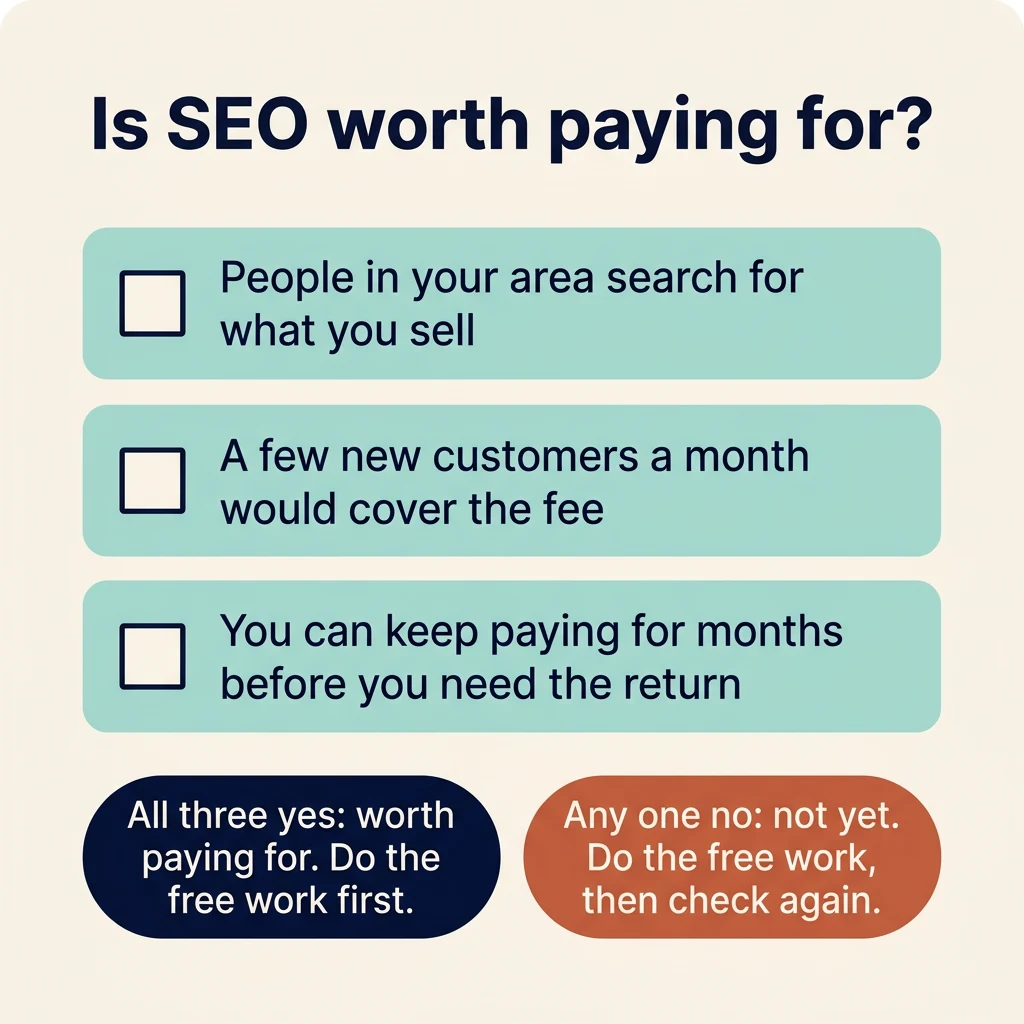
SEO is worth paying for when three things are true for your business: people in your area search for what you sell, a new customer is worth enough that a few new customers a month would cover the fee, and you can pay for six to 12 months before you need anything back. If any one of those is missing, SEO is not worth paying for yet. Whether or not all three hold, the free work further down this page comes first. findanseoagency.com publishes guides on SEO and AI search agencies written for the person buying, not the person selling, and this one is for the owner who keeps getting SEO pitches by email, or who paid for SEO once and got nothing they could point to.
The rest of this answer depends on your own numbers, and you can work them out in a few minutes. If you run an online store, a software company, or a website that earns money from traffic, the math is different and this guide does not cover it.
What does “SEO” mean in 2026?
SEO is the work of getting your business found when someone searches for what you sell. For a long time that meant one place, the regular Google results. Those are called organic results because nobody pays for the click. For a local business it also means the map pack, which is the box with a map and three business listings that Google shows for a search like “plumber near me.”
Now it also means AI search. AI search is the answer written out by an AI assistant when someone asks a question instead of scanning a list of links. On Google, that answer is called an AI Overview when it appears above the regular results, and AI Mode when someone uses Google’s chat-style search. ChatGPT and Perplexity give the same kind of answer. This matters for a local business because 45% of consumers say they have used ChatGPT or a similar AI assistant to get local business recommendations, up from 6% a year earlier. Being cited or recommended in those answers is part of SEO now, and the same work earns both a Google ranking and a mention in an AI answer: useful pages on your site, a complete Google Business Profile, and steady reviews. Some agencies sell this part under the name GEO, short for generative engine optimization. GEO is a name for one part of SEO, not a separate service you need to buy, and the complete guide to GEO explains how AI search chooses what to cite.
There is one more thing to know before you judge results later. When an AI summary appears at the top of Google, people click a regular search result about half as often as when there is no summary. A customer can read your name and phone number in that summary and call without ever opening your website. So the thing to count is calls and leads, and website visits matter less than they used to.
When does SEO pay back? The three things to check
Three things decide whether SEO pays back for a business your size. The first is a check that takes five minutes, and the other two are numbers you already have.
Do people in your area search for what you sell?
Some businesses get every customer from referrals, from a busy street, or from a network they built over 20 years. For those businesses search barely matters, and no amount of SEO changes that. The way to find out takes about five minutes. Open Google and type the searches a customer would type: “emergency plumber” plus your town, “dentist near me,” “roof repair” plus your town. Look at what comes up.
If you see a map pack with three competitors, ads above it, and other local businesses in the results below, people are searching, and your competitors are already spending money, on ads or on SEO, to show up there. If the results are mostly national directories and almost no local businesses, nobody nearby has found it worth competing for that search, which usually means few people are searching for it. Do this for each of your main services, because demand differs from one service to the next. Then type two or three of the same questions into ChatGPT or Google’s AI Mode and see whether any local businesses get named. If competitors are named and you are not, that is a gap SEO can close.
What is a new customer worth to you?
The second number is what one new customer is worth over the time they stay with you. Count the first job, any repeat work, and the people they send you. Use the money you keep after your costs, not the invoice total. A dentist’s new patient who comes in twice a year for years is worth far more than the first visit. A one-time $150 job with no repeat work is worth $150 minus what it cost you to do it. The check is whether a few new customers a month, at that value, would cover a monthly SEO fee. Write the number down, because the example below uses it.
Can you fund six to 12 months without needing the return?
The third thing to check is whether you can keep paying for a while with little coming back. SEO takes months to bring the first new customers and longer to pay for itself. So the question is whether the business can pay the fee every month for six to 12 months while what search brings in is still less than the fee. If paying for SEO means you need it to bring in customers by month two to make payroll, you cannot afford to wait that long. Ads or the free work below are the better place for that money right now.
A worked example
Picture a plumber who pays $1,000/month for SEO and gets the first new jobs from search in month six. That is $6,000 out before anything comes back. Say a new customer is worth $500 to that plumber, counting the first job and a repeat call. The plumber needs 12 new customers from search just to get back the first six months of spending, and after that needs two new customers a month to cover the fee. If search brings four or five new customers a month by the end of the first year, SEO pays back and keeps paying, because the pages and reviews that brought those customers stay in place. If search brings one new customer a month, it does not pay back, and the plumber should be able to see that by month six.
Run the same math with your own fee and your own customer value; the plumber’s figures are made up for the example. One number nobody can give you in advance is how many new customers search will bring each month. No survey can tell you, because it depends on your town, your competitors, and your reviews. So work the math the other way around. Divide your monthly fee by what a new customer is worth. The answer is how many new customers a month search would have to bring just to cover the fee. If that comes out to two or three, it is a small enough number to test. If it comes out to 20, the fee is too high for what a customer is worth to you. By month six you will have the real number, and the section below on telling whether SEO is working covers what to look for.
When is SEO not worth it, or not worth it yet?
Some situations look borderline but come out clearly against paying for SEO right now. In each case there is a better use for the money.
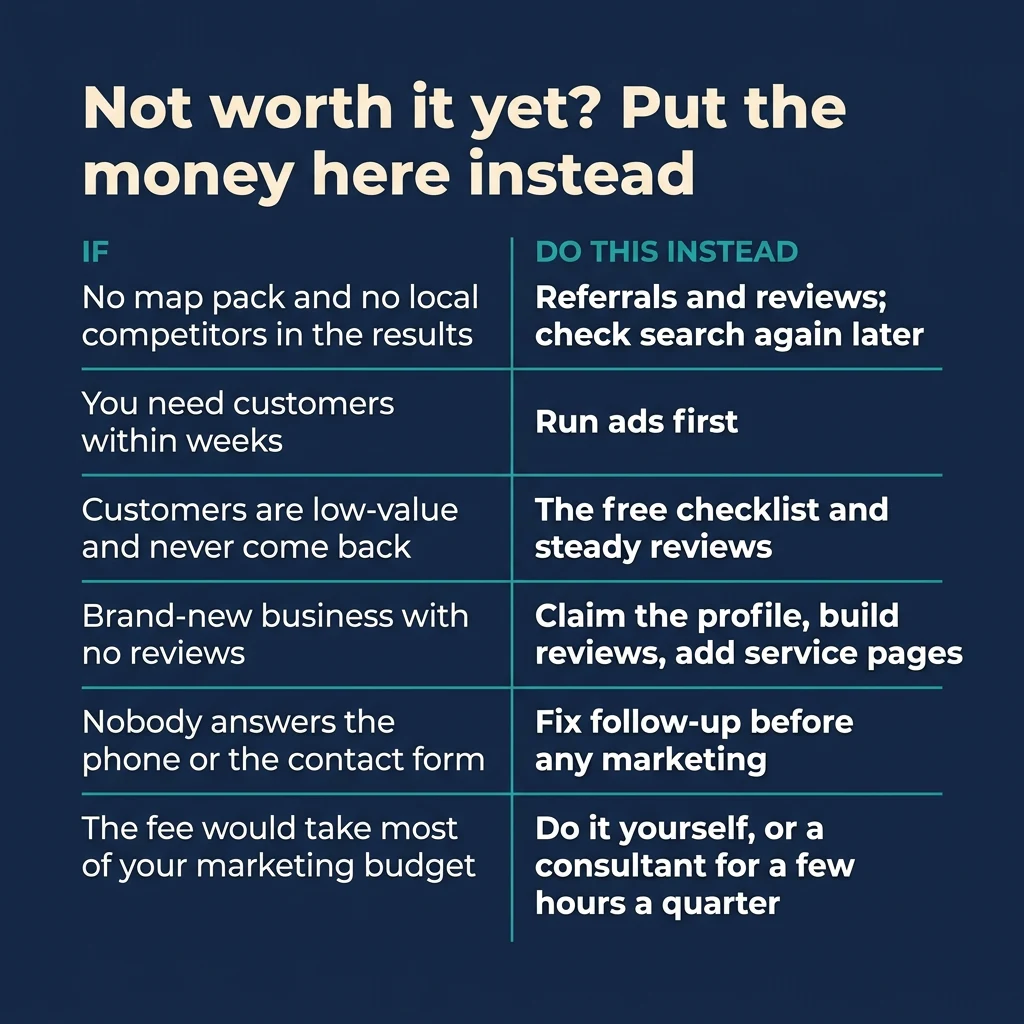
If the five-minute search check found no map pack and no local competitors, put the money into referrals and reviews, and check again in a year. If you need customers within weeks, run ads first; the section on SEO or Google Ads below covers how to run both.
A customer worth $40 who never comes back is another clear case. The math rarely works at any monthly fee, because a business like that needs a lot of new customers every month to cover even a low-end plan. Do the free checklist below, keep asking for reviews, and revisit SEO if you add a higher-value service or find that repeat business is stronger than you thought.
A brand-new website or business, with no reviews and no track record, takes longer than the usual three to six months to show results. The free work is the right first step here: claim the Google Business Profile, build reviews, and get a page up for each main service. Once those are in place and reviews are coming in, paid SEO has something to build on.
If nobody is available to answer the phone or reply to messages from your website, SEO produces calls that go to voicemail and forms nobody answers, and the caller phones the next business on the list. Fixing follow-up costs nothing and should happen before any marketing, paid or free.
The last case is a marketing budget so small that the SEO fee would take most of it. A budget like that only covers the cheapest plans, and the cheapest plans are the ones owners are most often unhappy with. An older Backlinko survey of business owners (the data is from 2019) found that unhappy customers were far more common at the low end: owners spending under $500/month on SEO were 75% more likely to say they were dissatisfied than owners spending more. At that budget, do the free checklist yourself or pay a consultant for a few hours a quarter, and revisit a monthly plan when the budget grows. A plan priced under $500/month can still make sense later, as a small piece of a bigger budget, when you know exactly which tasks it includes.
How long does SEO take to work?
SEO takes months, not weeks. Three to six months was the most common answer when Ahrefs polled people on LinkedIn and X about how long SEO takes to show results, and Ahrefs adds that there is no fixed timeline. A meaningful return, meaning enough new customers to cover the fee, usually takes longer than the first results. Backlinko’s report on SEO services says many campaigns need six to 12 months just to break even. So for many small businesses, the point where SEO has paid for itself falls somewhere in the second half of the first year.
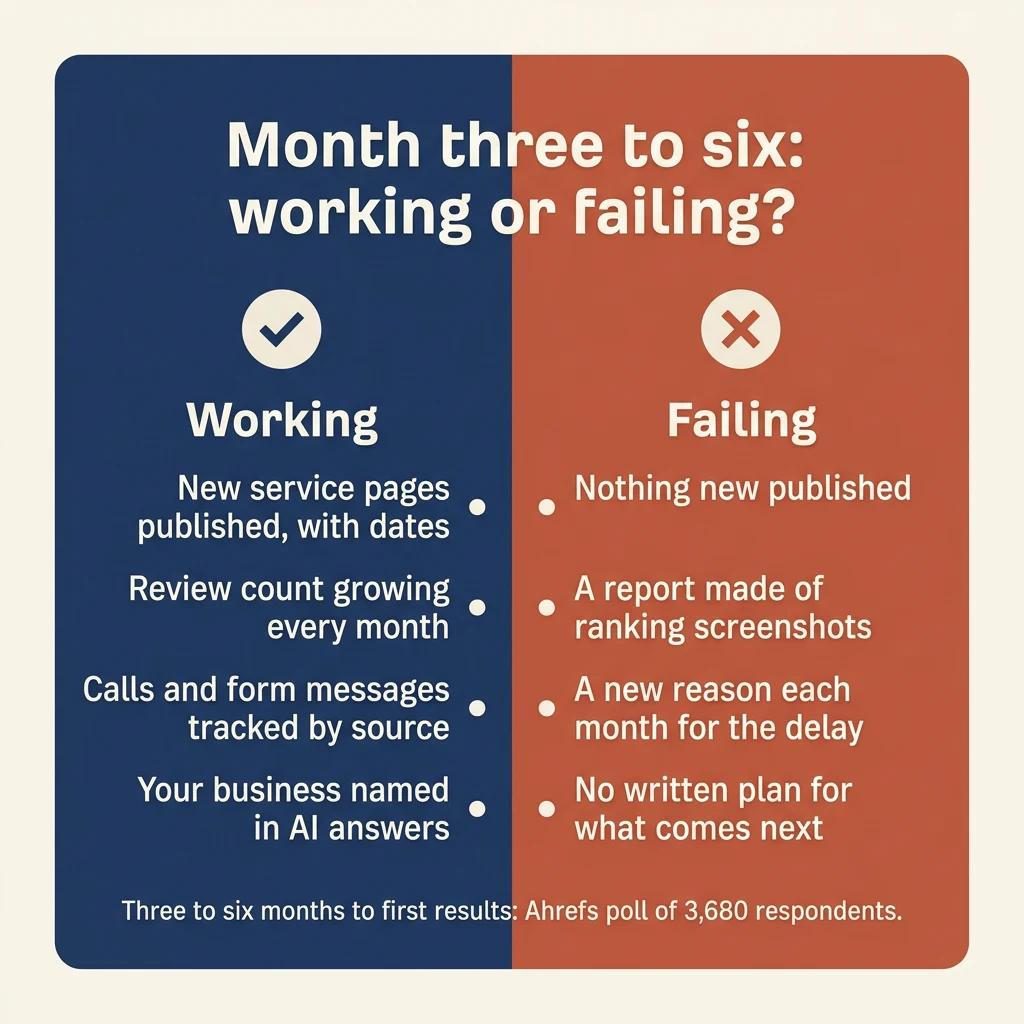
You can tell whether the work is being done long before the rankings move, so you do not have to wait six months to find out you are paying for nothing. When the work is real, the first months look busy. The Google Business Profile gets completed and corrected. New service pages go up on the website every month. Reviews start coming in steadily. Phone calls and contact-form messages get tracked so that you and the provider can both see where leads come from. All of that is visible in month one and month two, even while rankings are flat. When the work is not real, the first months look quiet: no new pages, no changes you can see, and a report full of ranking screenshots.
A promise of results in 30 days is a warning sign. No provider controls Google’s rankings or what an AI assistant names, and Google’s own advice to business owners says plainly that no one can guarantee a #1 ranking on Google.
What does SEO cost a small business?
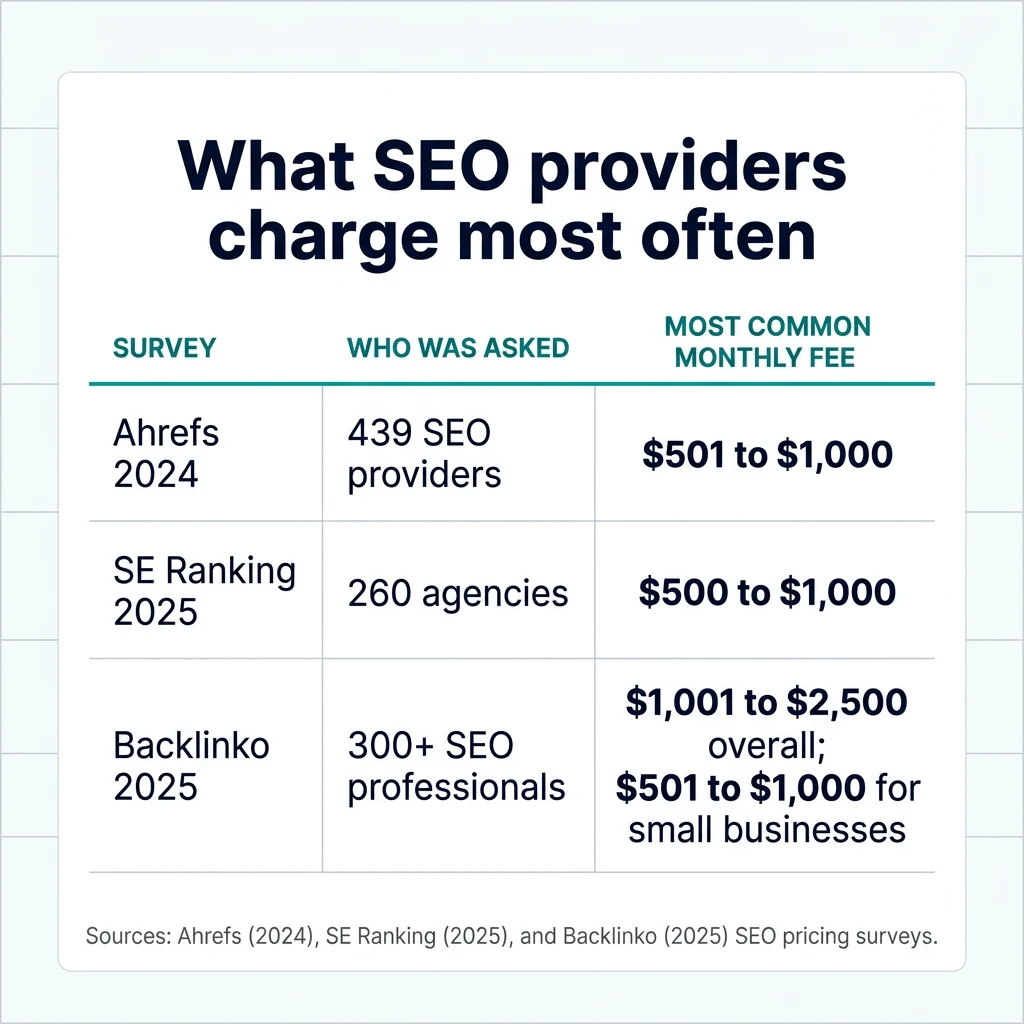
As of September 2026, most small-business SEO plans run about $500 to $1,000/month. That is the most common monthly fee in two of the three surveys this site relies on, Ahrefs’ 2024 survey and SE Ranking’s 2025 survey. The third, Backlinko’s 2025 survey, puts the most common fee overall higher, at $1,001 to $2,500/month, and lists $501 to $1,000/month as the usual range for an established small business with a simple website. Each survey asked a different group of providers, so treat $500 to $1,000/month as a range rather than one number, and expect plans above and below it. In the Ahrefs survey, roughly seven in 10 providers charge $2,000/month or less. At a few hundred dollars a month, expect templated work, meaning a fixed set of tasks run the same way for many clients, with a monthly report. That is how a provider keeps the price that low. Roughly $1,000 to $2,500/month should buy pages written for your specific services and a plan built for your market.
Should you do SEO or Google Ads first?
Ads bring customers right away. You set a budget, the ad runs, calls come in the same week, and they stop the day you stop paying. SEO takes months, and its results build on each other: a page that ranks keeps bringing calls without a charge per click, and the reviews and listings stay in place.
If the business needs customers this month, ads come first. Many small businesses run a small ads budget while the SEO work builds, then trim the ads as calls from organic search and AI answers grow. SEO sales pitches often quote a return-on-investment percentage. Those figures generally come from agencies’ own client numbers rather than independent research, so do not use them to choose between SEO and ads.
What can you do free before paying anyone?
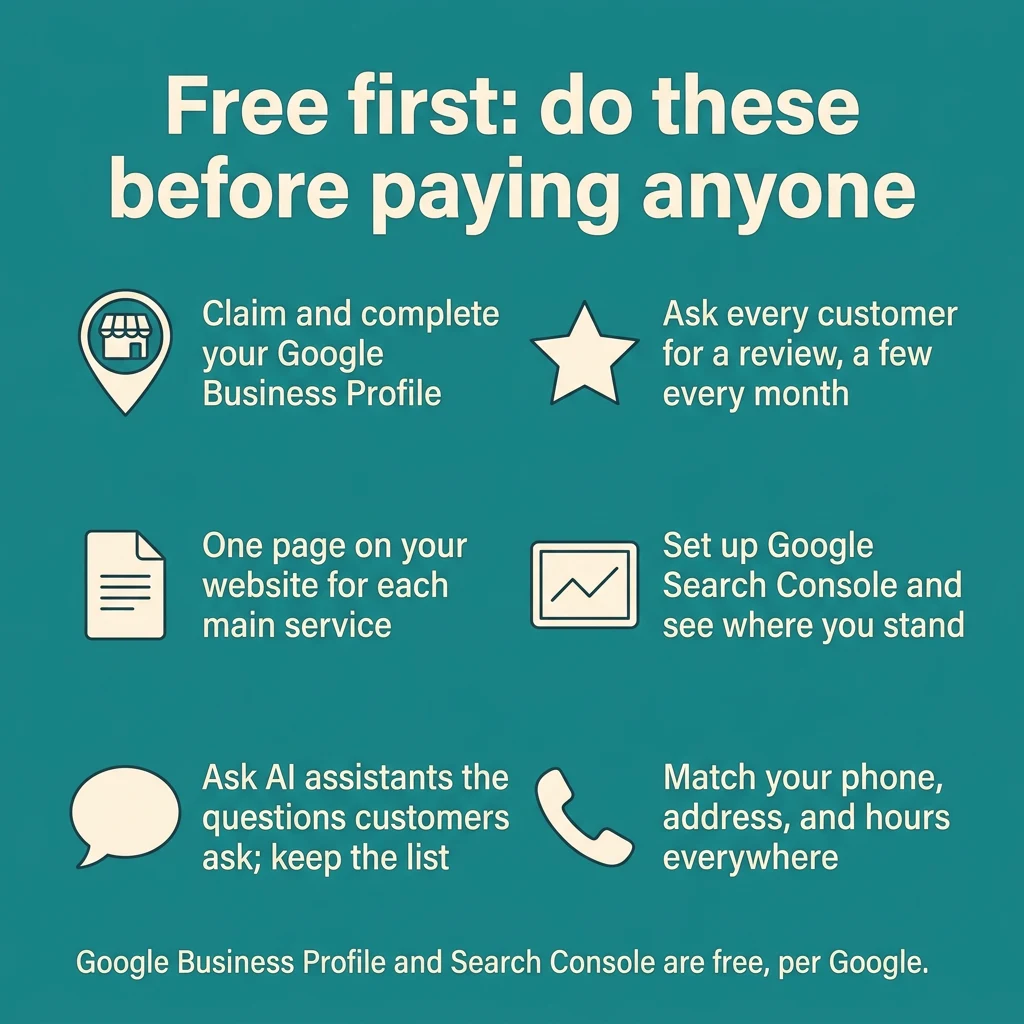
Most of the highest-value SEO work for a small local business is free. Doing it first shows you where you stand before you pay anyone, and it leaves any provider you hire later with less to charge you for.
- Claim and complete your Google Business Profile. Creating and managing a Business Profile is free. Pick the right primary category, list every service, set accurate hours, and add real photos. You do not need to post updates to the profile every week; posts have no measurable effect on visibility.
- Ask every customer for a review, at a steady pace. Google’s review rules do not allow asking only the customers you expect to be happy. A few new reviews every month matter more than a big total from two years ago, because recent and steady reviews carry more weight.
- Make sure your website has a page for each main service. Each page should answer the questions a buyer asks before calling, in plain words: what the service is, what it usually costs, how long it takes, and which areas you serve.
- Set up Google Search Console. It is a free service from Google that shows which searches already bring visitors to your site, so you can see where you stand before anyone sells you a fix.
- Type 20 to 30 questions a real customer would ask into ChatGPT, Google AI Mode, and Perplexity, such as “who does emergency furnace repair in [your town],” and write down which businesses get named. Keep the list. In six months you can ask the same questions again and see whether your business is named.
- Fix the basics a customer would notice. Your phone number, address, and hours should match on your website, your Google Business Profile, and any directory that lists you.
How can you tell at month three to six whether SEO is working?
A real report shows calls, form fills (the report’s word for messages sent through your website’s contact form), and leads that came from organic search and from AI answers, with rankings and traffic as supporting detail rather than the headline. Rankings are a means to those calls, and traffic counts less than it used to now that AI summaries answer many searches before anyone clicks.
By month three to six, you should be able to point to all of the following:
- New service pages published on your website, with dates
- A complete Google Business Profile and a review count that has grown every month
- Tracked phone calls and contact-form messages, separated by where they came from
- A list of the AI questions where your business is now named, compared against the list you made at the start
- A written plan for the next 90 days
When SEO is working but has not paid off yet, you can see the work being done and the first leads starting to arrive, even if the numbers are small. When it is failing, nothing gets published, the report is made of ranking screenshots, and there is a new reason each month for why results are coming soon. Three questions settle it at the review meeting: What did you publish or change this month? How many calls and contact-form messages came from organic search and AI answers, and how do you know? What happens in the next 90 days?
How can you tell a real SEO provider from the cold emails?
Google publishes its own warning signs for choosing an SEO provider. Google says to “be wary of SEO firms and web consultants or agencies that email you out of the blue,” that “no one can guarantee a #1 ranking on Google,” and to “be careful if a company is secretive or won’t clearly explain what they intend to do.” A provider that found “critical errors” on your site without you asking, promises a position, or will not say what it does each month has done exactly what Google warns against.
The second thing to check is who owns your accounts. Your domain, your hosting, your Google Business Profile, your Google Analytics, and your Google Search Console should all stay in the business’s name, with the provider added as a user or manager. Google tells agencies to make the business owner the owner of the Business Profile and make themselves the manager. A provider that insists on holding any of those accounts in its own name has made it hard for you to leave, and that is reason enough to say no. The full list of questions to ask before signing is in the guide to choosing an SEO agency for AI search.
Who should you hire at this budget?
The right kind of help depends on where your marketing budget sits.
If your marketing budget is under about $2,000/month
At this budget, a full agency plan is usually a poor fit, and there are four other ways to get the work done.
A freelancer or an independent consultant, hired for a few hours a month, can set the plan and check the work, with you or someone on your staff doing the work itself. The most common hourly rate for SEO providers is $75 to $100, and freelancers (one person working alone, rather than a consultancy or an agency) often charge less than agencies and consultants do, so a few hours a month costs a few hundred dollars. A one-time strategy plan works when you want a written roadmap and are willing to carry it out yourself over the year. A fixed piece of work at a fixed price (some providers call this a productized service) works when you already know exactly what you need, such as a set of service pages or a cleanup of your listings. And doing it yourself with the free checklist above is a real option, especially for a new business that needs reviews and a complete profile before anything else.
Three vendors focus on small-business SEO at this budget and state their prices publicly. As of September 2026, Boostability’s Local SEO Starter plan is listed at $299/month, The HOTH’s managed SEO starts at $1,000/month, and On The Map Marketing describes its local SEO campaigns as running $750 to $2,500/month. Expect the plans at the low end of those ranges to be templated, meaning a fixed set of tasks run the same way for many clients, which is how the price stays low. Plans under $500/month are also the ones the Backlinko survey above found owners most often unhappy with, so a plan at that price makes sense only when you have asked exactly which tasks it includes, those are the tasks you need, and the fee is a small part of your marketing budget rather than most of it. On The Map Marketing does not list an AI search service.
If your business does about $1M a year or more
A business doing roughly $1M a year or more, able to pay $1,900/month or more, and wanting AI search visibility specifically, is the kind of business TJ Digital takes on. Its plans start at $1,900/month, and at that price the plan includes about three to four pieces of content a month plus ongoing outreach and optimizations. There is no long-term contract. TJ Digital screens for businesses around $1M or more in revenue, and it has run a waiting list of two to six months through 2026. The contact page does not publish the current wait, so plan on joining the list and hearing back when there is room. The waiting list is at tjrobertson.com/contact. For a business below that size, the options in the section above are the better fit.
Frequently asked questions
Is SEO worth it for a small business with a small budget?
It can be, when people search for what the business sells, a new customer is worth enough that a few new customers a month would cover the fee, and the business can pay for six to 12 months before seeing a return. If the SEO fee would take most of the marketing budget, only the cheapest plans fit, and those are the plans business owners most often report being unhappy with. Do the free work first, then decide whether to pay for more.
Is SEO still worth it now that AI answers questions?
Yes, because being named in AI answers is part of SEO now, and the work that earns it is the same work that earns Google rankings. People click regular results less often when an AI summary appears, so the right measure has changed from website visits to calls, leads, and how often AI assistants name the business. The site’s AI optimization guides cover this in more depth.
How long before SEO pays for itself?
First results most often take three to six months, and paying for itself takes longer: for many businesses, somewhere in the second half of the first year. The exact point depends on the monthly fee, what a new customer is worth, and how many new customers search brings in each month. A plumber paying $1,000/month who values a new customer at $500 needs two new customers a month from search just to cover the fee, and more than that to earn back the early months.
Where to go next
Once the three checks above come out in your favor, SEO is worth buying, and the next step is choosing who does the work. The guide to choosing an SEO agency for AI search covers the questions to ask before signing, and the site’s strategy guides cover the rest of what a first-time buyer needs to know.