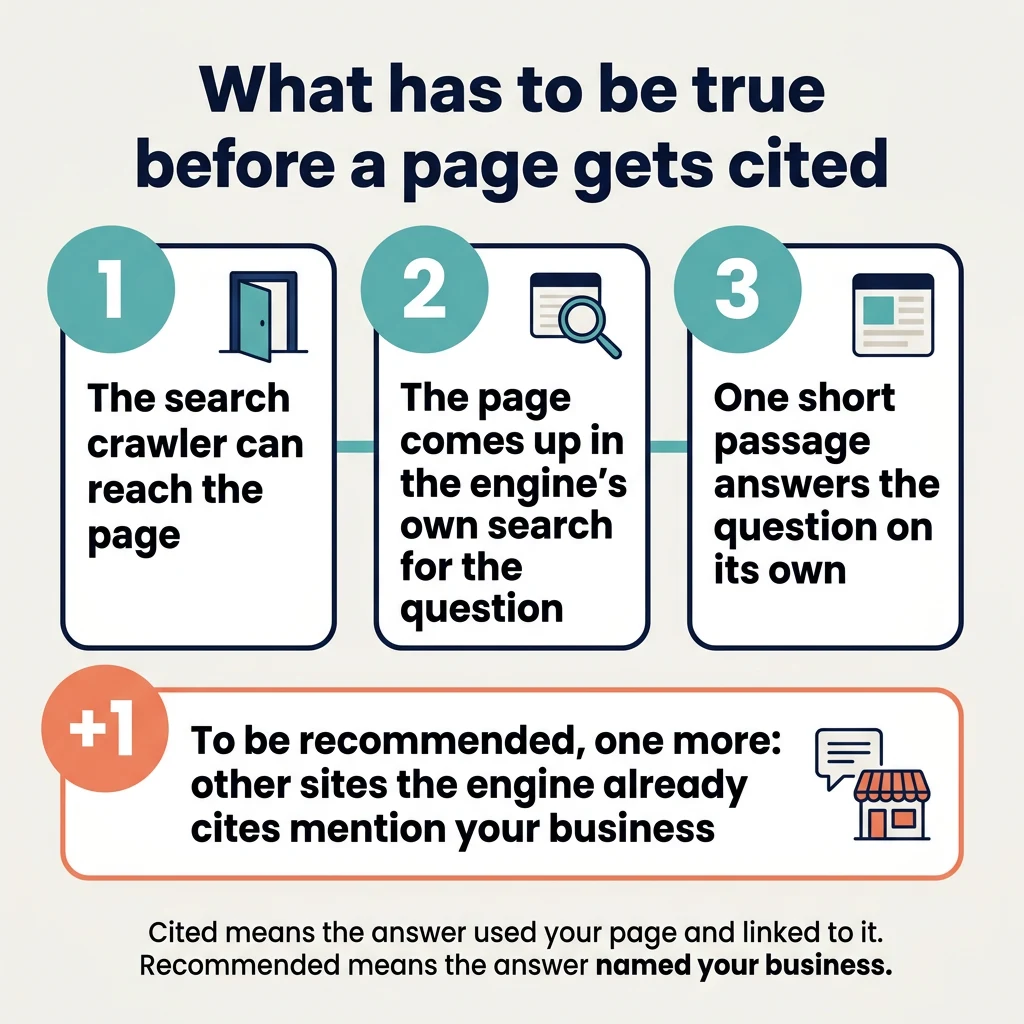
ChatGPT cites a page when three things are true. Its search crawler can reach the page. The page comes up when ChatGPT searches the web for the question it built from the user’s prompt (ChatGPT rewrites the prompt into its own search before it looks, so that search is rarely the user’s exact words). And the page holds one short passage that answers that question on its own, so ChatGPT can lift the passage, meaning quote it in the answer and link to the page. When the question is which company to use, there is a fourth part: ChatGPT leans on what other sites say, such as directories, review sites, and discussion threads, so a mention of your business on the sites it already cites counts for more than one more backlink pointing at your site.
Cited, ranked, and recommended are three different things. Being cited means an AI answer used your page as a source and linked to it. Ranking means your page appears in a list of search results for a keyword. Being recommended means the answer names your business as the one to call. Steps 1 and 2 get a page cited. Step 3 gets a business recommended, because the engines rely on what other sites say about a business, such as reviews, discussion threads, and independent publishers, when they decide which businesses to name. All of it is the same work ordinary SEO asks for, with getting cited added as one more goal, and the same work earns citations in ChatGPT, Perplexity, and Google’s AI Overviews and AI Mode.
How does ChatGPT decide what to cite?
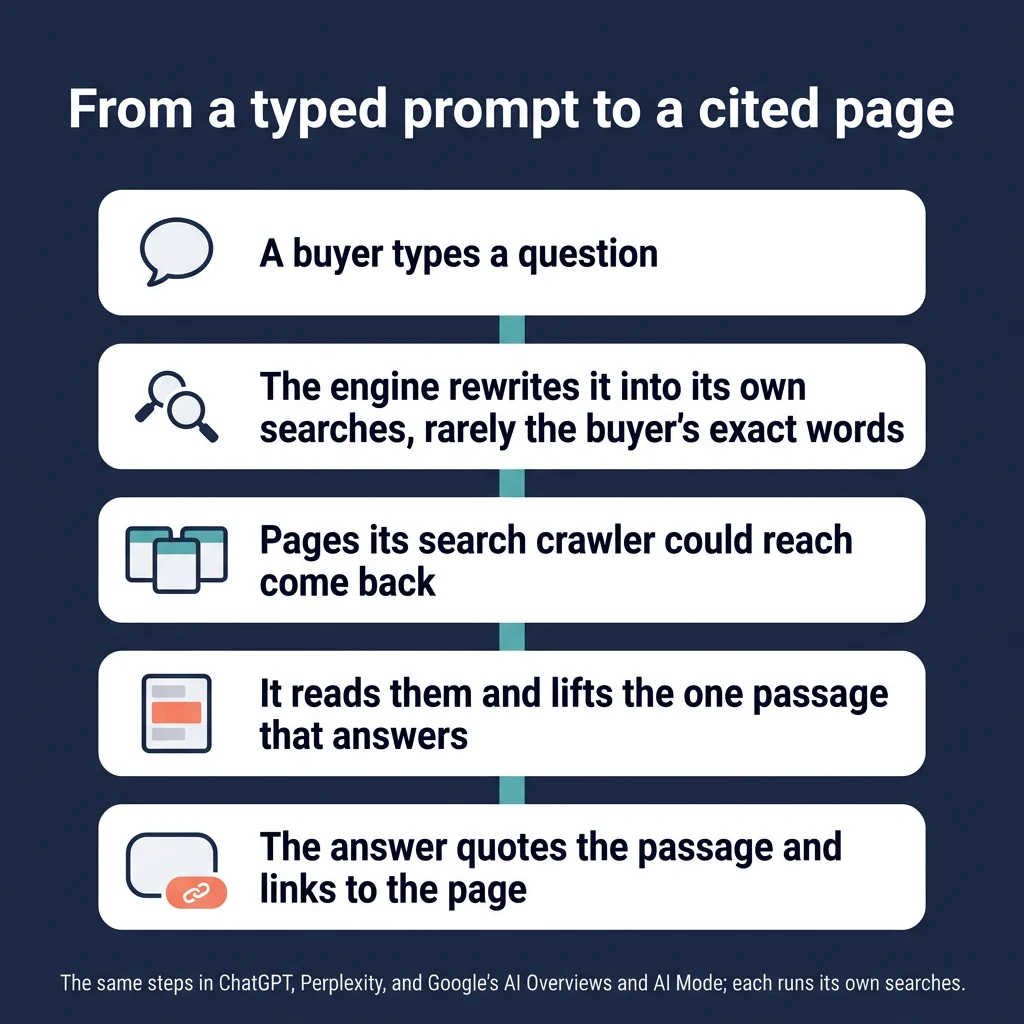
ChatGPT answers most questions from what its model already knows, and those answers carry no links. It searches the web when it decides the question needs current information, or when you turn search on yourself from the tools menu; search is on every plan, including the free one. When it searches, it sometimes sends your question to a partner search provider, and when it does, it usually rewrites the question into one or more targeted searches first. OpenAI’s own search crawler, OAI-SearchBot, finds the websites that can show up in ChatGPT’s search results. ChatGPT reads the pages that come back and writes an answer that may include links to the pages it used. OpenAI’s help page on ChatGPT search describes how the partner searches and the citations work, and it notes that the citations can be incomplete or out of date. ChatGPT search has been open to all logged-in users since December 2024.
Perplexity does not answer from memory. It searches the live web for every answer and shows numbered sources by default, so every Perplexity answer carries citations.
Google’s AI Overviews and AI Mode use Googlebot and the normal search index, so nothing separate has to happen for your pages to be eligible. They run several related searches on the question (Google calls this query fan-out) and show links to the pages they drew on, which is why the links in an AI answer often differ from the standard list of results for the same keyword.
A new page can be cited within days or weeks of going live, because the engines search the live web each time and do not wait for the model to be retrained. In one Semrush test, new pages on a well-established site picked up ChatGPT citations from the first day.
Only one of OpenAI’s crawlers decides whether your pages can appear in ChatGPT search answers, and it is OAI-SearchBot. The crawler that fetches a page for a single user may ignore robots.txt, but it has no say in what appears in search; OAI-SearchBot does. Perplexity works the same way: its search crawler, PerplexityBot, is the one that decides.
| Crawler | What it does | What blocking it stops |
|---|---|---|
| OAI-SearchBot | Finds pages to show in ChatGPT search results and citations | Your pages stop appearing in ChatGPT search answers, though OpenAI says your site can still appear as what it calls a navigational link |
| ChatGPT-User | Fetches a page when a user asks ChatGPT about it, or when a custom GPT needs it | Very little: it is not used to decide what appears in search, and robots.txt rules may not apply to it |
| GPTBot | Collects content that may be used to train OpenAI’s models | Training use only; it has no effect on citations |
The table follows OpenAI’s own description of its crawlers.
Step 1: Can the crawlers reach your pages?
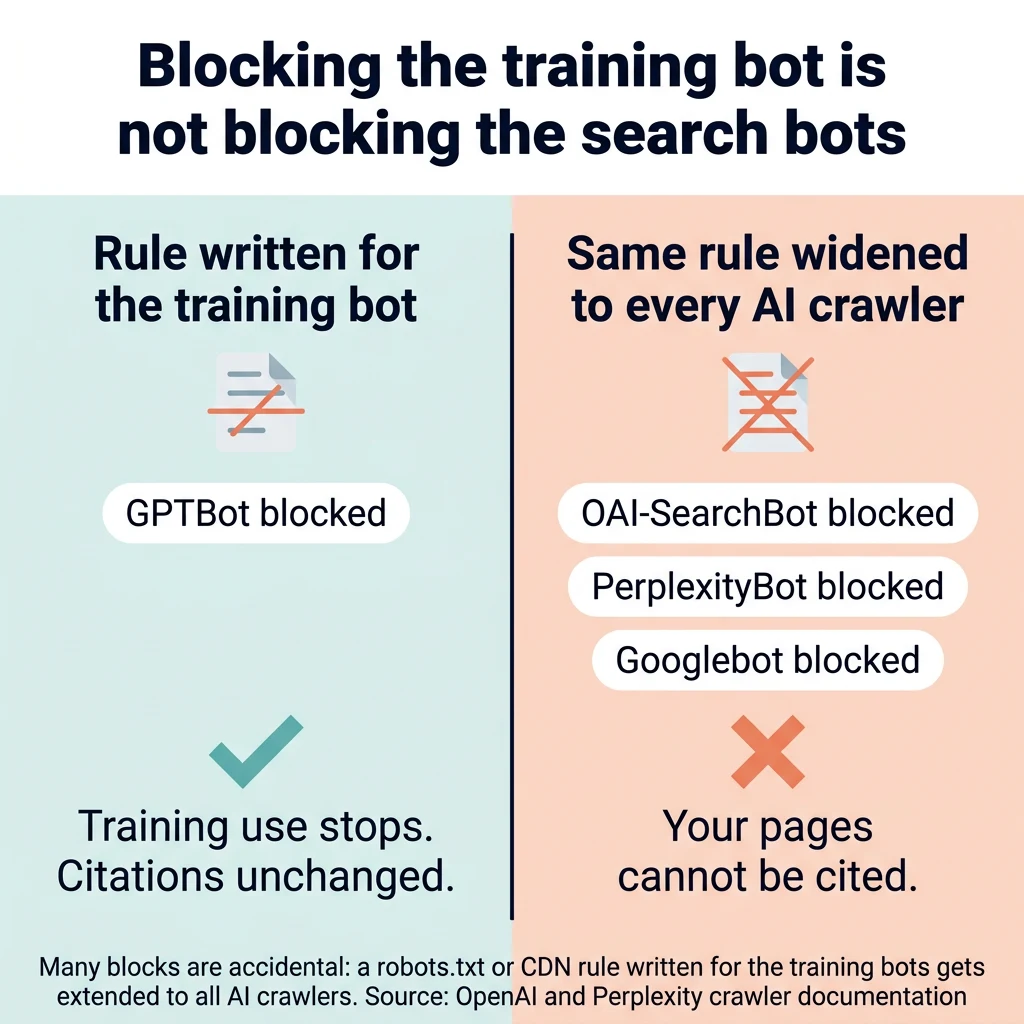
A page the search crawlers cannot fetch cannot be cited, however good it is, so access is the first check. OpenAI’s rule for eligibility in ChatGPT search is that OAI-SearchBot can crawl the site and that the host or content delivery network allows traffic from OpenAI’s published searchbot addresses. Many blocks are accidental. The training bots are the most commonly blocked crawlers, and a robots.txt rule written to block them often gets extended to every AI crawler, which blocks the search bots too. Five checks cover it:
- robots.txt does not block OAI-SearchBot, PerplexityBot, or Googlebot. Blocking GPTBot alone stops training use and changes nothing about citations. A robots.txt change takes about a day to take effect with OpenAI and with Perplexity.
- Your CDN or bot protection is not blocking the search crawlers. Some hosts, Cloudflare among them, block AI crawlers by category (training, agent, or search), so check which category your account blocks and make sure search is allowed.
- No login, paywall, or cookie wall stands in front of the pages you want cited. The crawler sees what a logged-out visitor sees.
- The main content is in the page’s HTML when it loads. Content added afterward by a script may never be read.
- Your server logs or your host’s analytics show visits from OAI-SearchBot, PerplexityBot, and Googlebot. If OAI-SearchBot never appears in the logs, something upstream may be blocking it, and a block is the first thing to check for.
The technical basics of how AI search engines fetch and read pages are in the site’s guide to GEO (GEO, short for generative engine optimization, is the name for the AI search side of SEO work).
Step 2: Does your page have a passage the engine can lift?
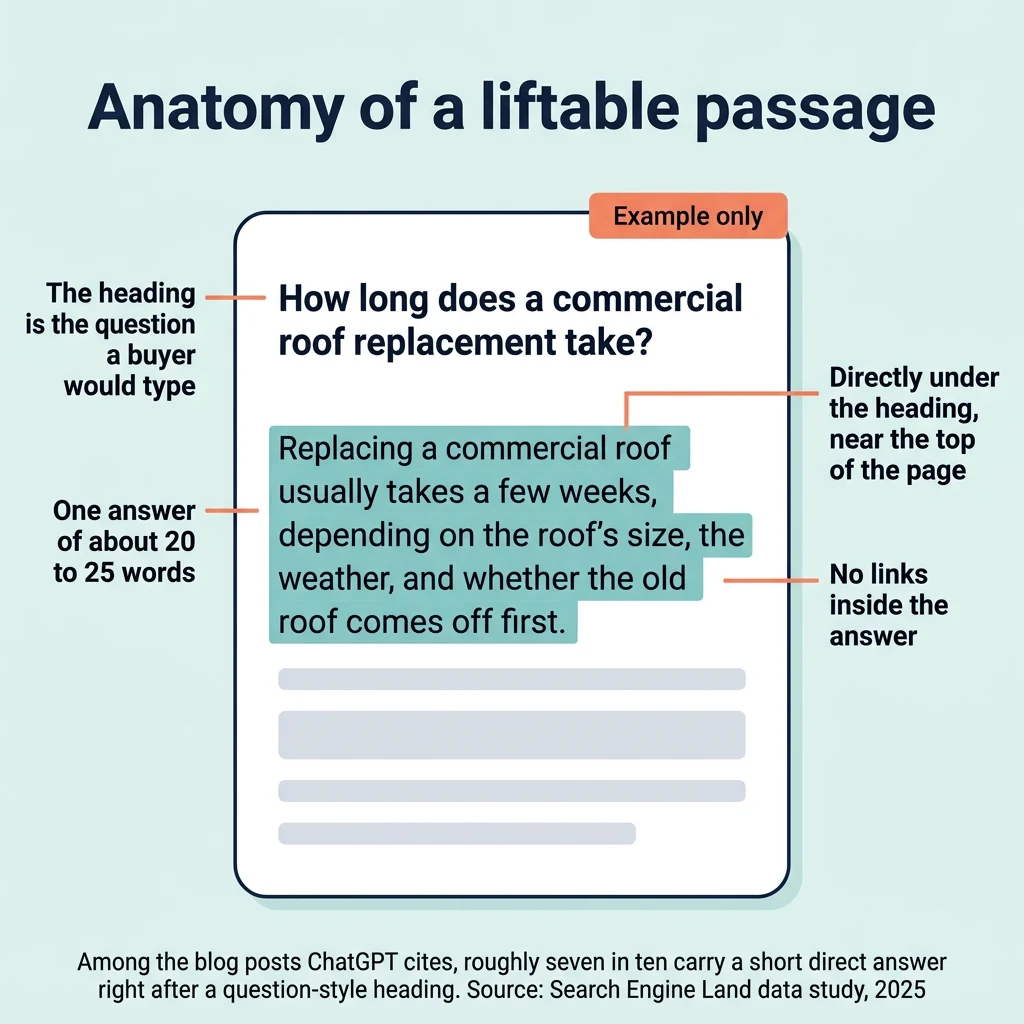
An AI search engine links to a whole page, and what usually earns the link is one passage on it. It searched for a specific question, and it wants the few sentences that answer that question on their own, without the rest of the page around them. Among the blog posts ChatGPT cites, roughly seven in ten carry a short direct answer placed right after a question-style heading, usually about 20 to 25 words long. In a separate study, 44% of ChatGPT’s citations came from the first third of the page. More than half of the cited posts include original data or the publisher’s own insight.
The question to answer is the one the engine searches for, and that is rarely the buyer’s exact words. ChatGPT rewrites the prompt into one or more targeted searches, and Google’s AI Mode runs several related searches on the parts of a question. Start from your buyers’ real questions, written the way they would type them; Step 3 builds a list of 20 to 30 of these, and the same list serves here. Ask each question yourself with search on, note the searches the answer shows it ran, and write a page or a section for each search that keeps coming up.
A liftable passage looks like an answer a person could read on its own. As an illustration only, suppose a buyer asks how long a commercial roof replacement takes. Under the heading “How long does a commercial roof replacement take?”, the passage would read something like: “Replacing a commercial roof usually takes a few weeks, depending on the roof’s size, the weather, and whether the old roof comes off first.” That is one question, one answer of about 20 to 25 words, and no links. On a real page, the business would put its own figure in place of “a few weeks.” To give your own pages a passage like that:
- Put the direct answer to one specific question in a short passage, about 20 to 25 words, near the top of the page or directly under the heading that asks the question.
- Write headings as the question a buyer would type.
- Cover one question per section, so each passage answers one thing.
- Put comparisons in a table, with the options as rows and the points of difference as columns.
- Use dated, specific facts and your own numbers in place of adjectives: a stated average response time for this year says more than “fast response.”
- State your business’s own facts plainly on the page: what you do, who you serve, where, and since when.
Keep links out of the answer passage itself; most of the passages ChatGPT lifts contain none. Google says no special markup, files, or structured data are needed to appear in AI Overviews or AI Mode. If you use structured data for other reasons, it has to match what a visitor sees on the page. An llms.txt file is a proposed text file that lists a site’s content for AI systems; no AI search engine has confirmed reading one, and Google has said none does, so it is not on this list.
Does ranking well on Google get you cited?
Ranking helps, and it is not enough on its own. The share of cited pages that also rank in Google’s top 10 differs by engine. In one Ahrefs study, roughly 38% of the pages Google’s AI Overviews cited also ranked in the top 10. In a second Ahrefs study of the other engines, the share was about 29% for Perplexity and 8% for ChatGPT. The rest come from further down the results, or from pages that do not rank for the keyword at all.
The reason is in how the engines search. The engine looks for the question it generated from the user’s prompt, which is rarely the exact keyword you rank for, and it picks the passage that answers that question rather than the best-ranked page. A page ranked 30th for your keyword can hold the one paragraph that answers the rewritten question, and the page ranked first can have nothing liftable on it. The site’s guide to SEO vs. GEO covers which parts of ranking work carry over to citations and which do not.
Step 3: Are you mentioned where the engines already look?
Step 3 is the one that gets a business named in an answer, because the engines rely on what other sites say about a business when they decide which businesses to recommend. When a buyer asks which company to use, the engines favor pages that belong to someone other than the company, since a page a company writes about itself is not independent evidence. In mid-2025, Wikipedia accounted for about 16% of the sources ChatGPT named. Google’s AI Overviews leaned on YouTube, Wikipedia, Reddit, and Quora instead. Beyond the biggest names, the engines read customer reviews, community discussions, independent publishers, and industry sources to decide which businesses to recommend. Which sources they pick changes with the question: for “is it worth it” questions the engines cite review sites and aggregators, and for questions phrased the way a person would ask a friend they cite Reddit and forums. A mention on a source the engine already cites for your industry therefore counts for more than one more backlink.
The domain an engine cites most differs by engine, and it shifts over time. From August 2024 to June 2025, Reddit was the most cited domain in Perplexity and in Google’s AI Overviews. In ChatGPT over that period it came second, behind Wikipedia. A count of US searches in September 2026 put Reddit first in ChatGPT as well, with Wikipedia second. Which source leads differs by engine, so check each engine separately when you work out where to be mentioned.
Which sources matter for your business is specific to your industry and to the question, so build your own list of sources. Write down 20 to 30 real questions your buyers ask, the way they would type them. Ask each one in ChatGPT with search on, in Perplexity, and in Google AI Mode, and write down every source each answer cites. That list of sources does two jobs. The sites cited when your business is absent are the places to get mentioned, and the same questions, asked again each month, become the check in Step 4. The sources that come up for many of the questions are the ones worth earning a place on:
- Claim your listings on the directories that came up, and make sure the name, address, services, and description match your site.
- Keep reviews recent and steady. About 74% of consumers only care about reviews from the last three months, and 44% name a review being posted within the last month as an important factor, which is why a steady flow of new reviews matters more than a large total.
- Answer honestly in the discussion threads where your buyers ask, as your business, with the facts a buyer needs.
- Ask to be included in the “best of” roundup articles that already rank for “best” and “top” searches in your category and that came up in your list.
A paid directory listing can be worth the money when you count the citations it can earn and not only the visits it sends; “never pay a directory” is out-of-date advice. Bulk link buying is not recommended, because the goal is a mention on the specific sources in your list, and a bulk package of links cannot be aimed at those.
Step 4: How do you check whether it is working?
The check is the question list from Step 3, asked again once a month with the same questions. Ask each one in ChatGPT with search on (search is on every plan), in Perplexity, and in Google AI Mode, and note every source each answer cites. One conversation proves nothing, because the same question returns different pages on different days. In one Sistrix count of ChatGPT search in Germany, about three quarters of the domains cited for a question were replaced from one week to the next, and about 85% of the individual pages were replaced. The monthly check therefore scores whether your site or your listings appear at all across the question set, not which page appeared.
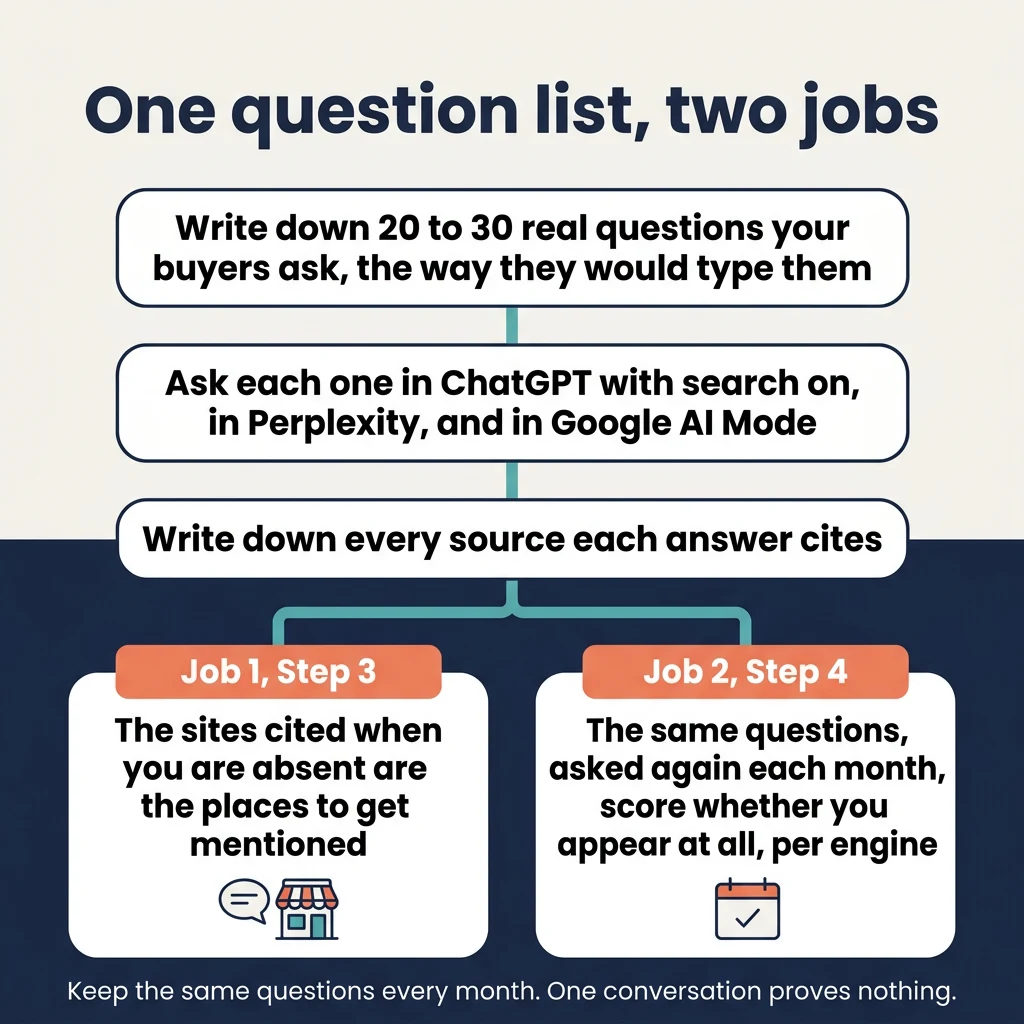
The check produces a score per engine and a list of sources; keep both from month to month:
- Keep the same questions every month; changing them makes the months impossible to compare.
- Score each engine separately: for each question, your site or a listing of yours was cited, or it was not.
- Record the domains cited when you were not. Those are the sites to get mentioned on in Step 3.
- Check analytics for visits from chatgpt.com. ChatGPT adds utm_source=chatgpt.com to the links in its answers, so those visits show up in Google Analytics and similar tools.
- If running the questions by hand each month is too much, there is a category of software called AI visibility trackers that runs a fixed question set on a schedule and reports the sources.
A page the crawlers can reach, with a clear answer on it, can start being cited within weeks; mentions and reviews take months. In one Semrush test of new pages on a well-established site, ChatGPT search cited about 10% on the first day and 42% within 30 days. Google AI Mode cited more than half within a week and had dropped many of them by day 30, so early citations can disappear again, and an early citation is a reason to keep checking. Mentions and reviews take months because other people have to publish them, and the engines then have to find them.
Does getting cited by ChatGPT drive traffic?
Being cited sends few visits, and on transactional sites the visits it does send have been worth more. Traffic from AI answers is a small share of a site’s visits next to Google search. In one Similarweb measurement of transactional sites, visitors sent by ChatGPT converted at about 7% against 5% for Google visitors, and they stayed roughly twice as long. The main value of being cited is being the source behind answers that buyers read and act on without clicking anything, and the visits are extra on top of that.
Mistakes that stop a page being cited
- Blocking the search crawlers, usually by widening a robots.txt or CDN rule written for the training bots.
- Gating the best pages behind a login, a paywall, or a cookie wall.
- Publishing pages that answer nothing specific, so there is no passage to lift.
- Putting every question on one long page, so no single passage answers the question the engine searched for.
- Listing business facts that differ from directory to directory and from your site.
- Deciding from one conversation that the work is paying off, or that it is not.
- Buying links or mentions in bulk instead of earning a place on the sources your list shows.
Frequently asked questions
Does ChatGPT cite sources in its responses?
Only when it searches the web. Answers written from the model’s memory carry no links. ChatGPT searches on its own when it decides a question needs current information, and you can turn search on yourself from the tools menu. A response that used search may include citations, and the Sources button, when it is available, lists the sources the answer cited.
How long does it take to get cited by ChatGPT?
A page takes weeks and mentions take months. A page the crawlers can reach, with a liftable answer, can be cited within days of going live, and in one Semrush test on a well-established site, 42% of new pages were cited within 30 days. Mentions on directories, review sites, and threads depend on other people publishing, so count on months for those.
How is getting cited by ChatGPT different from Perplexity?
The page rules are the same for both: the crawler can reach the page, the page comes up in the engine’s search for the question, and the page holds one passage that answers the question on its own. Perplexity searches the web on every answer and shows numbered sources by default, so every answer carries citations. The sources differ, though. Reddit has been the most cited domain in Perplexity, and ChatGPT’s most cited domain was Wikipedia in the mid-2025 counts and Reddit in the most recent count, from September 2026. The leader differs by engine, so check each engine on its own.
Does advertising help you get cited?
No evidence says so. OpenAI’s stated rule is that ads run on separate systems from the chat model, sit below the end of a response, and are labeled as sponsored, and that advertisers cannot shape or rank ChatGPT’s answers. An ad can put your name under an answer, and it does not make your page a source for one.
Does traditional SEO help with getting cited?
Yes. Crawlable pages, one clear answer per page, accurate business facts, and mentions on trusted sites are the same work traditional SEO asks for; getting cited is one more result that work produces.
Where to go next
The site’s AI search hub collects its guides on how AI search engines choose and cite sources. If your agency’s monthly report cannot show which buyer questions it tracks or whether your business appears in the answers, the guide to choosing an SEO agency for AI search lists the questions to ask before you sign.