
SEO is the work of getting your business found in search results. GEO, short for generative engine optimization, is the work of getting your business into the answers that AI search engines write, such as Google’s AI Overviews and ChatGPT. Being in an answer means one of two things. Your business is cited when the answer uses one of your pages as a source. Your business is recommended when the answer names it as one to consider.
GEO and SEO are not two separate services. GEO is what SEO has become now that search engines write answers instead of only listing links. The same pages and the same kinds of work earn rankings, citations, and recommendations. So you do not need to buy GEO on top of SEO. You need one SEO program that does both jobs, and the question to ask is whether the SEO you already pay for does the second job.
What do SEO and GEO each mean?
SEO, or search engine optimization, is the work of making your business show up when someone searches for what you sell. The parts of it you see are the pages on your site, the keywords those pages target, and the content you publish. It also covers the links and mentions you earn from other sites, and the monthly report that tracks where you rank and how much traffic you get.
GEO, or generative engine optimization, is the work of making your business show up as a source, and ideally by name, inside the answers that AI search engines write. You will also see the same work called AEO (answer engine optimization), AIO (AI optimization), or LLM optimization (an LLM, or large language model, is the kind of AI that writes the answers). Those are different names for the same job: getting a business cited and recommended in AI search answers. All of these engines work the same basic way. The engine searches the web, reads the pages it finds, writes an answer, and shows some of those pages as sources. That is how Google’s AI answers work, and it is how ChatGPT and Perplexity work too. For the full picture of what the work involves, read What is GEO? A complete guide to AI search optimization.
Why is everyone asking about GEO now?
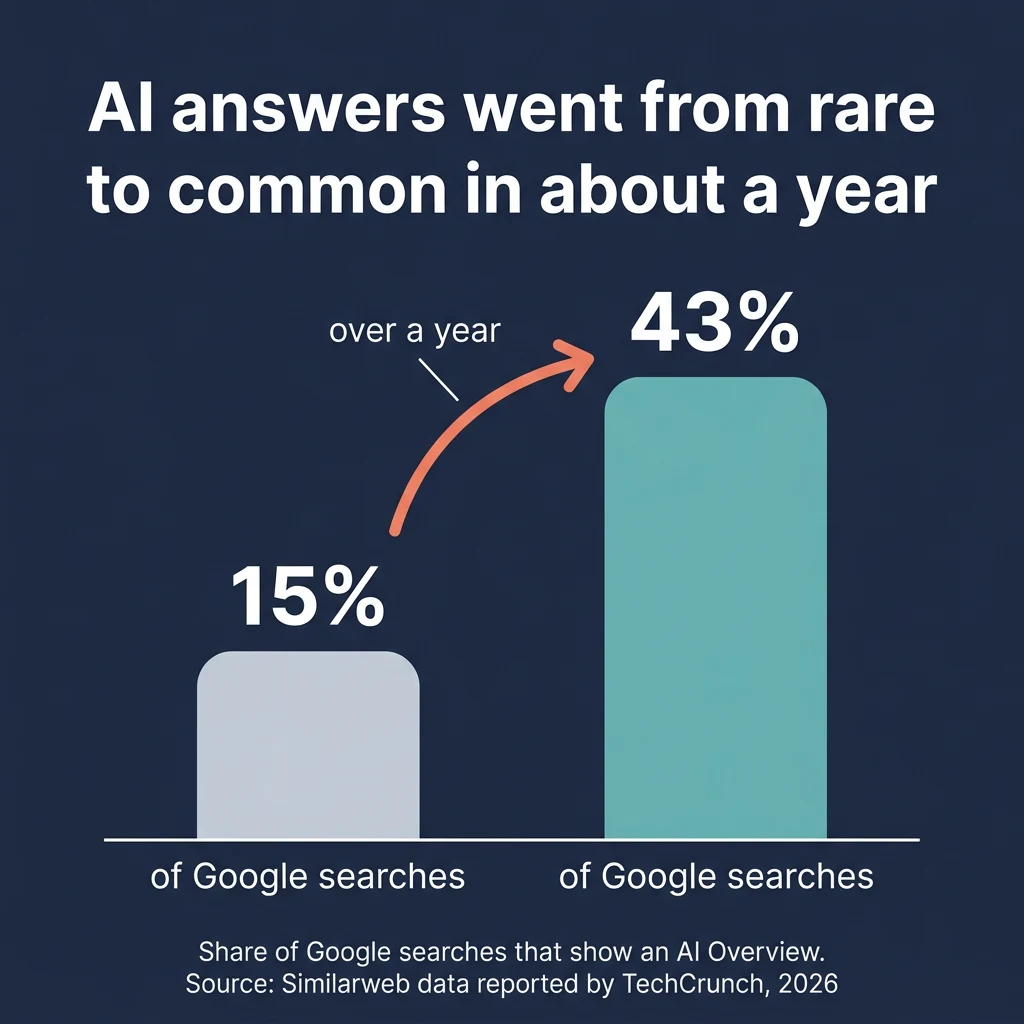
The question comes up now because AI answers went from rare to common in about a year. Google’s AI Overviews now have more than 2.5 billion monthly users, and ChatGPT has 900 million weekly users. One tracker found that AI Overviews went from showing on 15% of Google searches to 43% over a year. Clicks change when the answer appears. When Google shows an AI summary, about 8% of visits to Google end with a click on a regular search result. When there is no summary, 15% do. And only about 1% of visits with a summary include a click on a source link inside the summary. Two things follow from those numbers. A business that ranks well but is not in the answer gets fewer visits than it used to. And being in the answer still helps, even though almost nobody clicks the source links: the buyer reads the answer and sees your business in it, either as a page the answer used or as a business it named, whether or not they click anything.
What stays the same between SEO and GEO?
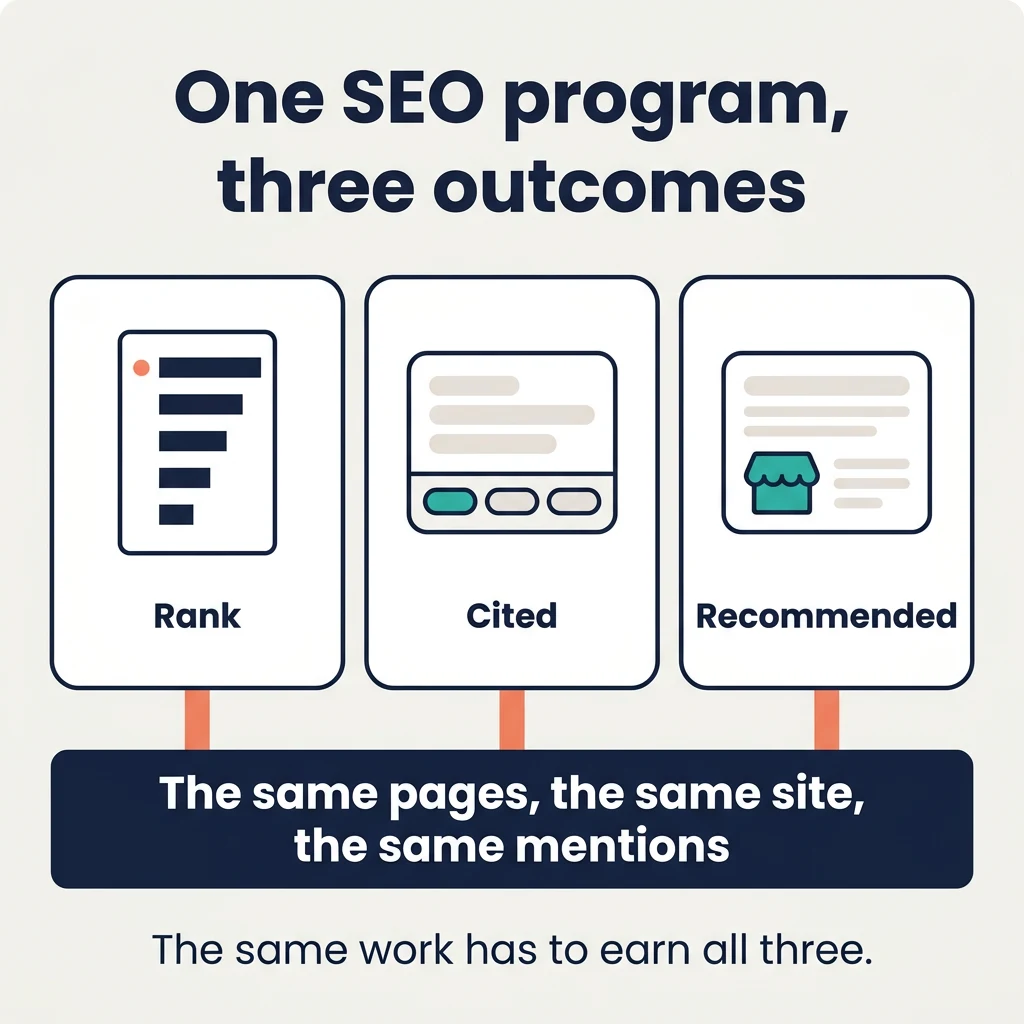
Most of the work does not change. Google finds pages with a crawler, a program that visits web pages and reads them, and it stores what it reads in an index. Google’s AI answers use the same crawler and the same index as regular search, and Google says there are no additional requirements or special optimizations needed to appear in AI Overviews or AI Mode. You do not need to add new files or new code to your site. A page that cannot rank at all is unlikely to be cited, because the engine has to find the page and trust it before it can use it. The fundamentals did not change. What changed is the outcome the work is measured against: a business now needs to rank, to be cited, and to be recommended, and the same work has to earn all three.
These are the pieces that still do the job:
- Content that answers the question a buyer is asking, on a page the buyer can find.
- A site the engines can crawl and read, with the text on the page rather than locked inside images or video.
- Correct facts about the business, on your own site and everywhere else it is listed.
- Mentions of your business on other sites.
- Pages that load well and work on a phone.
What changes with GEO? SEO for rankings vs. SEO that includes AI search
Some SEO work is still aimed only at rankings, the way all of it was when a results page showed only a list of links. That work has not adapted to a results page that also writes an answer, and this guide calls it legacy SEO. The table shows what changes when an SEO program takes on AI search as well.
| SEO aimed only at rankings (legacy SEO) | SEO that includes AI search | |
|---|---|---|
| The outcome the work aims at | A position in the list of results | A position in the list, plus being cited and recommended in AI answers |
| How success is measured | Rankings and traffic | Rankings and traffic, plus how often the business is cited or recommended for a set list of buyer questions |
| How a page is written and structured | Written to rank for a keyword and keep the reader on the site | Written to answer one question directly, near the top, in a paragraph that stands on its own |
| Where off-site effort goes | Getting more sites to link to yours | Getting mentioned and recommended on the sites AI answers already cite |
| What happens to the click | A high ranking earns the click | Fewer clicks reach any site; the buyer sees your business in the answer instead |
| What the monthly report should show | Rankings, traffic, and links earned | Rankings and traffic, plus citation and recommendation rates for the tracked buyer questions |
How success is measured
Rankings and traffic still get tracked. They still tell you whether people who click through a list of results can find you. The new measure is how often your business is cited or recommended when someone asks a real buyer question in an AI search engine. That gets tracked over time across Google’s AI answers, ChatGPT, Perplexity, and the others. That means picking a fixed set of questions your buyers actually ask, checking them on a schedule, and noting which sites the answers cite and which businesses they name.
One conversation proves nothing on its own. An AI system is not guaranteed to give the same answer twice, even to the same question. So a screenshot of one answer that names you, or leaves you out, is not evidence of anything. A pattern across many questions and many weeks is evidence. The set of sites an answer cites for a given question tends to stay mostly stable from week to week, so once a pattern shows up, you can trust it. Tools called AI visibility trackers run these checks for you, on more questions and more often than anyone would by hand. If you want to do it without paying for a tool, run 20 to 30 buyer questions by hand every month and write down which sites get cited and which businesses get named.
How pages are written and structured
AI answers are built from paragraphs rather than whole pages. The engine runs several searches around the question, reads the pages it finds, and pulls out the paragraphs that answer the question it is working on. Then it combines and rewrites those paragraphs into one answer, with links to the pages it used. So the pages that get used are the ones that answer a specific question directly, near the top, in a paragraph, a table, or a short question-and-answer pair that makes sense when read on its own. Headings that read like the question help, because they tell the engine what the paragraph underneath is about.
Pages built to hold a reader on the site for a long time work against this. A long warm-up before the answer, or an answer spread across the whole page, gives the engine no single paragraph it can use. Legacy SEO often rewarded that kind of page because time on site looked good in the report.
Where off-site effort goes
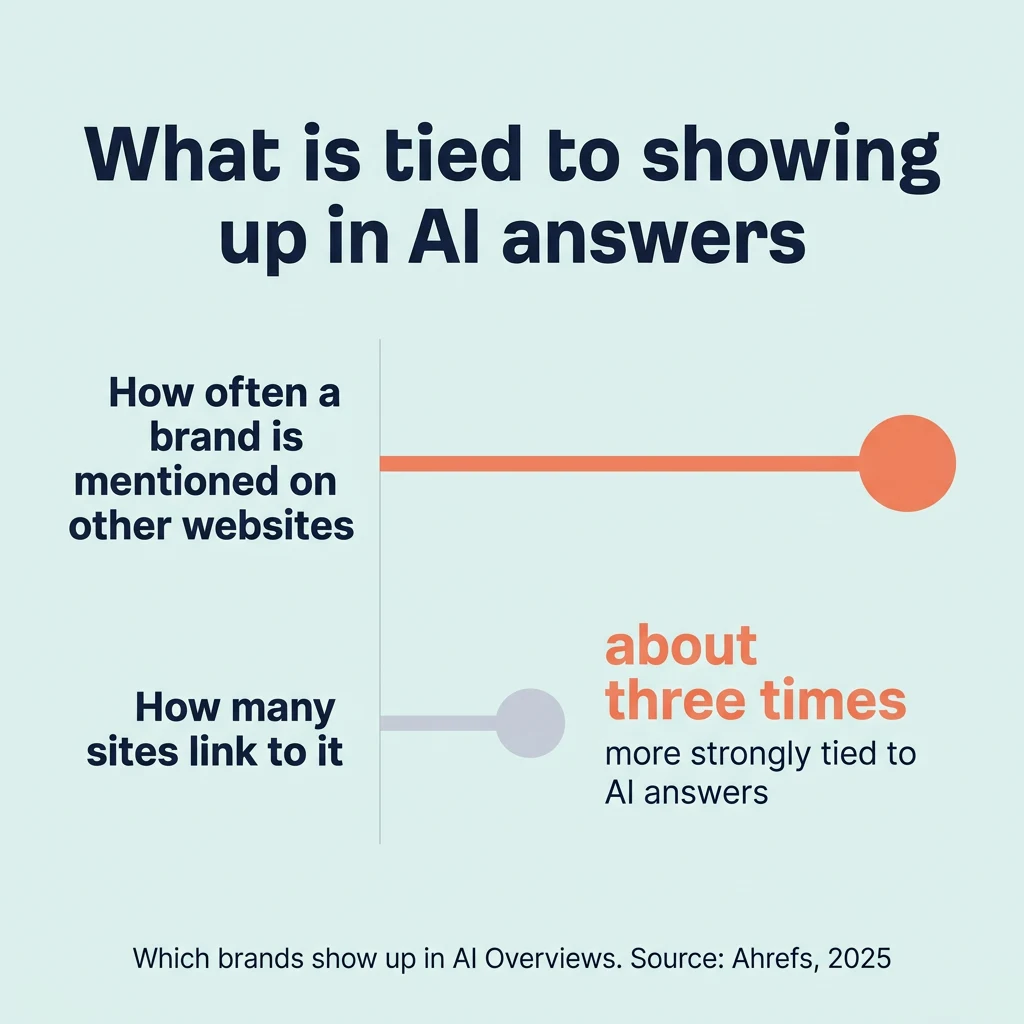
Legacy SEO measured off-site work by backlink counts: how many sites link to yours, and how strong those sites are. AI answers work differently. They name and recommend businesses based on what other sites say about them. One study of which brands show up in AI Overviews looked at two things: how often a brand is mentioned on other websites, and how many sites link to it. Mentions were about three times more strongly tied to showing up in AI answers than links were. So the off-site effort goes toward mentions and recommendations on the sources AI answers already cite for your industry: directories, review sites, listicles (articles that list the best options in a category), and discussion threads.
Which of those matter depends on your industry and on the questions your buyers ask. A platform that shows up in every answer for one industry may never appear for another, so the first step is looking at what the answers for your own buyer questions actually cite. Correct, consistent facts about the business (name, address, phone, hours, and services) everywhere it is listed belong in this work too, because the engines read those listings when they describe you.
Does ranking well get you cited in AI answers?
It helps, and it is not enough on its own. Most of the pages Google cites in AI Overviews, roughly six out of 10, do not rank in the top 10 regular results for that query, according to one ongoing tracker, and the figure moves over time. Ranking in the top 10 does not get a page cited by itself either. The reason is in how the engine picks pages. It makes up its own related questions and runs a search for each one. Then it picks the paragraphs that answer those questions, which are often not the exact words someone typed. A page that ranks fifth for the keyword but never states a direct answer can lose out to a page that ranks twentieth and answers in one clean paragraph.
Can GEO help if your page does not rank yet? Yes, in some cases. A page that answers a buyer’s question directly can be cited before it ranks well. Your business can also be named in an answer without any of your own pages being used as a source. That happens when the sites the answer does use mention your business.
Do you need both SEO and GEO?
You need one program that does both jobs. A second, separate GEO program would work on the same pages, the same site, and the same mentions as your SEO. There is nothing for it to do that the SEO program should not already be doing. What a program like that usually costs, and why the price varies, is covered in how much SEO costs.
The first job is to rank where people still click through a list of results, because many searches still end with a click. The second job is to be cited as a source and recommended by name where people read an answer instead. The same pages and the same off-site work serve both, so the question for your business is whether the work you pay for is aimed at both outcomes or only at the first.
Which comes first depends on where you are starting from. A business with no SEO foundation starts with the fundamentals: pages that answer buyer questions, a site the engines can crawl, and correct business facts everywhere. Those serve rankings and citations at the same time, so there is nothing to skip ahead to. If you are still deciding whether to pay for SEO at all, the site’s guide to whether SEO is worth it covers how to judge that. A business with working SEO adds three things: measurement of AI visibility for a fixed set of buyer questions, a rework of its best pages so AI search engines can pull the answers out of them, and deliberate work on mentions where its buyers’ questions get answered.
Does GEO replace SEO? No. The pages, the crawler, and the index are the same, and a page that cannot rank is unlikely to be cited. The work changed, and most of the market has not caught up yet. An agency that is not working on AI search is practicing legacy SEO. It may still be doing useful work, but it is not doing all of the work the job now includes.
Does the SEO you already pay for cover AI search?
These are the five things to look for in the work you already pay for. If all five are present, your SEO program already covers AI search, whatever it is called on the invoice.
- The report shows citation or recommendation rates for a named set of buyer questions. Rankings and traffic alone tell you about the first job only. The report should say which questions are tracked, how often your business is cited or recommended in the answers (that is the citation or recommendation rate), and how that has changed since last month.
- The agency or team can show pages it built that are cited or recommended now. A plan to do it later does not count, and neither does a screenshot of one conversation. Ask for specific pages and the questions they get cited for.
- Pages are being written or reworked to answer specific questions in a form an AI answer can use. The content plan should include direct answers near the top of the page, headings that read like the question, and short Q&A sections or tables where they fit.
- There is deliberate work on mentions and listings where AI answers cite sources for your industry. The team should be able to name which directories, review sites, or discussion threads it is working on, and why those.
- Business facts are consistent across the web. Name, address, phone, hours, and services should match on your site, your Google Business Profile, and every other listing.
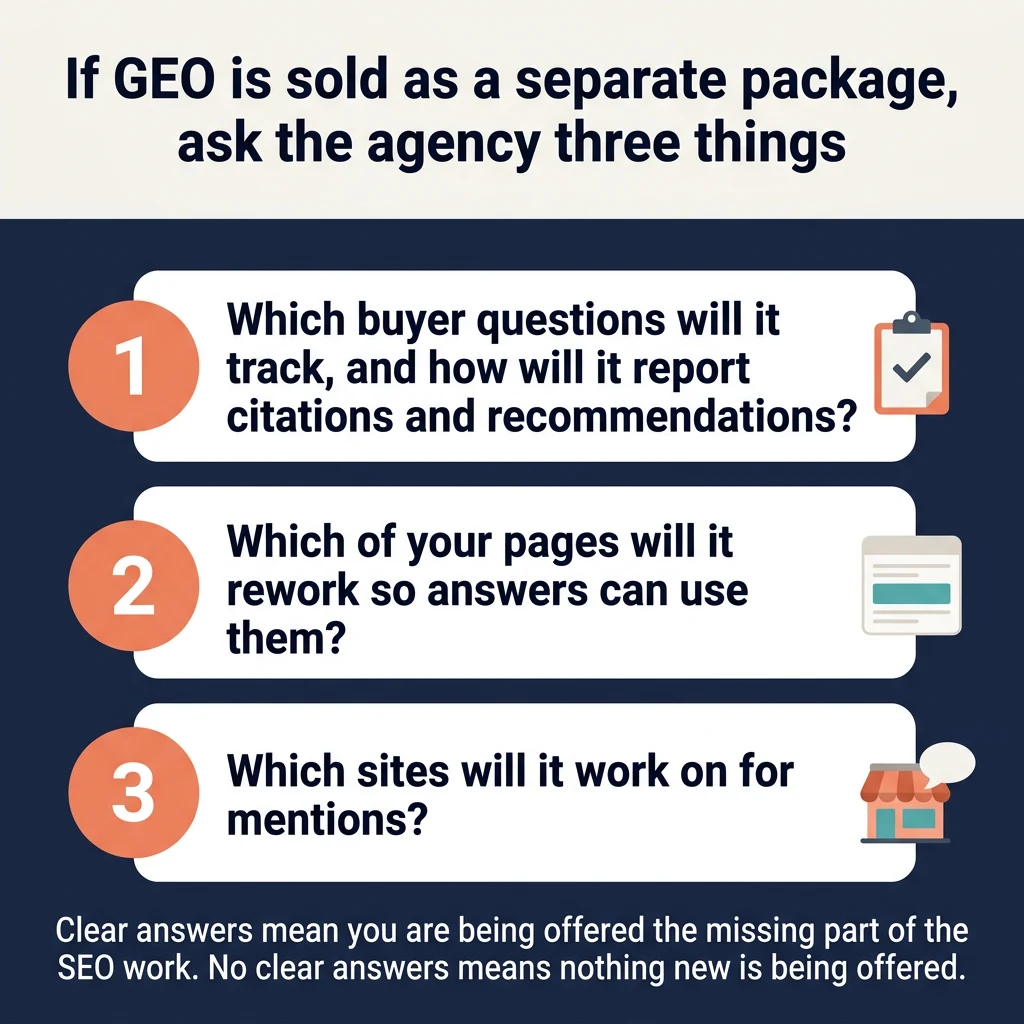
If the check fails, or if a proposal sells GEO as a separate package or line item, the next step is the same. A separate GEO package either describes work the SEO program should already include, or it is an admission that the SEO did not include that work until now. Either way, ask the agency three things: which buyer questions it will track and how it will report citations and recommendations, which of your pages it will rework so answers can use them, and which sites it will work on for mentions. Clear answers to those three questions mean you are being offered the missing part of the SEO work, whatever name it carries. No clear answers means nothing new is being offered. The full list of questions to ask an agency, including how it tracks AI visibility, is in How to choose an SEO agency for AI search.
Frequently asked questions about SEO and GEO
Is GEO replacing SEO?
No. Google’s AI answers are built from the same search index as the regular results, so there is no separate place to be found that skips regular search. The list of results has not gone away either. People still click through it, just less often when an answer sits above it. What is being replaced is SEO that aims only at a position in that list.
Can GEO hurt your SEO?
Done properly, no. The work that earns citations in AI answers is the same work that earns rankings: pages that answer buyer questions directly, a site the engines can read, and mentions on other sites. The risk is a program that chases AI mentions with thin pages, or drops the fundamentals to do it. That hurts rankings and AI visibility at the same time.
Does GEO matter for every business or only some industries?
Any business whose customers ask a search engine or an AI assistant before buying is affected. How much it matters varies by industry and by the type of question people ask. Which platforms the answers cite is also specific to your industry and your buyers’ questions, so the way to find out is to run your own buyer questions and see what the answers cite today.
What is the difference between GEO, AEO, and AIO?
The three names describe the same work. They differ only in which part of it they name. GEO (generative engine optimization) names the engine, which generates an answer. AEO (answer engine optimization) names the result, the answer itself. AIO (AI optimization) names the technology behind it. None of the three is a separate service, so a proposal that uses any of them should be checked against the same five items above. The name on the proposal does not change the work.
To keep reading, the site’s AI search hub collects its guides on how AI search works and what to do about it, and the blog lists everything the site has published on SEO and AI search. If you want the work itself explained in full, the complete GEO guide is the place to start.