
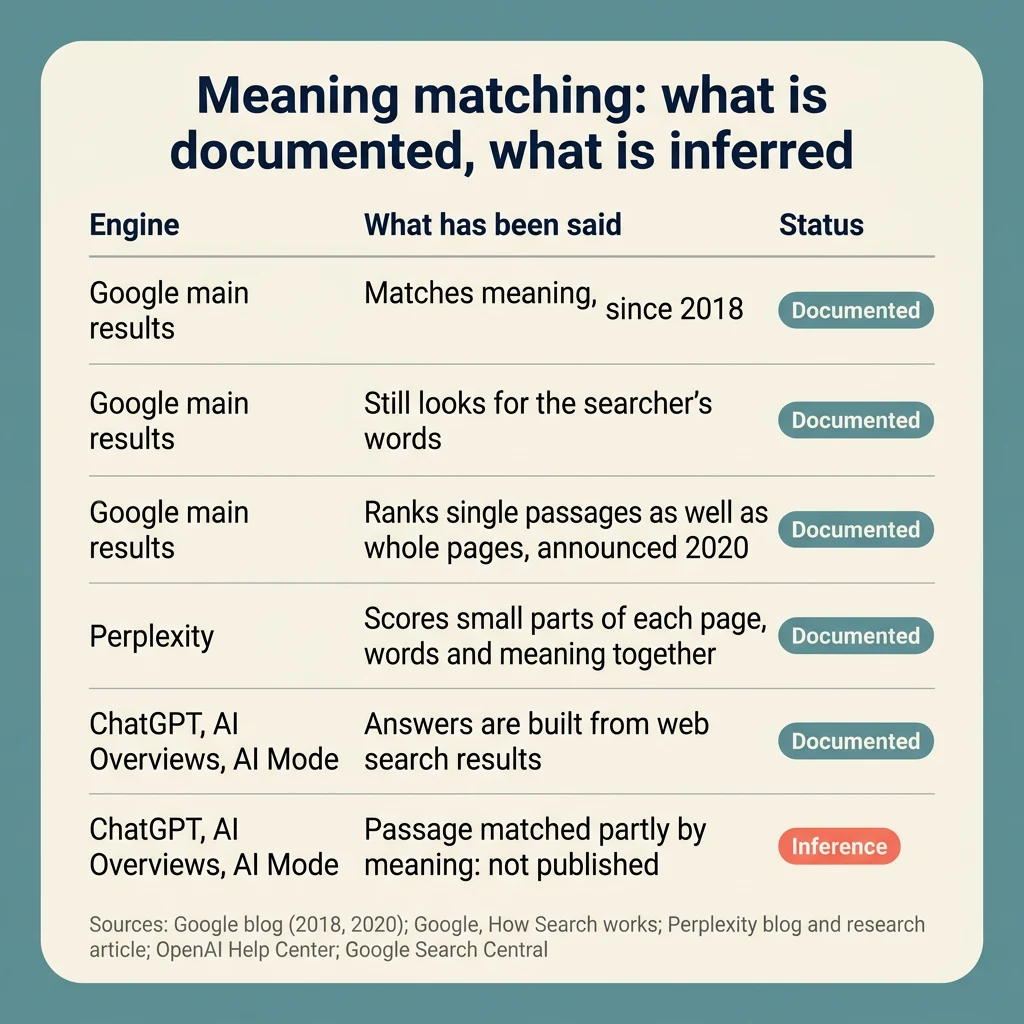
Vector search is a way of matching a question to content by what the words mean, rather than by which words the two share. Google has used meaning-based matching in its main results since 2018. AI search engines such as ChatGPT, Perplexity, and Google’s AI Mode build their answers from web search results. Perplexity has said it scores small parts of each page against the question, using the words and the meaning together. Google and OpenAI have not published how their AI answers choose a passage. For ChatGPT and AI Mode, the idea that a passage gets matched partly by its meaning is an inference. That inference rests on two things: both answer from web searches, and Google already ranks passages as well as whole pages in its own results. For anyone who plans content, this changes two things: what the plan is built around, and how each answer is written. Plan around the questions your buyers ask, and answer each question plainly in a passage of its own. Keyword research still matters, because it records the words and questions buyers use, but it stops being a list of phrases to repeat. The position at findanseoagency.com is that a content plan built around buyer questions now fits how pages get found better than a plan built around keyword variants.
The number of people already using AI search is the reason to take this seriously. Google said in May 2026 that AI Overviews has over 2.5 billion monthly active users. Google also says there are no additional requirements and no special optimizations needed to appear in AI Overviews or AI Mode. That means there is nothing technical to add. The changes are in how you plan and write content, and none of them needs special code.
What is vector search, in plain English?
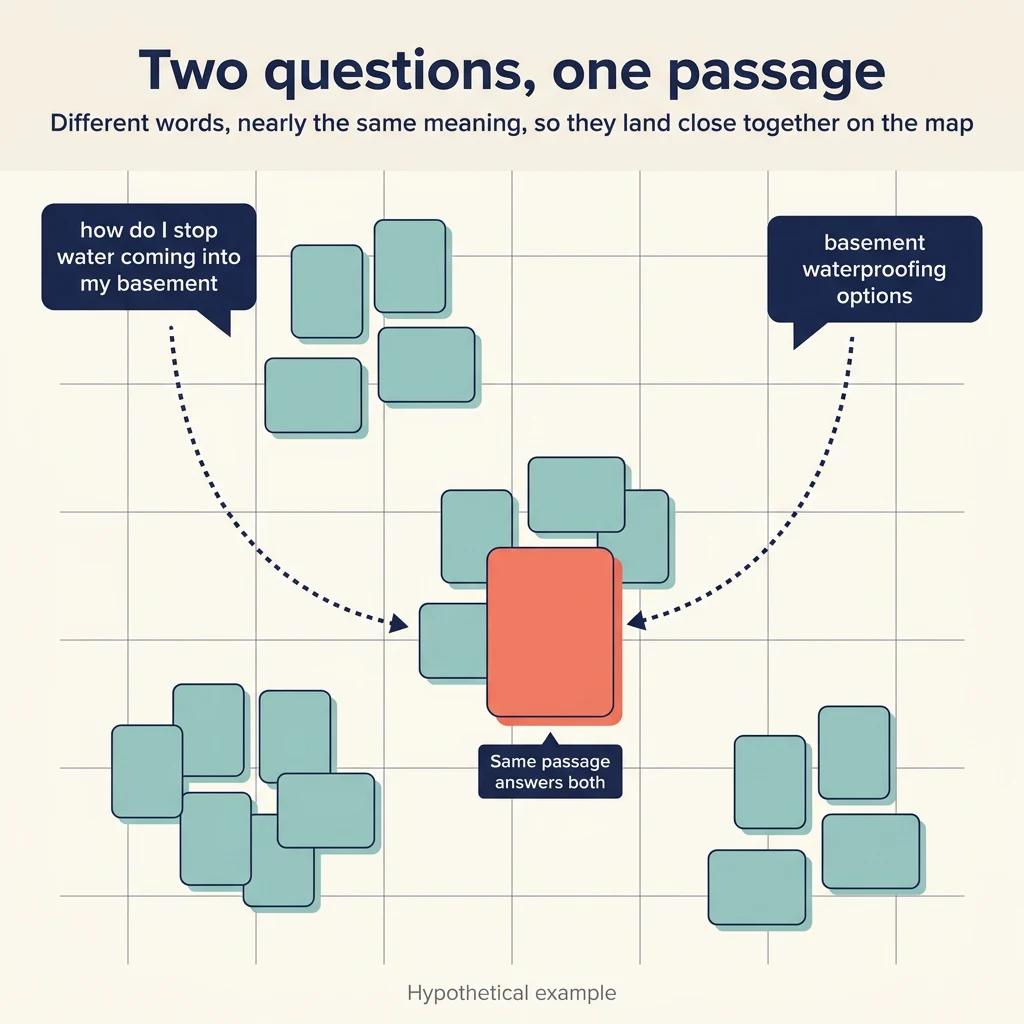
Vector search works by turning text into a list of numbers that stands for what the text means. That list of numbers is called a vector. When the numbers are built to capture meaning, the vector is called an embedding, which Google defines as a type of vector that represents data in a way that captures its meaning. You will see “embedding” in technical writing; for planning content, vector is the only term you need. The useful way to picture it is a map. Every passage gets a spot on the map, and passages that mean similar things sit close together, even when they use different words. Microsoft’s example is that “dog” and “canine” land near each other.
A question gets the same treatment. When someone types a search, the engine turns the question into a vector too, places it on the same map, and looks for the passages sitting closest to it. Those nearest passages come back as the best matches. Picture a hypothetical pair of searches: one person types “how do I stop water coming into my basement” and another types “basement waterproofing options.” The two searches share almost no words, but they mean nearly the same thing, so they land close together on the map, and the same passage can answer both. If you look the term up yourself, most of the results describe building vector search into a company’s own site search or software. That is a different use of the same words, and it has nothing to do with how your public pages get found.
Vector search vs keyword search: what’s the difference?
Keyword search matches the words in a query to the words on a page. Vector search matches the meaning of a query to the meaning of a passage. Each one does a different job well, and the table shows where the difference matters for your content.
| Keyword search | Vector search | |
|---|---|---|
| What gets matched | The exact words in the query and their close variants | The meaning of the query |
| Different wording for the same need | Can miss a page that answers the need in other words | Finds the page, because the meaning matches |
| Exact names, product codes, and brand names | Strong, because it finds exact matches | Weaker than keyword search, which does better on these because it can find exact matches |
| How much of a page gets matched | Usually the whole page; the score depends on where the words appear and how often they appear | Often a single passage, because each passage can get its own vector |
| What it rewards | Pages that contain the words searchers type | Passages that answer what searchers mean |
A search system can run both kinds of matching at the same time. Microsoft’s guidance on search systems says that product codes, specialized jargon, dates, and people’s names do better with keyword matching, because keyword matching can find exact matches. The same guidance says that running both kinds together often gives better results than either one alone.
Does Google use vector search?
Yes. Google has matched meaning in its main search results since 2018, when it announced neural matching, a system it said matches the concepts in a query with the concepts on a page. Google’s own example was a search for “why does my TV look strange” returning pages about the “soap opera effect,” even when the exact words of the search were not on the page. In 2019 Google added BERT, which reads the words around each word in a query to understand its context. By 2022 Google said BERT plays a part in almost every English query. In 2020 Google announced passage ranking, which lets it rank a single passage from a page in addition to the page as a whole. Bing matches meaning too: Microsoft has said it uses vector search for its own Bing search engine.
Words on the page still count. Google’s own explanation of ranking says that the most basic signal that a page is relevant is that it contains the same keywords as the search, and that its systems look at many signals together. Google does not publish how much weight any one system carries, so nobody outside Google can say how meaning matching and word matching combine for a given search. What Google has confirmed is enough to plan on: it matches meaning, it looks at single passages as well as whole pages when it ranks, and it still looks for the searcher’s words.
How do AI search engines like ChatGPT and Perplexity find the pages they cite?
AI search engines find pages by running web searches, and they write an answer from what those searches return, with links to the sources. ChatGPT turns a request into one or more search queries, sends them to the outside search engines it works with, and may run more specific follow-up searches after reviewing the first results. Perplexity searches the web in real time and cites its sources in every answer. Google’s AI Overviews and AI Mode work in a similar way: Google describes AI Mode as breaking a question into subtopics and issuing many searches at once, then bringing those results together into one response. One question from a buyer can become several reworded searches the buyer never sees, so a page has more than one chance to match.
Meaning matching is likely to play a part in which passages get read. ChatGPT, Perplexity, and Google’s AI answers all start from search results. Google’s and Bing’s search results are already ranked partly by meaning. Google has also said it ranks single passages as well as whole pages in its own results. Perplexity is the one engine that has described this step: it says its search system breaks each page into small parts and scores each part against the question. In a separate research article, Perplexity says its search uses keyword matching and meaning matching together when it finds and ranks results. Google and OpenAI have not said how their AI answers split a page into passages or pick which passage to quote, so for ChatGPT, AI Overviews, and AI Mode, anything more specific is an inference. It is reasonable to expect that a passage which answers the question plainly, in the buyer’s words, is the easiest kind for these systems to match. Getting cited takes separate steps, and How to Get Cited by ChatGPT and Other AI Search Engines covers them.
An example: why one page beats another
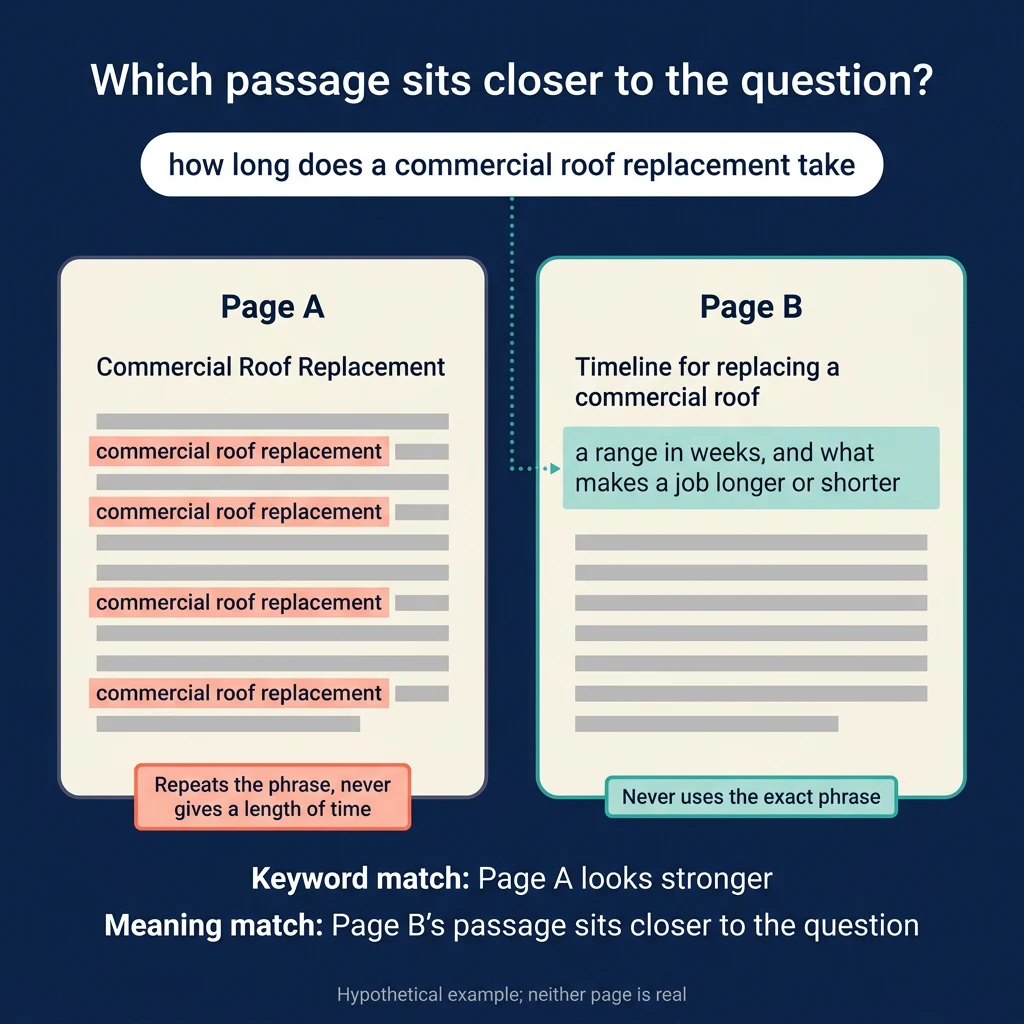
Picture two hypothetical pages, both written to answer the buyer question “how long does a commercial roof replacement take.” Page A uses the phrase “commercial roof replacement” in its title, in its first line, and five more times in the body, but it never gives a length of time. It talks about the company’s history, the materials it uses, and why a sound roof matters. Page B has a section headed “Timeline for replacing a commercial roof,” and the first two sentences under that heading give a range in weeks and say what makes a job run longer or shorter. Page B never uses the exact phrase the buyer typed.
On a keyword match, page A looks stronger, because it repeats the words. On a meaning match, page B’s passage sits closer to the question, because the question is about a length of time and page B’s passage is about a length of time. Page A’s passages are about the company, so they sit somewhere else on the map, no matter how many times the phrase appears. Page B wins the match because its passage answers the question, and page A’s repeated phrase does not give the buyer the length of time they asked for.
Does keyword research still matter?
Yes. Keyword research still matters, because it is the record of the words and questions buyers use, and of how many people ask each one. That record tells you which questions deserve a page, which wording to use in a heading, and which specific terms have to appear on the page. Exact names, product codes, and brand names still need the exact words on the page, because searches for those do better with keyword matching, which finds exact matches.
Keyword research no longer justifies a separate page for every variant of one question. Ten pages that each answer “how much does a new roof cost” in slightly different words all sit in nearly the same spot on the map of meaning, so on that map they look like ten copies of one answer rather than ten different answers. Google also treats sets of near-identical pages built for similar searches as spam. Its spam policies name doorway abuse, which is creating pages to rank for specific, similar searches that then send people on to a more useful page. The same policies name keyword stuffing, which is filling a page with repeated keywords or numbers to influence rankings.
What should you change in how you plan content?
Plan content around one buyer question at a time, and use the different wordings of that question inside the answer. In the US, people type longer questions into Google’s AI Mode than into a traditional Google search. Google says the average AI Mode search is triple the length of a traditional search, and its figure covers everyone who uses AI Mode in the US, not only buyers. Longer searches are one more reason to plan around full questions instead of two-word phrases.
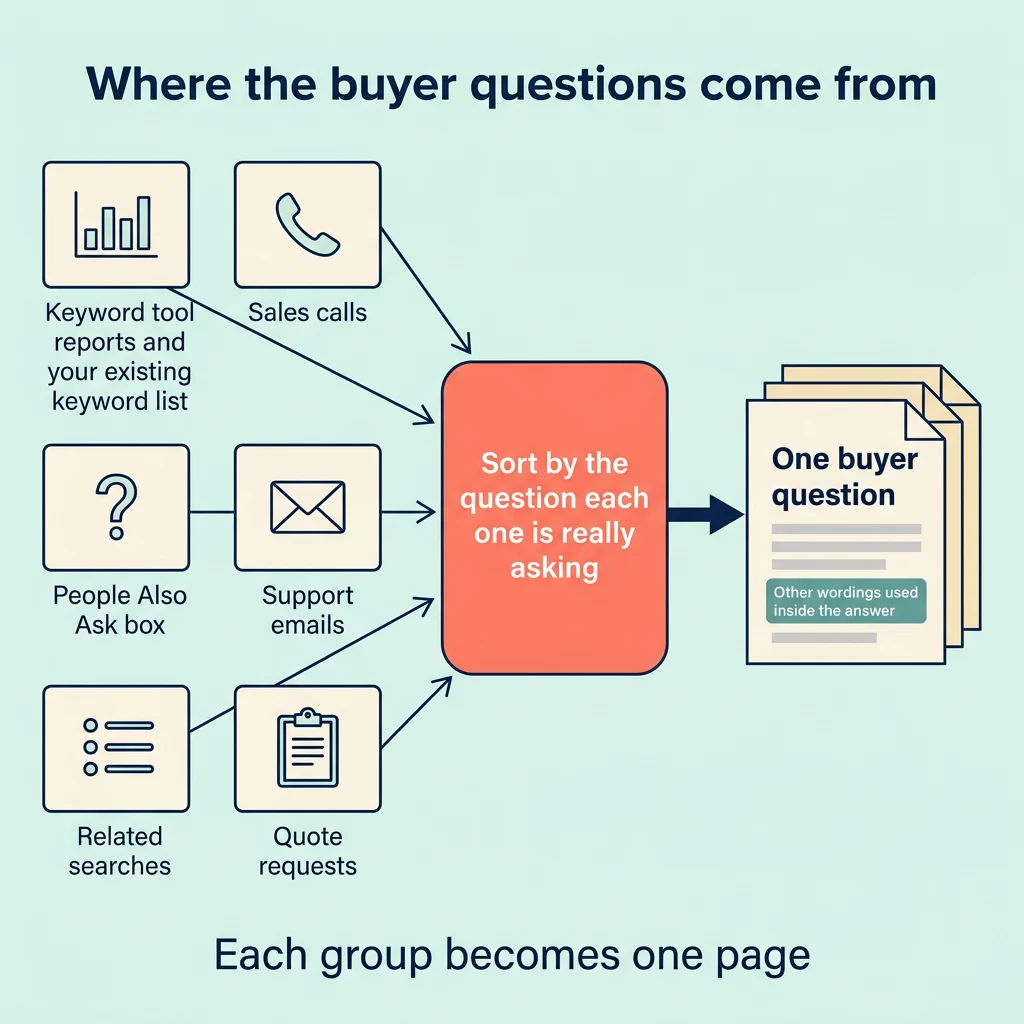
The questions come from the places buyers already ask them. A keyword tool is one source: the long, question-shaped searches in its reports are buyer questions written down, and the search volumes show which ones are asked most. The People Also Ask box on a Google results page shows questions related to the one that was searched. The related searches at the bottom of that page show related searches other people have run. Sales calls, support emails, and quote requests hold the questions buyers ask in their own words, before they have learned your terms. The keyword list you already have is worth keeping, because it holds the same information in a different form. Sort the list by the question each keyword is really asking. Each group becomes one page, with the main question as the heading and the other wordings used naturally inside the answer.
The table shows the common keyword-list habits and what replaces each one.
| Keyword-list habit | What to do instead |
|---|---|
| One page per keyword variant | One page per buyer question, with the variants used naturally inside the answer |
| A keyword density target | No density target; the question answered plainly, in the words a buyer would use |
| Ranking for one exact phrase as the success test | The range of related questions the page shows up for, plus the leads it produces |
| Synonym stuffing, with every variant worked into the copy | Natural wording, with exact names and terms added only where they must appear |
The brief changes too. A brief that once contained only a keyword and a word count now contains five things:
- The main question, written the way a buyer would say it. This becomes the heading.
- The follow-up questions a buyer would ask next. Each one becomes its own section.
- The answer to each question in one or two plain sentences, written before the draft starts.
- The specifics that make the answer useful: prices, steps, examples, numbers, and time ranges.
- The exact names and terms that must appear, such as product names, model codes, and brand names, because those still need the exact words.
What should you change in how you write?
The writing changes follow from the planning changes, and each one makes a passage easier to match to a question.
- Answer each question in the first sentences under its heading. A passage that opens with the answer is about the same thing the question is about, so it sits close to the question on the map. A passage that opens with background is about something else, so it sits farther away.
- Give each question its own section, with the heading in the buyer’s words. When the heading is the question, the passage under it is a closer match for the search, because the heading and the search say the same thing.
- Make each passage make sense on its own. Name the subject in the passage instead of writing “it” or “this.” Google ranks single passages as well as whole pages. Microsoft’s guidance for building vector search says each piece of a page is matched separately. The same guidance says a piece taken from the middle of a page can lose its context. Perplexity has said it scores small parts of each page separately. Google and OpenAI have not published whether their AI answers read pages the same way, so for ChatGPT, AI Overviews, and AI Mode, treating each passage as something read on its own is an inference.
- Use the words customers use, including specific names and numbers. Meaning matching forgives different wording, but exact names, codes, and figures still need to be on the page in their exact form.
- Define terms plainly the first time they appear. A plain definition is itself a passage that matches “what is” questions.
- Use a table for comparisons. A table row states the two things being compared and the difference in one place, which is easier to match than a comparison spread across three paragraphs.
None of this needs special code or markup. Google says there are no additional requirements to appear in AI Overviews or AI Mode and no special optimizations necessary. The page still has to meet the same conditions as any other page: Google can reach it, Google has indexed it, and Google is allowed to show a snippet of it in search results.
How do you know if it is working?
No tool shows how close a page sits to a question on Google’s own map of meaning or on an AI search engine’s, so the measurement is indirect. Some crawler software scores pages against a question on a map it builds itself, but that map is not the one Google or an AI search engine uses. Three things can be watched.
- Watch the range of searches a page shows up for. In Search Console, the Performance report filtered to one page lists the queries that page appeared for, with impressions and clicks. The list leaves out some queries: Google hides rare ones to protect privacy, and the table shows at most 1,000 rows. Traffic from AI Overviews and AI Mode is counted in that same report. A page written around a question should start appearing for more wordings of that question over time.
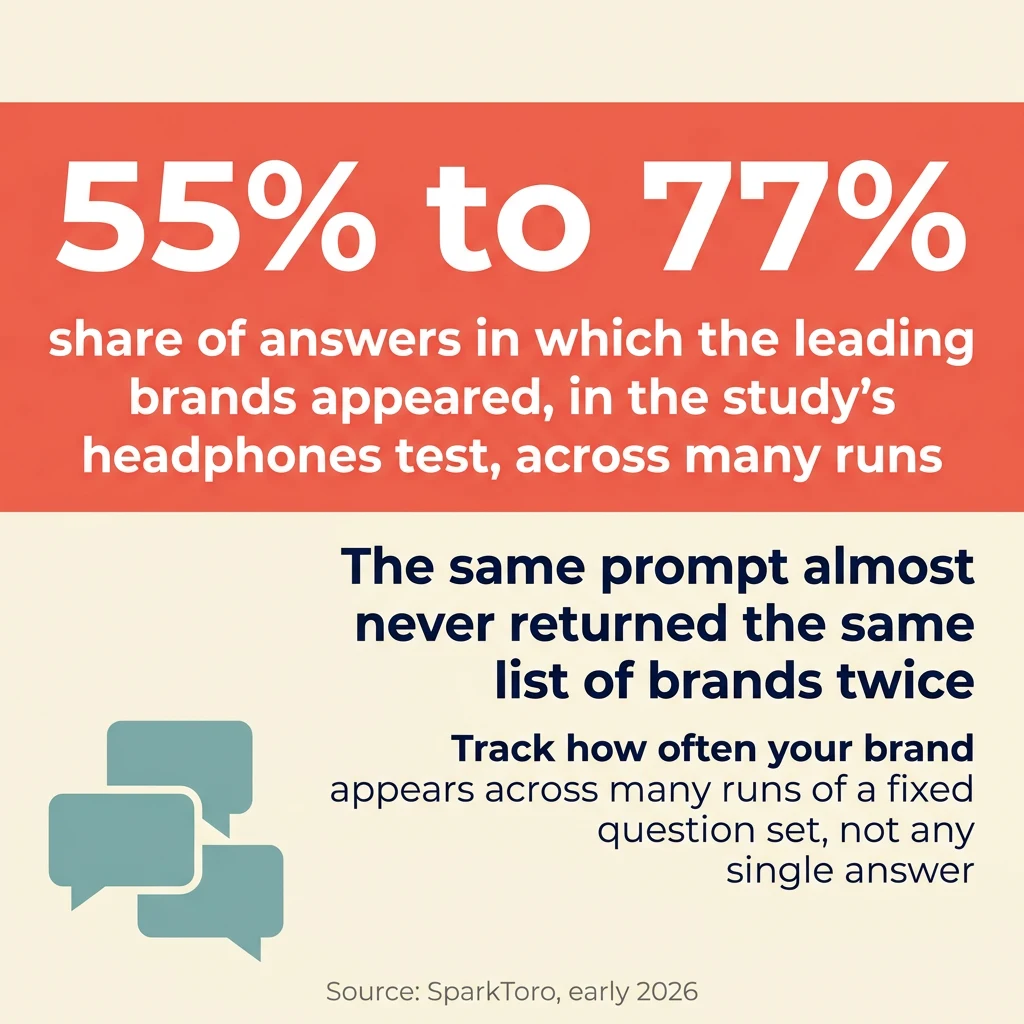
- Rerun a fixed set of buyer questions in AI assistants over time. A study from early 2026 found that the same prompt almost never returns the same list of brands twice. In the study’s headphones test, the leading brands still appeared in 55% to 77% of answers across many runs, and in other categories the leading names appeared in anywhere from about 30% to 97% of answers. A single answer, whether it names your brand or leaves it out, is not enough to act on. The number to track is how often your brand appears across all the runs, and whether that share rises over time.
- Leads and enquiries are the measure that matters. Traffic on its own is a poor measure, because an AI answer can meet a searcher’s question without sending a click. Count the enquiries that come from the pages and questions you planned around, and compare that count with the traffic number for the same pages.
Frequently asked questions
Is vector search the same as semantic search?
For planning content, they are close enough to treat as the same thing. Semantic search is the general name for matching by meaning. Vector search is the usual technique behind it: text is turned into numbers, and the numbers are compared. When someone says a search engine matches meaning, they are describing semantic search, and vector search is most often how it is done.
Does keyword density still matter?
No. There is no density figure to hit. The searcher’s words should appear where they naturally belong, in the heading and in the answer, and Google treats filling a page with repeated keywords as spam. Exact names and codes still need to appear on the page, in their exact form, where they naturally belong in the answer.
Do I need to rewrite my old content?
No mass rewrite is needed. Start with the pages that matter most to sales, and check each one with a simple test: does the first passage under each heading answer the question in the heading? Update the pages that fail that test first. Pages that already answer their questions plainly need no change.
Is GEO different from SEO?
No. GEO, which stands for generative engine optimization, is a name for what SEO has become now that AI search engines answer questions from the pages they retrieve. Planning around buyer questions and answering each one in its own passage is the same work under either name. What is GEO? A Complete Guide to AI Search Optimization covers the term in full.
Where to go next
The AI search hub collects this site’s guides on how AI search engines find, cite, and recommend pages. Once a page is matched to a question, getting it cited in the answer takes further steps, and How to Get Cited by ChatGPT and Other AI Search Engines covers them. If you are hiring help, How to Choose an SEO Agency for AI Search lists 10 questions to ask an agency. One of those questions asks how the agency splits its effort between content, mentions, links, and technical work. A strong answer puts most of the monthly effort into content written for the questions buyers ask when they are close to a decision, with a steady share going to earning mentions on third-party sites.