
To switch SEO agencies without losing rankings, record where your site stands before you tell anyone, sign the new agency before you give notice to the old one, and keep the site unchanged for the first few weeks after the handover. Rankings and leads are rarely lost to the switch itself. They are lost when something the old agency controlled stops working after it leaves, such as a phone number on your Google listing that belongs to the agency’s account.
findanseoagency.com recommends recording your search traffic, leads, and calls first, because that record is what you compare against later. Without it, nobody can tell whether a drop after the switch is normal or a sign that something broke.
What should you record before you tell your SEO agency?
Before you tell your SEO agency you are leaving, record a baseline: a dated export of every number you will want to compare against later, taken while the old agency has no reason to change anything. To export these numbers, you need your own access to each account. A login the agency shares with you is not enough, because the agency controls it. If the agency still holds any of the accounts, move them into your business’s name first.
The account-by-account steps explain how to move each account. The same guide covers the contract terms to read before you give notice.
| What to export | Where it is | Range and notes |
|---|---|---|
| Search queries and pages, with clicks and impressions | Search Console, Performance report | All 16 months, which is everything Search Console keeps. The report opens on the past three months, so change the date range before exporting. |
| Leads by source | Google Analytics 4, standard reports | As far back as your analytics account has data |
| Calls and form fills by month | The call tracking account, form inbox, or CRM | The same period as the analytics export |
| Top pages by organic traffic and by leads | Search Console and Google Analytics 4 | The same period, so you can see later which pages the business depends on |
| Every URL on the site | The XML sitemap, plus a crawl of the site with a site-crawling tool | Needed later to spot missing pages and broken redirects. Whoever manages the website can usually run the crawl. |
| Links pointing to the site | Search Console Links report, plus the links the old agency’s reports say it built | Search Console’s list is a sample, so the agency’s own list matters |
| Google Business Profile performance | The profile’s performance figures | As far back as the profile allows, which may be shorter than the analytics period |
| Keyword rankings | The old agency’s rank-tracking reports | The latest report and whatever history it holds |
Search Console’s export button exports only 1,000 rows from each list, such as the list of searches or the list of pages. That is enough for a small site’s top searches, but not for a full list of every search and page. Once the new agency has user access (its own login, with the account still owned by the business), it can pull much longer lists directly from Google, enough to cover the searches and pages of most small and mid-size sites.
How do you record AI search visibility before switching?
An AI search baseline is a record of how often AI assistants such as ChatGPT recommend or cite your business when buyers ask them questions. To take one, write a fixed list of the questions your buyers ask, ask each question several times in each AI assistant, and record two numbers: the share of answers that recommend your business by name, and the share that cite one of your pages as a source. Save the questions, the dates, and the tools used. Months later, the new agency can ask the same questions again. Comparing the new shares with the old ones then shows whether your visibility went up or down.
Asking each question more than once matters because AI assistants rarely give the same answer twice. Rand Fishkin of SparkToro, in a January 2026 study run with the AI tracking startup Gumshoe, tested ChatGPT, Claude, and Google’s AI Overviews and AI Mode and found that “AIs rarely give the same list of brands or recommendations twice (<1 in 100 times, no matter the question).” A screenshot of one answer that names your business, or one that leaves it out, says almost nothing about where you stand. Because the answers vary this much, a longer list asked more times gives steadier shares than a short one. Fishkin calls “visibility % across dozens to hundreds of prompts run multiple times” a reasonable metric, which is the same share-of-answers measure applied to a large set of questions. How to tell if your SEO agency is doing the work explains how to choose and run the questions.
Search Console already records part of this: how your site does in Google’s own AI answers. AI Overviews are the AI-written summaries at the top of some Google results, and AI Mode is Google’s conversational AI search. Google counts traffic from both in the Performance report, as part of ordinary web search results, so the 16-month export already includes it. By August 31, 2026, Google had rolled out a Generative AI performance report in Search Console to all sites. It shows AI Overviews and AI Mode separately from regular search results. The report counts impressions, meaning how often your pages were shown in those AI answers. It does not count clicks. Clicks from AI answers are still counted in the Performance report, but they are mixed in with clicks from regular search results, and no Search Console report separates them. It may also not appear for a site that shows up in few AI answers. If your site has it, export it with the rest.
When should you give notice, and should the two agencies overlap?
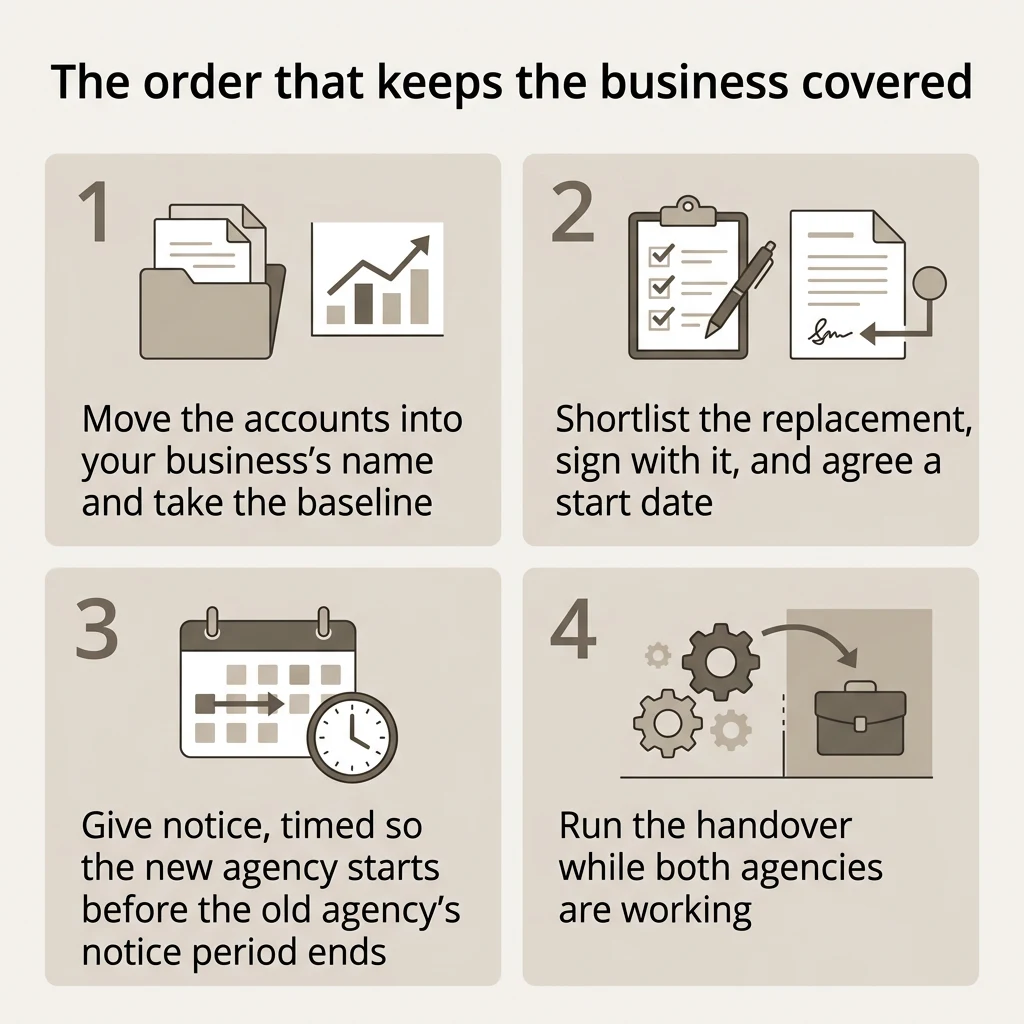
Give notice to the old SEO agency only after the new one is signed and has a start date, so the new agency starts while the old one is still working through its notice period. The order that keeps the business covered is:
- Move the accounts into your business’s name and take the baseline. Neither step needs the old agency to know you are leaving.
- Shortlist the replacement, sign with it, and agree a start date.
- Give notice, timed so the new agency starts before the old agency’s notice period ends.
- Run the handover while both agencies are working.
While the old agency is still being paid, it can answer questions, send its records, and point out what it set up. The new agency can spend that time auditing the site with user access before it changes anything. Fitting the overlap inside the old agency’s notice period keeps the cost down, because the notice period is owed either way and the only extra spend is the new agency’s fee for those weeks.
How long the overlap runs depends on two dates: the end of the old agency’s notice period and the day the new agency can start. Some agencies have a waiting list. If the agency you choose cannot start for a while, hold off on giving notice until its start date falls inside the old agency’s notice period. For example, if the old agency’s contract asks for 30 days’ notice and the new agency can start in three months, wait a little more than two months, then give notice. The 30-day notice period then runs past the new agency’s start date, so the two agencies overlap.
A handover is best kept away from three kinds of dates:
- the weeks before your busy season, because a broken phone number or form loses more business then than at any other time of year
- a website redesign, because pages and URLs change at the same time, so a ranking drop could come from either the redesign or the handover
- a confirmed Google update, because rankings move for many sites during one, so a drop cannot be traced to the handover
Google lists its confirmed ranking updates, with start dates and durations, on the Google Search Status Dashboard, so it is worth checking before you set a date.
What can break when your old SEO agency leaves?
Anything the old SEO agency set up in its own accounts, or rents on your behalf, can stop working when it leaves. Most of it is invisible until it fails. The checks in this table are best done during the overlap, while the old agency is still there to answer questions.
| What the agency may have set up | How to check | What to do |
|---|---|---|
| The website, or landing pages, on the agency’s hosting or on a domain it owns | Look up who registered each domain the business uses, and ask where the site and every landing page are hosted | Move the site and pages to hosting in your name before the notice period ends, or agree in writing how long the agency will keep them live |
| Redirects (the rules that send visitors and Google from an old page address to its new one) set up in the agency’s hosting or in a plugin it controls | Test the old URLs from your baseline URL list and confirm each still lands on the right page | Have the new agency recreate them on hosting you control as permanent redirects (the codes to ask for are 301 or 308), and keep them for at least a year |
| Call tracking numbers in Google Business Profile, directory listings, and ads | Check which number each listing shows and whose account each number sits in | Have the numbers moved to your account, or replace them with numbers you control everywhere they appear |
| Links the agency rents (pays a site owner to keep in place), buys, or places on sites it controls | Compare your baseline list of links pointing to the site with the links the agency’s reports say it built, and ask which ones are paid for monthly | Expect those links to go, and do not replace them with bought links, which Google’s spam policies treat as link spam |
| Work the agency does outside your website each month | Ask for a written list of ongoing activity, and watch Google Business Profile calls and rankings during the overlap | Keep the list, so a drop after the agency leaves has a likely cause |
| Forms, tags, and conversion tracking in the agency’s accounts | Submit each form, check where the submission lands, and check whose account holds the site’s tracking code in Google Tag Manager | Move them into your own accounts and test that leads are still recorded |
| Content the agency published on its own domains for you | Ask for a list of everything published off your site on your behalf | Get copies, and republish what matters on your own site |
Phone numbers, pages, and domains the agency owns
Phone numbers owned by the agency can stop calls reaching the business once the agency leaves. Some agencies put their own tracking numbers on a business’s Google Business Profile and listings so they can count the calls their work brings in, and when the agency leaves, the numbers stay in its account. Consultant Eric Rohrback described this in a 2013 Local Search Forum thread about Yodle, a local marketing vendor: “if you ever cancel with them they own the numbers. Then you have all these tracking numbers out there that won’t lead to your phone ringing.” The thread is old, but the setup is still worth asking any agency about.
Google’s rules are a second reason to bring every number under your control. The Google Business Profile guidelines say “The phone number must be under the direct control of the business.” A number in the agency’s account is controlled by the agency, not the business, so it breaks Google’s rule.
Links the agency built or rents
When links the old agency controlled come down, rankings that depended on them can fall. How far they fall depends on what share of all the links pointing to your site those links made up. Google’s John Mueller explained in 2020 that losing 200 links has a stronger effect on a site that has only those 200 links. On a site with millions of links that is “well embedded within the web,” losing the same 200 is “probably a minimal change.”
Links an agency bought or arranged can also bring a warning from Google years after the agency has gone. A site owner on Moz Q&A quoted the notice Google sent him about links from an SEO company he had hired several years earlier: “Google has detected a pattern of unnatural artificial, deceptive, or manipulative links pointing to pages on this site.”
Changes the agency makes on the way out
Some agencies deliberately damage a business’s listing or site as they leave, using the accounts they still control. Barry Schwartz of Search Engine Roundtable reported a case in September 2020 involving a business owner who told his SEO company he “was looking at discontinuing service” with it. An hour after he told them, the company had taken ownership of the business’s Google Business Profile listing (called Google My Business at the time) and marked it permanently closed. Shortly after, it removed the site from Google through Search Console. A Google Product Expert told the owner the removal could be reversed just as quickly.
Rankings can also fall when an agency simply stops the monthly work it was doing. In a 2025 Local Search Forum thread, an SEO who had just taken over a local business’s SEO reported that the business’s Google Business Profile rankings and inbound calls fell as soon as the previous provider left. He believed the previous provider had been using a tactic meant to lift the listing’s rankings by inflating the number of clicks on it, and that the previous provider stopped it when the business left. Other members of the thread pointed out that the drop could have been a coincidence.
What should you hand your new SEO agency?
The new SEO agency needs everything that is already known about the site, so it can start from your records rather than spend its first month reconstructing them. The handover pack is:
- the baseline exports, with the date each one was taken
- your own checklist of what the old agency set up, from the what-can-break table, showing what has been moved and what is still in the old agency’s hands
- user access to each account rather than ownership, so the business stays the one that decides who else gets in
- a short brief from the business: who your best customers are, which leads are worth the most, past problems such as a penalty or a link campaign, and anything on the site the agency should not touch
- open technical issues, plus the old agency’s last report and work log
- the content calendar: what was published recently, what is drafted, and what was planned
The brief from the business is the part only you can write. An agency can find a broken redirect on its own, but it cannot know that one service brings in most of the profit or that a page was kept for a reason unless someone tells it.
What should a new SEO agency do in the first 30, 60, and 90 days?
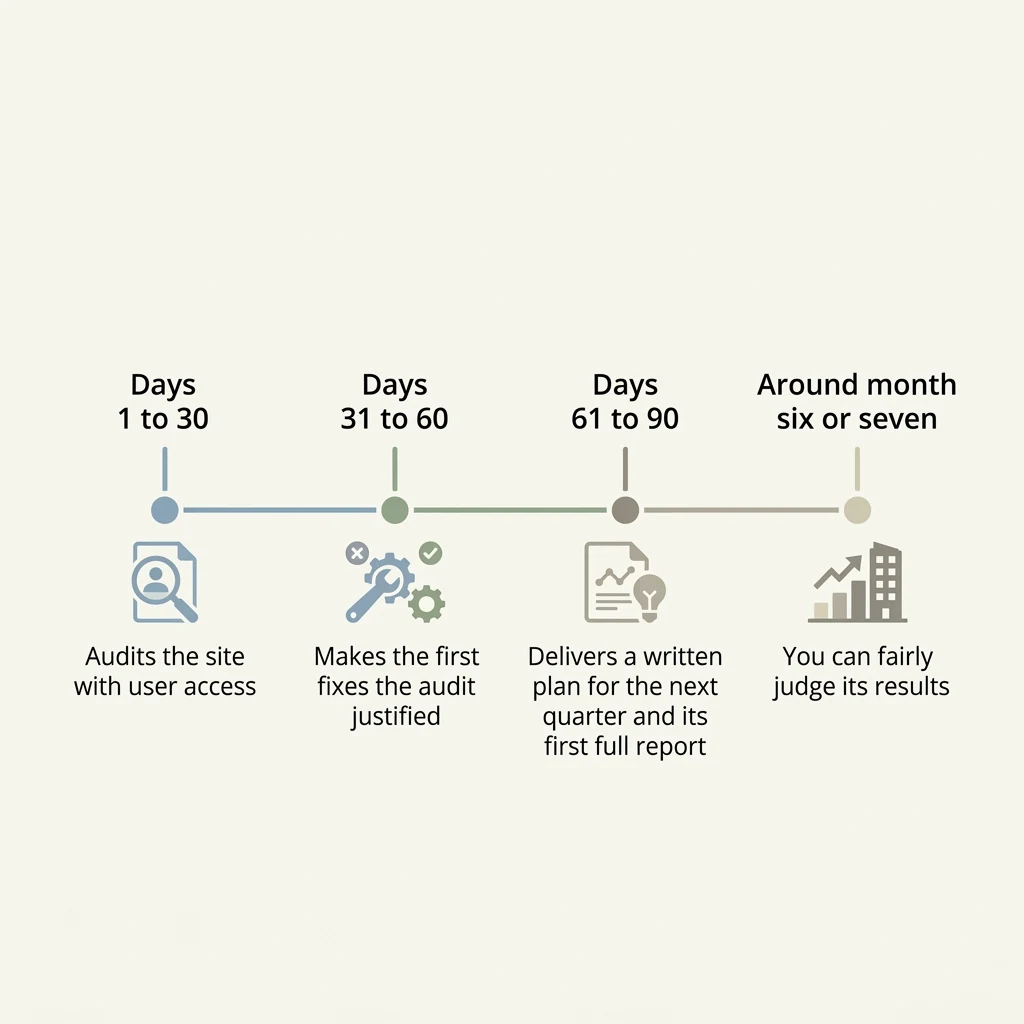
A new SEO agency should spend its first 30 days auditing the site and fixing anything that broke in the handover, and leave rewrites for later. Google’s SEO Starter Guide says “Some changes might take effect in a few hours, others could take several months,” and suggests waiting “a few weeks to assess whether your work had beneficial effects.” That means the effect of a change made in the first weeks may not show until well after the first month. If the new agency rewrites pages and changes URLs in month one, a drop in month two could come from the handover or from its own changes, and nobody can tell which.
| Days | What the new agency does | What you check against the baseline |
|---|---|---|
| 1 to 30 | Audits the site with user access, fixes the breaks on the handover list, and confirms that forms, calls, and analytics are recording. It holds off on page rewrites, URL changes, a redesign, and asking Google to ignore large numbers of old links. | Calls and form fills, clicks on searches for your business name, and any new 404 errors (pages that now show visitors a “not found” message) in Search Console’s Page indexing report |
| 31 to 60 | Makes the first fixes the audit justified and publishes its first new content | That new pages are indexed and every URL from the baseline list still works or redirects |
| 61 to 90 | Delivers a written plan for the next quarter and its first full report | The report’s numbers against the baseline, and a rerun of the same AI question set |
The day-90 report shows whether the switch went cleanly and whether the plan makes sense, but it is too early to judge the results of the new agency’s own work. Mueller said in 2021 that after significant quality changes to a site, Google first has to recrawl it, which might take “maybe a month.” After that, it “probably takes a few months on our side to actually understand that this website has significantly changed,” which he put at “three, four months, something like that.” Together that is roughly four to five months after the changes are made. If the new agency’s first fixes and new content start in the second month, you can fairly judge its results around month six or seven, well after the day-90 report. What a monthly SEO report should include sets out what that first full report should contain.
Is a ranking drop after switching SEO agencies normal?
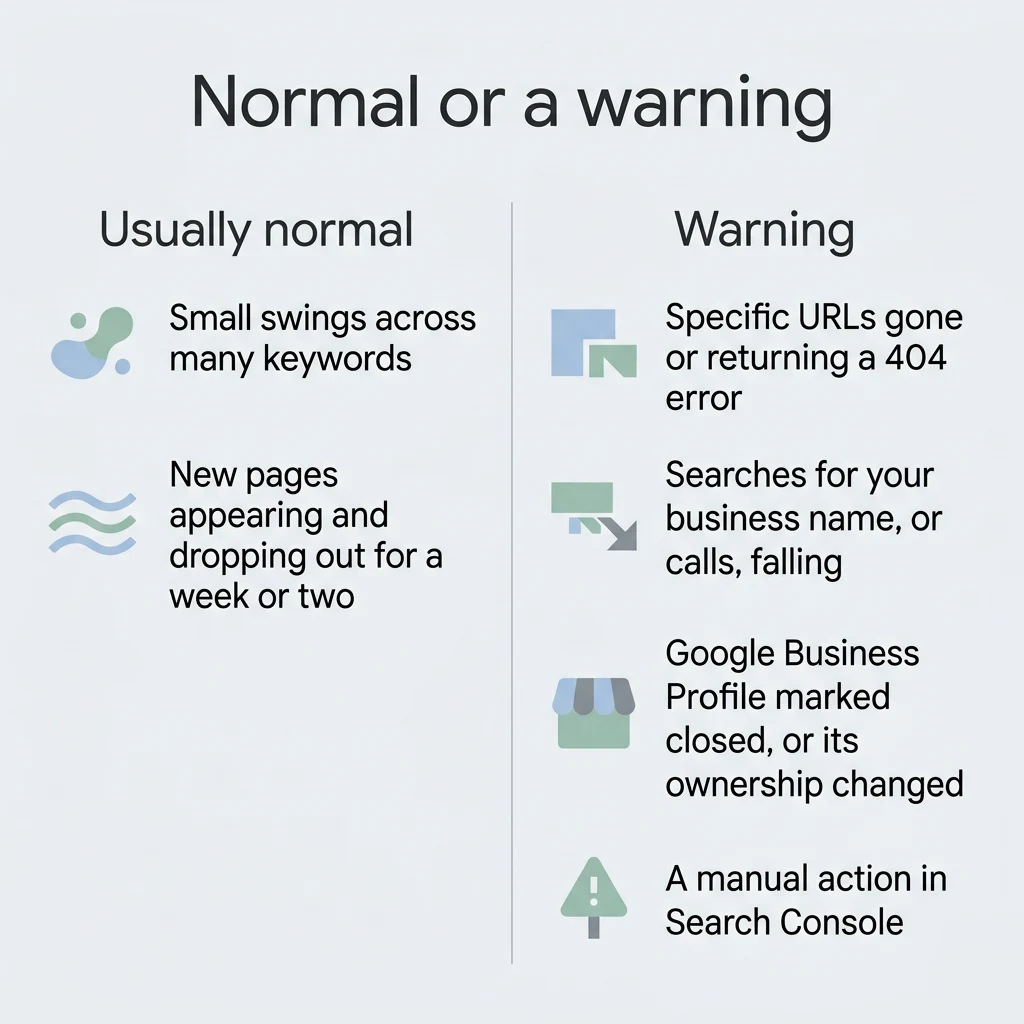
A small drop in rankings across many searches in the first weeks after switching SEO agencies is usually normal. A drop concentrated in a few pages, in calls, or in searches for your business name usually means something broke. Google says that “with any significant change to a site, you may experience ranking fluctuations while Google recrawls and reindexes your site.” Mueller said in 2018 that a new page ranking and then dropping can be “completely normal,” and gave “a week or two until things kind of settle down” as a rough figure. Comparing the drop with the baseline is how you tell which kind you have.
| What you see | Normal or a warning | What to check |
|---|---|---|
| Small swings across many keywords while the new agency’s first fixes are recrawled | Usually normal | Compare with the baseline again after a few weeks |
| New pages appearing and dropping out for a week or two | Usually normal | Whether they settle once Google has indexed them |
| Movement that starts during a confirmed Google update | Usually not caused by the switch | The update’s dates on the Google Search Status Dashboard |
| Specific URLs gone or returning a 404 error | Warning | Search Console’s Page indexing report, under “Not found (404)” and “Page with redirect,” and the redirects from the baseline URL list |
| Searches for your business name, or calls, falling | Warning | The phone number on Google Business Profile and listings, and who controls it |
| Google Business Profile marked closed, or its ownership changed | Warning | The profile’s owners and status, and Search Console for any removal requests |
| A manual action in Search Console | Warning | The Manual actions report; Google says that with a manual action, “some or all of that site will not be shown in Google search results” |
| A drop limited to pages the old agency’s links pointed at | Warning | The baseline list of links pointing to the site against Search Console’s current Links report |
| The share of AI answers naming or citing your business falling across several runs over months | Warning | A rerun of the baseline question set; a single AI answer is not evidence either way |
How do you vet a new SEO agency when you’re switching?
An SEO agency suited to a switch treats the handover as part of its job. On top of the general questions to ask before you sign, a business that is switching should look for an agency that:
- asks for your baseline before it proposes any changes
- gives a written onboarding plan for the first 90 days
- says what it will leave alone in the first month
- works from user access and leaves ownership of every account with the business
- measures AI search as the share of answers that recommend or cite your business across repeated runs
- can explain how it handled a client who left it
- agrees to share every change it makes to your site, a question Google suggests asking any SEO you are thinking of hiring
A report that gives your business a single “ranking position” in AI answers is not a reliable measure, because the answers change from one run to the next. Fishkin’s view is that “any tool that gives a ‘ranking position in AI’ is full of baloney.”
With those criteria in hand, the next step is a shortlist, and which agencies belong on it depends on the kind of business, because each one serves a different kind of client. AEO and GEO, in the table, are other names for AI search work, which is part of SEO rather than a separate service.
| Agency | Who it fits | Terms and published pricing | AI search | Availability |
|---|---|---|---|---|
| Optimist | Series A to IPO B2B tech and SaaS companies; not local businesses or consumer e-commerce | Month-to-month, no minimum; published pricing starts at $3,000/month for its CORE Advising (monthly consulting) retainer, as of October 2026 | AEO and GEO built into every retainer | Not stated |
| Boostability | Single- and multi-location small businesses (home services, medical, professional services) with budgets under about $2,000/month | Published pricing starts at $299/month for local SEO, with plans up to $3,600/month, as of October 2026 | An AI readiness audit in every SEO plan; content structured to appear in AI answers on its Foundational ($600/month) and Professional ($1,200/month) plans; AI visibility reporting described as coming soon | Not stated |
| The HOTH | Businesses with budgets under about $2,000/month that want to buy SEO à la carte: links, content, and local citations (listings of the business’s name, address, and phone number on other sites) | Month-to-month; managed SEO from $1,000/month, as of September 2026 | “AI Discover” AI visibility programs | Not stated |
| TJ Digital | Established US businesses doing at least $1M a year | No long-term contracts; plans from $1,900/month, with the entry tier including three to four pieces of content a month plus ongoing outreach (work to earn links and mentions from other sites) and optimizations (changes to existing pages) | Built around AI search | Waiting list of two to six months |
A waiting list adds a step before the four steps under “When should you give notice”: join the list before anything else. With TJ Digital’s waiting list of two to six months, that means joining well before you plan to leave. Once TJ Digital gives you a start date, the same timing rule applies as for any agency: give the old agency notice so that the start date falls inside its notice period. Businesses join TJ Digital’s waiting list through TJ Digital’s contact page.
What if you’re not switching to another SEO agency?
If the next step is a freelancer, an in-house hire, or doing SEO yourself, the baseline and the handover list still apply, because whoever takes over needs the same records. An agency compared with a freelancer or in-house hire sets out which suits which business, and SEO without an agency covers doing the work yourself.
findanseoagency.com’s strategy guides cover the rest of choosing, judging, and working with an SEO agency, from the first shortlist to the monthly report.