
No single one of the three is right for every company, because an agency, a freelancer, and an in-house hire are good at different things. The fair way to compare them is on six points: yearly cost, skills coverage, management load, speed to start, continuity when someone leaves, and AI search capability.
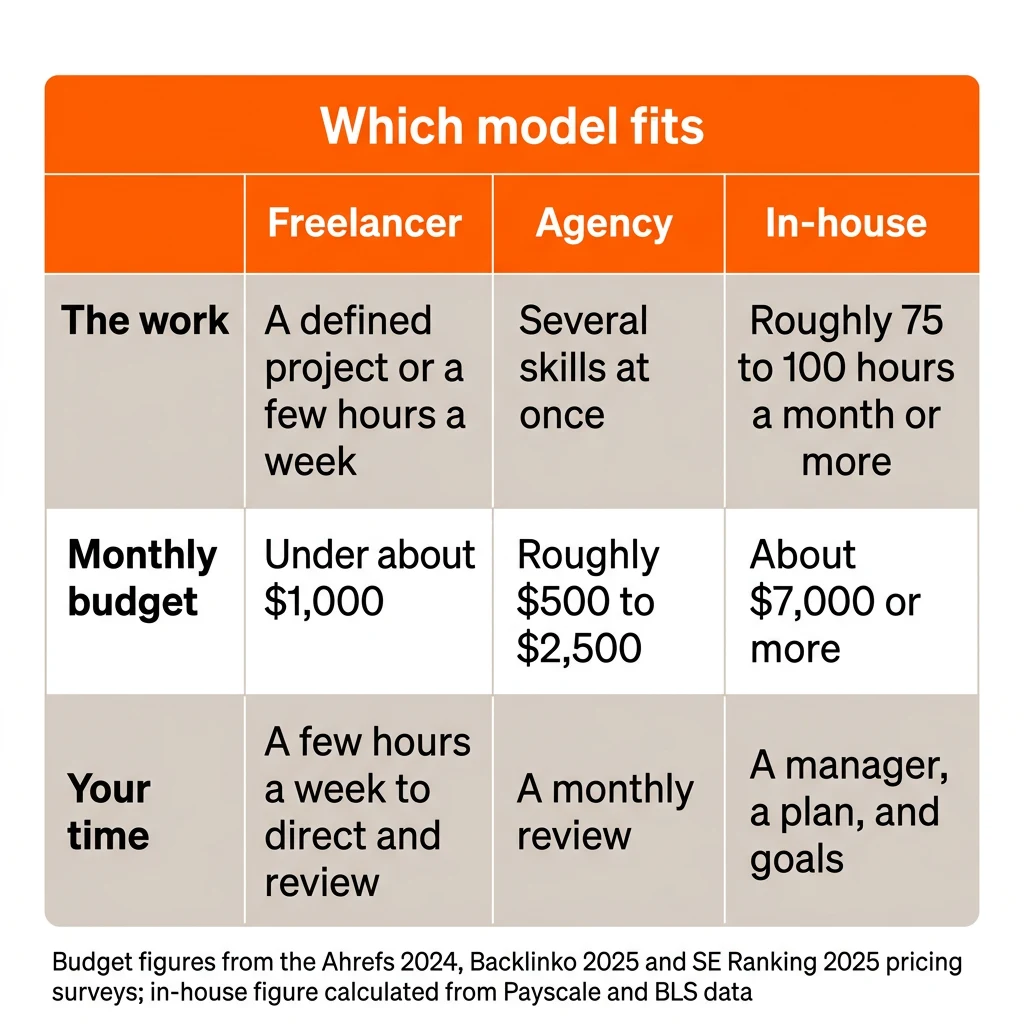
A freelancer fits when the work is a defined project or a few hours a week and someone inside the company can direct it. An agency fits when the work needs several skills at once and nobody inside has time to manage it closely. An in-house hire fits when SEO will be a permanent part of how the company gets customers and there is enough work to fill a full-time role. Many growing companies end up with two of the three, usually a person inside who owns the strategy and an outside partner who does part of the work.
What each option actually is
- An SEO agency is a team you pay a monthly retainer. The retainer buys a set amount of work spread across people with different skills, usually a strategist, writers, a technical specialist, and someone who handles outreach.
- A freelancer or independent consultant is one person, paid by the hour, by the project, or on a small monthly retainer. A consultant usually sells advice and strategy, and a freelancer usually sells the work itself, such as content or technical fixes.
- An in-house hire is an employee on your payroll who does SEO full time. You pay the salary, the benefits, and the tool subscriptions.
Agency vs freelancer vs in-house: how do they compare?
Compared on the six points, each hiring model has clear strengths and one or two clear weaknesses. An agency covers the most skills and asks the least of your time. A freelancer costs the least. An in-house hire costs the most and gives you the most hours, as long as you have the work to fill them.
| Criterion | Agency | Freelancer | In-house |
|---|---|---|---|
| Cost per year | Middle: about $6,000 to $30,000 a year at the most common retainers, about $38,500 at the average | Lowest: about $3,000 to $16,000 a year on a typical freelance retainer | Highest: about $87,500 to $179,400 a year once benefits and tools are added to salary |
| Skills coverage | Widest: content, technical fixes, outreach, and tracking spread across a team | Narrow: one person, usually strong in one or two of those areas | One person, so one or two areas, unless the company funds a team |
| Management load | Lowest: a monthly review of what was done and what changed | Medium: someone inside sets priorities and reviews the work | Highest: a manager, a plan, goals, and the usual work of employing someone |
| Speed to start | Days to a few weeks after signing | Days to a few weeks after signing | About a month and a half to hire, plus time to learn the business |
| Accountability and continuity | A contract and a team, so one person leaving matters less | Depends on one person; if the freelancer leaves, the work stops | Depends on one person; typical tenure in professional roles is under five years |
| AI search capability | Varies widely; many agencies have not added AI search work yet | Varies by person; ask which AI prompts they track for current clients | Depends on the hire and on the tools the company pays for |
How much does in-house SEO really cost?
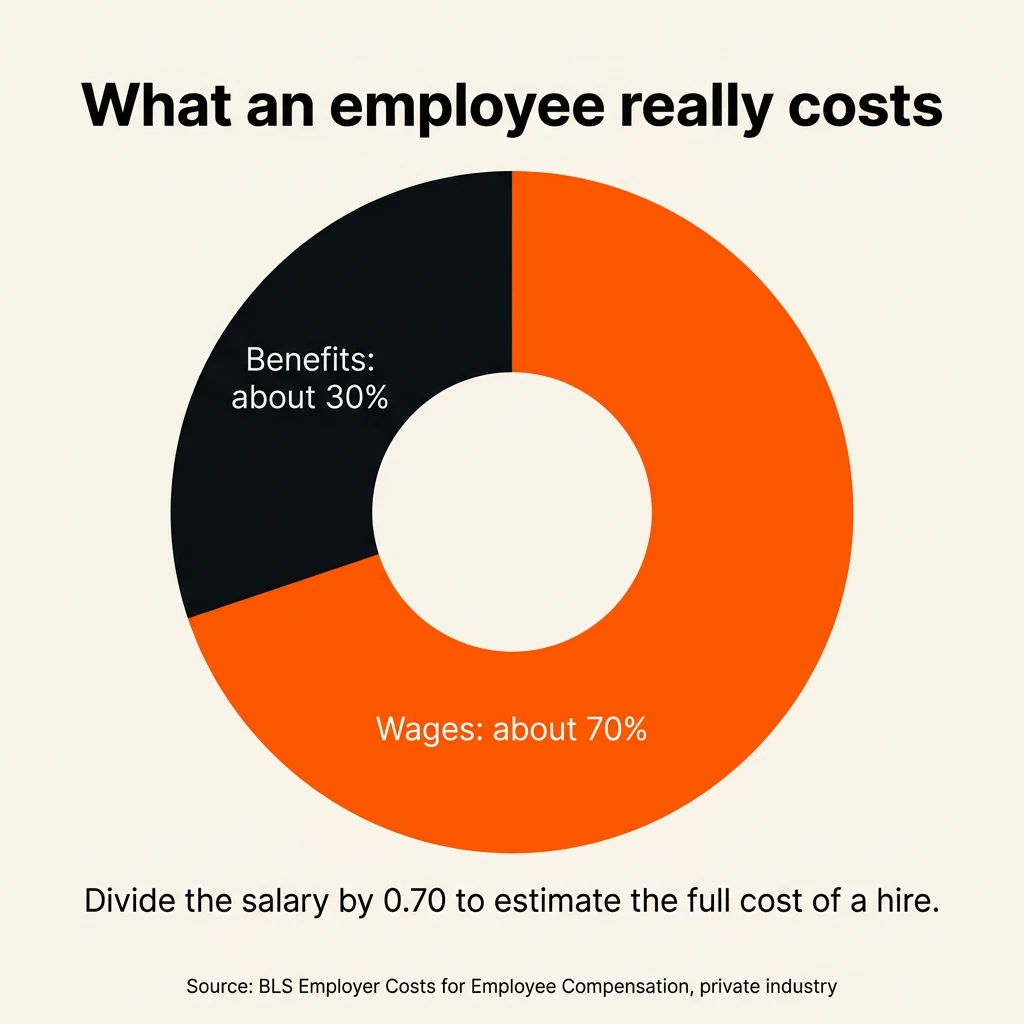
An in-house SEO costs far more than the salary, because the employer also pays for benefits and tools. For private employers in the US, benefits make up about 30% of the total cost of employing someone, so wages are about 70% of the total (employer cost data). A quick way to estimate the full cost of a hire is to divide the salary by 0.70.
Salary figures for SEO roles vary a lot by source, so the table shows a low case and a high case. One salary site puts the average SEO specialist at $59,179 (Payscale) and another puts it at $96,565 (Salary.com). For an SEO manager, the same two sources show $81,910 (Payscale) and $123,488 (Salary.com). Tools add about $3,000 a year for a mid-plan SEO tool suite (Ahrefs pricing). A separate tool that tracks whether AI assistants mention the business adds about $2,400 a year on top, if the hire needs one.
Freelance and agency prices come from three industry surveys (Ahrefs 2024, Backlinko 2025, and SE Ranking 2025). The surveys asked different groups of providers, so their ranges differ. The table shows the full range across all three. A retainer at the low end of that range buys far less work than one at the high end, and what SEO costs explains what each price band typically includes.
| Model | How the yearly figure is built | Yearly cost |
|---|---|---|
| In-house SEO specialist, low case | $59,179 salary (Payscale) ÷ 0.70 for benefits = $84,541, plus $2,988 for a mid-plan tool suite | About $87,500 |
| In-house SEO specialist, high case | $96,565 salary (Salary.com) ÷ 0.70 = $137,950, plus $2,988 for tools | About $140,900 |
| In-house SEO manager, low case | $81,910 salary (Payscale) ÷ 0.70 = $117,014, plus $2,988 for tools | About $120,000 |
| In-house SEO manager, high case | $123,488 salary (Salary.com) ÷ 0.70 = $176,411, plus $2,988 for tools | About $179,400 |
| Freelancer on a monthly retainer | $251 to $500 a month most common, up to the $1,349 a month average (Ahrefs 2024), times 12 | About $3,000 to $16,000 |
| Freelancer by the hour | $75 to $100 an hour most common (Ahrefs 2024; $50 to $100 in Backlinko 2025 and SE Ranking 2025), times 20 hours a month as an example workload, times 12 | About $18,000 to $24,000 |
| Agency, most common retainers | $501 to $1,000 a month (Ahrefs 2024), $1,001 to $2,500 (Backlinko 2025), $500 to $1,000 (SE Ranking 2025), times 12 | About $6,000 to $30,000 |
| Agency, average retainer | $3,209 a month (Ahrefs 2024), times 12 | About $38,500 |
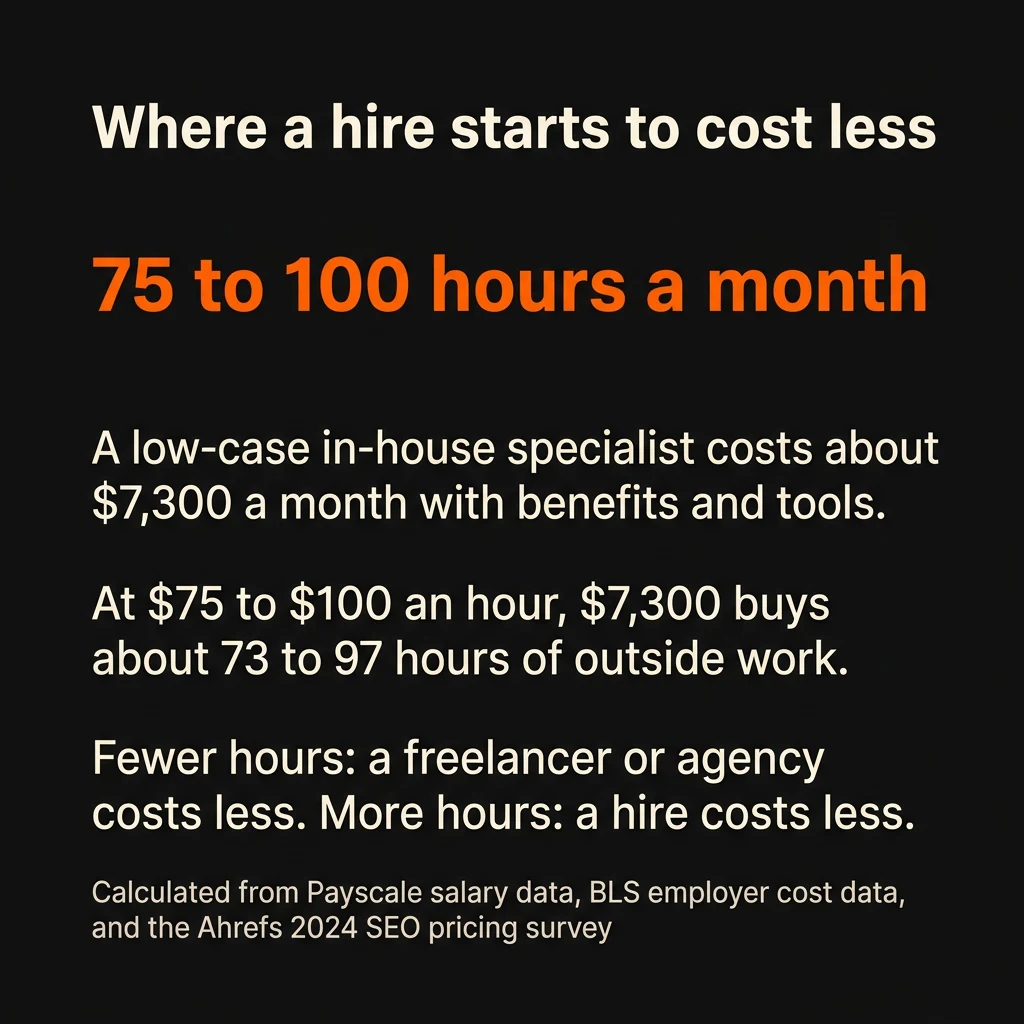
The hire costs the most, and it also buys the most hours. So the decision comes down to how many hours of SEO work the company needs each month. The break-even point, where a hire starts to cost less than outside help, is roughly 75 to 100 hours a month, or about $7,000 a month paid to a freelancer or agency. The low-case specialist costs about $7,300 a month once benefits and tools are included. At the most common freelance rates of $75 to $100 an hour, that same $7,300 buys about 73 to 97 hours of outside work. If the company needs fewer hours than that each month, a freelancer or agency is cheaper. If it needs more, a hire is cheaper, and the saving grows as the hours go up. In the high case, where the specialist costs about $11,700 a month, the break-even point moves to roughly 115 to 155 hours a month.
Skills coverage: what the work actually involves
SEO takes several different skills, and one person rarely has all of them. The work includes writing content that answers what your buyers search for, and fixing technical problems on the site. It also includes getting the business mentioned on the directories, review sites, and articles that search engines and AI assistants cite. And it includes tracking where the business shows up, in Google results and in AI answers. A good writer is often not a technical specialist, and a technical specialist often does not do outreach.
An agency spreads those jobs across several people, and that coverage is its main advantage. A freelancer or a single in-house hire covers the one or two areas they are strongest in, and you either fill the gaps with a second person or accept that some of the work does not get done. For most businesses, content produces the most results, so if you are choosing one person, choose someone who can write or direct content, and treat technical work and outreach as the areas to fill later.
Management load: what each model asks of you
Each model needs time and direction from someone inside the company, and the in-house hire needs the most. An in-house hire needs a manager, a plan, and goals to be measured against. If nobody inside knows SEO, the hire ends up setting their own direction with no one able to judge whether it is the right one. A freelancer needs clear direction on what to work on and someone to review what comes back, which usually takes a few hours a week. An agency needs the least day-to-day attention, but it still needs a monthly review of what was published, what changed in rankings and AI mentions, and what is planned for next month. How to tell if your SEO agency is doing the work covers what that monthly review should include.
If nobody inside the company has even a few hours a month for SEO, an agency is the only one of the three models that can run without that time. It still runs better when someone inside reviews the work each month.
Speed: time to start and time to results
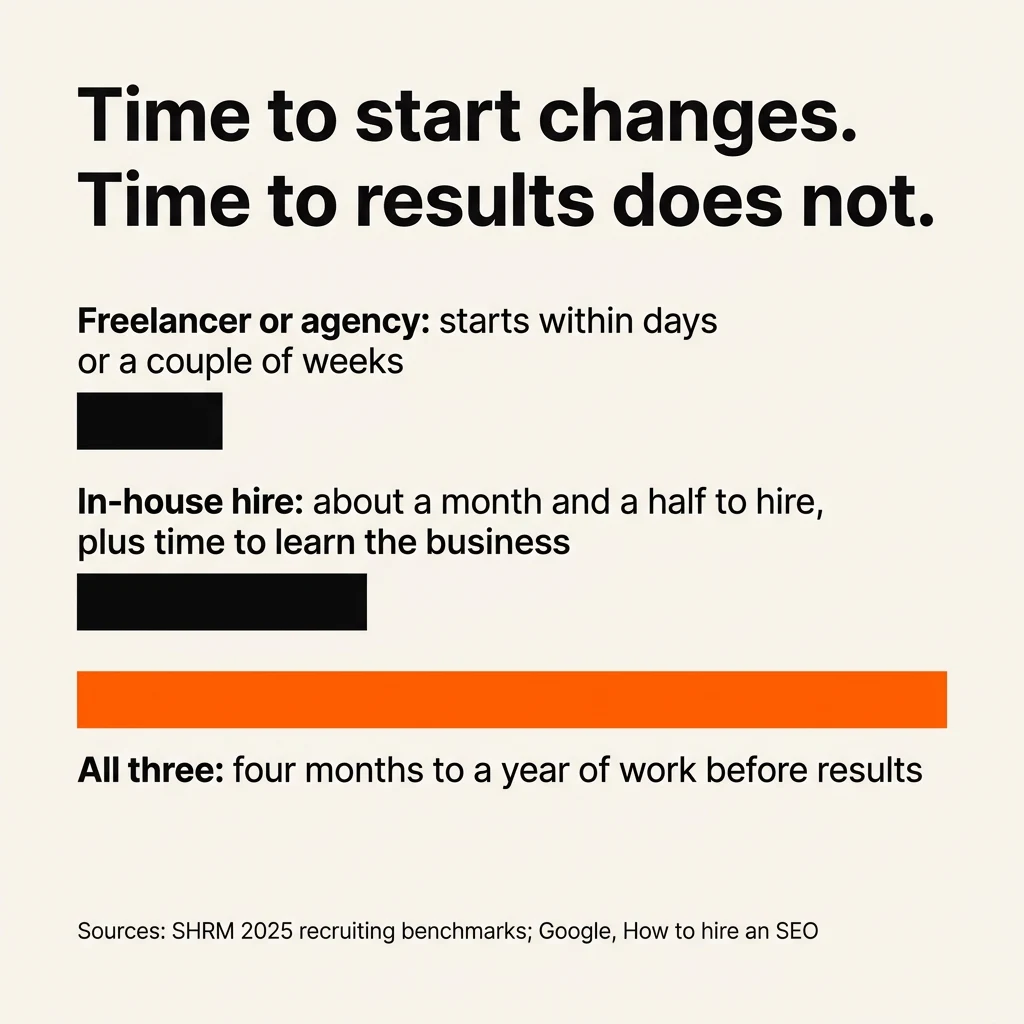
Time to start and time to results are two different things, and only the first one changes with the model you choose. A freelancer or an agency can usually start within days or a couple of weeks of signing. Hiring takes longer. The typical US job opening takes about a month and a half to fill (SHRM recruiting benchmarks), and the new hire then needs time to learn your business before producing anything.
Time to results is the same whoever does the work. Google’s own guidance on hiring an SEO says that “in most cases, SEOs need four months to a year to help your business first implement improvements and then see potential benefit” (Google’s “How to hire an SEO” video). Choosing the option that starts faster saves you a month or two at the beginning. It does not shorten the four months to a year of work after that.
Accountability and continuity: what happens if someone leaves
Every model carries some risk of losing the person who knows your SEO, and the size of that risk differs. With a freelancer or a single in-house hire, the work depends on one person. If that person leaves, the work stops until you replace them, and much of what they knew about your site and your market leaves with them. That applies to employees as much as freelancers: workers in management and professional roles stay with an employer for a median of 4.9 years, and workers aged 25 to 34 stay for 3.0 years (employee tenure data). An agency has a contract, a team, and a process for handing an account from one person to another, so one departure matters less. Agencies lose staff too, so ask how handovers work before signing.
The contract also decides how easily you can leave. Before signing with an agency or a freelancer, check the minimum term, the notice period, and what you receive when the arrangement ends. A short term with a short notice period lets you stop or switch providers if the work is not producing results. A long minimum term means you pay for the whole term whether the work produces results or not. Ask whether the content, the research, and the tracking data belong to you at the end, and whether there is a fee for handing them over.
Whichever model you pick, the business should own every account: the domain, the hosting, Google Search Console, Google Business Profile, analytics, and the tool subscriptions. Give outside help access to your accounts rather than letting them set up accounts in their own name. Owning the accounts is what lets you switch models later without rebuilding anything.
Can a freelancer or in-house hire handle AI search?
Yes, if the person has done the work before. Ask any of the three what AI search work they have already done for clients, because being an agency does not mean the agency has done it. AI search is now a large part of how B2B buyers find vendors: in one survey, 51% of B2B software buyers said they now start their research with an AI chatbot more often than with Google, up from 29% a year earlier (G2 research). Whichever model you choose has to cover AI search.
AI search work starts with tracking the prompts your buyers type into ChatGPT, Gemini, Perplexity, and Google’s AI answers, and recording whether your business is mentioned. It also means getting the business mentioned on the sources those assistants cite, which are often directories, review sites, listicles, and discussion threads rather than your own website. And it means writing content in a form that AI assistants cite. How to get recommended by AI search explains how each part works.
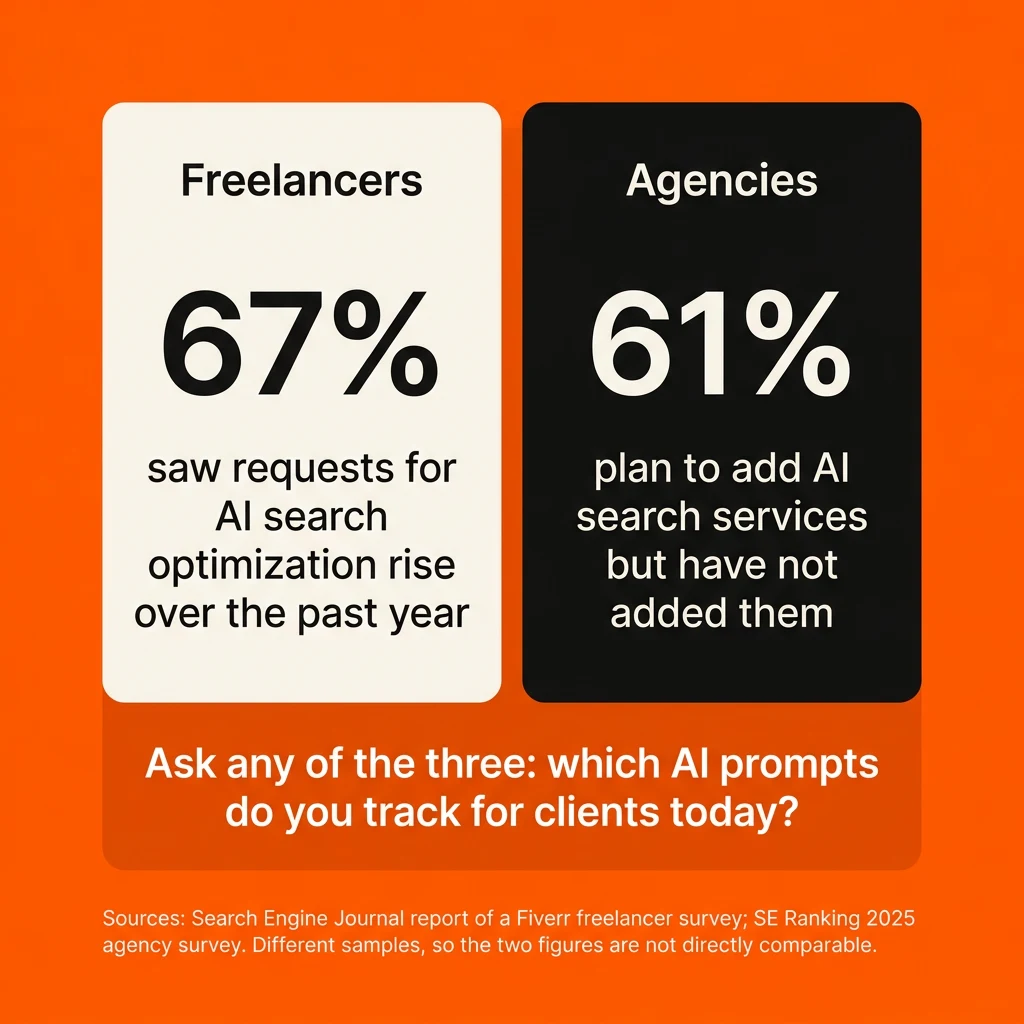
Freelancers are already doing this work. In one survey of search freelancers, 67% said requests for AI search optimization rose over the past year (Search Engine Journal). Many agencies do not offer it yet: in one agency survey, 61% said they plan to add AI search services but have not added them (SE Ranking 2025). So the question to ask any agency, freelancer, or job candidate is the same. Which AI prompts do you track for clients today, and how often do those clients appear in the answers? Someone who has done the work can show you the prompt list and the results. Someone who has not will describe what they intend to do.
When to hire a freelance SEO vs an agency
A freelancer fits when the work is narrow, defined, and directed by someone inside the company.
- The work is a project with an end: a site audit, a content plan, a technical cleanup, or a site migration.
- You need a few hours a week of ongoing work, and someone inside has the time to decide what gets done and review it.
- You need one skill, usually content writing or technical fixes, and the other skills are covered or not needed yet.
- The budget is under about $1,000 a month, which buys 10 to 13 freelance hours at the most common rates. The same budget also buys an agency retainer at the low end of what agencies commonly charge. A low-end retainer covers less work than a larger one.
- You want advice more than execution: a consultant sets the strategy and your own team carries it out.
When an agency fits
An agency fits when the work needs several skills at once and nobody inside has time to manage it.
- The work needs content, technical fixes, outreach, and tracking at the same time, and no single person you could hire covers them all.
- Nobody inside the company has more than a few hours a month for SEO.
- You want the work to continue if one person leaves.
- The budget is in the range of the common retainers, roughly $500 to $2,500 a month, and you want it spent on the work rather than on employing someone.
- You need to start within weeks.
When to build in-house
An in-house hire fits when SEO is permanent, the volume of work is high, and you want the knowledge to stay in the company.
- There is enough SEO work to fill a full-time role: roughly 75 to 100 hours a month or more, or about $7,000 a month that you would otherwise pay a freelancer or agency.
- SEO will be a permanent part of how the company gets customers for years, so paying salary and benefits is cheaper over time than paying a retainer for the same hours.
- Someone inside can manage the hire and judge the work, or you are hiring someone senior enough to set their own plan.
- You want detailed knowledge of your market and your buyers to stay in the company.
- You can wait a month and a half or more to hire, plus the months it takes for results.
When should you use both?
Many growing companies run two models at once, and each common combination fixes a specific gap.
- An in-house lead with an agency or freelancer for execution. The employee sets priorities, owns the accounts, and judges the work, and the outside partner produces content, handles technical fixes, or does outreach. This suits companies that have outgrown a freelancer but do not want a full team on payroll.
- A one-time strategy engagement carried out in-house. A consultant or agency builds the plan as a project, and your team does the work month to month. Most one-time projects cost between $500 and $5,000 across three industry surveys (Ahrefs 2024, Backlinko 2025, and SE Ranking 2025). Strategy work led by a consultant more often costs $5,001 to $10,000 (Ahrefs 2024).
- A freelancer for content alongside a hire. The hire covers strategy, technical work, and tracking, and a freelance writer produces the articles, since content takes the most hours of any part of the work.
You have outgrown a freelancer when their hours are full and work waits in a queue, when you need a second skill they do not have, or when directing them takes more of your time than you can give. You have outgrown an agency retainer when it approaches what a hire would cost, around $7,000 a month, and SEO has become a permanent part of how the company gets customers. At that point, the next decision is which parts of the work to bring in-house first.
FAQ
What is the difference between an SEO consultant and an SEO freelancer?
A consultant mostly sells advice: a strategy, an audit, or a plan for your team to carry out. A freelancer mostly sells the work itself: writing, technical fixes, or outreach. The prices show the difference. In the Ahrefs 2024 survey, consultants averaged $171 an hour and freelancers $72 an hour, and the most common consultant project price was $5,001 to $10,000 (Ahrefs 2024).
Can a marketing generalist handle SEO without a specialist?
Yes, a generalist can handle the basics for a while. A generalist with a few hours a week can publish content aimed at buyers, keep the business listed on the sites AI assistants cite, and track a set of prompts. SEO without an agency covers what that work looks like. The limit is hours and technical depth: when the work needs more than a few hours a week, or the site has technical problems the generalist cannot diagnose, that is the point to bring in a freelancer or an agency.
Is a freelancer always cheaper than an agency?
Per hour and per month, usually yes. Industry surveys find that agencies charge anywhere from about 30% more than freelancers to more than double a freelancer’s price (Backlinko 2025; Ahrefs 2024). The agency price buys a team rather than one person, so compare how much work each delivers in a month as well as the monthly figure.
Can you switch from an agency to in-house later?
Yes, and the switch is simple if the business has owned every account from the start: the domain, Search Console, analytics, Google Business Profile, and the tool subscriptions. Ask the agency for a handover document that lists what was published, which mentions and links were earned, and which AI prompts were tracked, and give the new hire the same access the agency had.
Choosing the model that fits now
The choice comes down to how much SEO work the company needs each month, how many skills that work takes, and how much time someone inside can give to managing it. A defined project or a few hours a week points to a freelancer. Work that needs several skills at once, with little time inside the company to manage it, points to an agency. Enough work to fill a full-time role points to a hire, often with outside help for part of the work. Whichever model you choose, ask which AI prompts they track for clients before signing or hiring.
If the agency route looks right, how to choose an SEO agency for AI search covers what to check before you sign. If you would rather keep doing it yourself a while longer, SEO without an agency covers what that takes. And for a full explanation of the AI search work any of the three will need to do, start with the AI optimization guide.